

By Jim Stockstill
Transforming of evil to an Angle of Light (Part one)
Evil Masquerading as Light (Part two)
From an EVIL beginning to a RIGHTEOUS life (Part three)
March 14, 17, 21, 2022 – three part series (links above)
Transformed
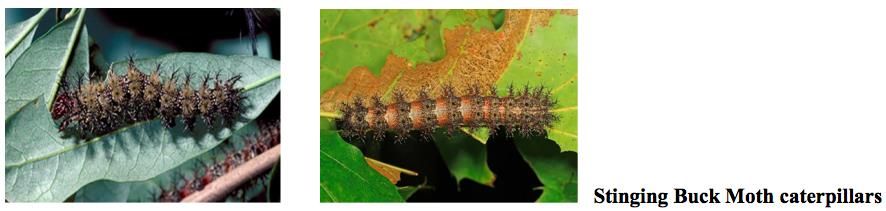
The 2-inch-long critters are fearsome-looking, armed with rows of branched spines. Those connect to glands producing venom so potent that even a glancing touch from a falling buck-moth caterpillar can bring on instant pain and swelling.
“I have met several people who had roughly caterpillar-shaped scars from encounters with these caterpillars,” Mississippi State entomologist Blake Layton said in a news release. “Such stings usually occur when someone inadvertently sits on a caterpillar while wearing shorts, rests a forearm on one, or has one crawl down their collar.”
April and May are the usual months for the caterpillars in Louisiana and Mississippi. In Alabama, they show up in May and June, according to an Auburn University entomologist.

Buck Moths (Hemileuca maia) are insects that are of great ecological importance. Most of the time, it is mistaken for a butterfly though these insects have unique features. They come in a variety of shapes and sizes. The Buck Moth has an interesting process of laying eggs as their eggs hatch and grow in the soil emerging only when the Buck Moth baby grows up. The Buck Moth caterpillar sting from the stinging long and short spines on the body is very painful and leads to swelling and inflammation as the spines are connected to the venom glands.
Interesting Trivia
- The Black Moth is infamous for having their bodies covered in hair-like scales and stings that produce poison in defense.
- A specific characteristic of arthropods is the presence of jointed appendages. This species of insect possesses wings that are lobbed and covered in black spots that have an eye-like appearance.
- The Buck Moth caterpillar is a tree feeding Saturniidae that feeds on several types of oak including scrub oak, blackjack oak, dwarf chestnut oak, and live oak. These insects can be found on the tree bark or the leaf litter.
- A Buck Moth may live alone or sometimes maybe spotted with fellow Buck Moth caterpillars. What is crucial for their survival is the ability to camouflage. Their body color and design aid them in hiding them from predators.
- The life cycle of a Buck Moth is over a year. Their life cycle involves systematic laying and hatching of eggs. The appearance of larvae and their conversion to become adult Moths takes a decent amount of time.
- A female Buck Moth (Lepidoptera Saturniidae) lays around 70-200 eggs in the oak leaf litter. After she lay eggs, the mature larvae hatch out of these eggs and enter the soil to pupate in late July. In October, larvae emerge as mature moth flies, and again in February, they mate to continue the life cycle.
- Buck Moth caterpillars appear cute but are not to be touched. Their color and appearance make them attractive to predators, but great defense systems make them dangerous.
- Buck Moth caterpillars and moths communicate by forming an alliance and flying together and sometimes display emotions as well.
- They fly at an exceptionally good speed. This aids them in protecting themselves from predators. The average speed with which they fly is 34 mph, but studies have shown that they can achieve a speed of 60 mph.

The monarch butterfly or simply monarch (Danaus plexippus) is a milkweed butterfly (subfamily Danainae) in the family Nymphalidae. The name “monarch” is believed to have been given in honor of King William III of England, as the butterfly’s main color is that of the king’s secondary title, Prince of Orange. Other common names, depending on region, include milkweed, common tiger, wanderer, and black veined brown. It may be the most familiar North American butterfly, and often is considered an iconic pollinator species although it is not an especially effective pollinator of milkweeds.
The eastern North American monarch population is notable for its annual southward late-summer/autumn instinctive migration from the northern and central United States and southern Canada to Florida and Mexico. During the fall migration, monarchs cover thousands of miles, with a corresponding multigenerational return north. The western North American population of monarchs west of the Rocky Mountains often migrates to sites in southern California but has been found in overwintering Mexican sites, as well. In 2009, monarchs were reared on the International Space Station, successfully emerging from pupae located in the station’s Commercial Generic Bioprocessing Apparatus.
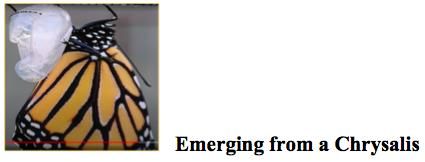
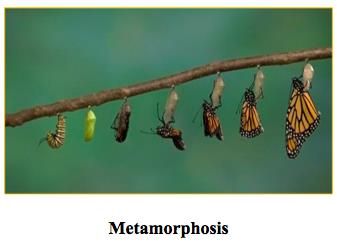
One day, the caterpillar stops eating, hangs upside down from a twig or leaf, and spins itself a silky cocoon or molts into a shiny chrysalis. Within its protective casing, the caterpillar radically transforms its body, eventually emerging as a butterfly or moth.
Butterflies develop out of a chrysalis, often mistaken as a cocoon, which is spun by moths. The chrysalis develops when the caterpillar sheds its final layer, and the remaining skin hardens, usually hanging from a branch or leaf. The butterfly will begin to emerge after 10 to 15 days when a small hole opens in the chrysalis.
The cocoon is a time before the butterfly is revealed in all of its splendor where it is protected from the world. But inside the cocoon, there is a struggle that happens as the butterfly has to make its way out. It is the struggle that gives strength to the butterfly so that when it emerges from the cocoon it can fly.
The Struggle
- Four-minute video on the process of metamorphism from a caterpillar to a beautiful Monarch Butterfly.
A Story of a kindhearted young man:
Thrilled to see an amazing transformation of nature, he sat and watched the butterfly as it struggled to force its body through a little hole of its cocoon. After a while, the butterfly seemed to stop making any progress. It was struggling so hard to get out!
The kindhearted man decided to help the butterfly. He got a pair of scissors and tweaked the cocoon to make a larger opening for the butterfly. Although with good intention the man hindered the growth of the butterfly.
Sometimes struggles and challenges are exactly what we need to grow in our lives. Like, the struggle to get out of the cocoon gives the butterfly its beautiful wings, struggles in our life make us stronger and give us wings to fly. (Read the full short story here)
Interesting Trivia
- The surface of a Monarch’s wing is covered with thousands of tiny, colorful scales. Loss of these scales is what causes Monarchs to lose their color.
- Have you seen a tattered and faded Monarch? After flying for an extended time, these scales will fall off and the Monarch’s wings will appear faded or even clear. You can generally tell the age of a Monarch this way.
- The tiny scales on the wings of Monarchs have been studied by biologists and aerospace engineers alike to better understand how they affect flight.
- The color of a monarch caterpillar.
- A monarch caterpillar is striped in orange, black and white, the same colors displayed by the adult butterfly when it emerges from its chrysalis.
- The Monarch’s studded gold chrysalises are created by the coupling of a carotenoid pigment and a hill-like structure that reflects light from the peaks. They get the carotenoids from their diet of milkweed.
- Monarch chrysalides shimmer in the sunlight like golden studded enclosures. Word ¨chrysalis is derived from the Greek word ¨chrysos¨ meaning ¨gold.¨
- Camouflage- the golden studs might increase their camouflage by looking like dew droplets on leaves and reflecting leaves on the surface or as a warning to deter predators by showing aposematic or warning coloration.
- Two black spots on the inside surface of their hind wings distinguish male Monarch butterflies from females.
- It is helpful to know how to identify a male from a female Monarch when gardening to attract butterflies. If you notice a female on a milkweed plant, they are most likely laying their eggs there. You can then bring those leaves inside to raise your Monarchs. Male and female Monarch butterflies are easily distinguishable. The females generally have thicker veins on their wings, and they do not have black spots on their hind wings (which are specialized scales). In the case of most butterflies, these scales release hormones to attract females but they are not sure that this is the case with Monarchs as well.
- How far can monarch butterflies fly?
- Migrating monarchs travel about 50 miles per day‚ though some have been known to fly as far as 80 miles in a day.
- How far is the monarch butterfly migration?
- Monarchs are the only butterflies that make a long migration: the last generation born in late summer and early fall flies up to 3,000 miles from the northeastern U.S. and southern Canada to its wintering grounds in the forested highlands of central Mexico never having been there before!
- Like clockwork, monarchs return to Mexico each year around the first of November, the Day of the Dead, leading local people to believe that they are the spirits of their deceased ancestors, come back to visit.
- What do monarch butterflies eat?
- Monarchs are dependent for survival on the milkweed plant, which the newly hatched larvae eat almost exclusively.
- The Monarch caterpillar is a voracious eater, and it can gain about 2700 times its original weight. Monarchs must consume a lot of food in a short amount of time to have enough food stored to go through metamorphosis. Monarchs outgrow their skin five times. These sheds or molts are called “instars.” Once the caterpillar has reached their fifth instar, it will find a place to pupate.
- Monarch butterflies smell and taste with their antennae and legs which are covered with sensory cells called chemoreceptors. These chemoreceptors help Monarchs find milkweed to lay their eggs on.
- Like Monarchs, when we smell and taste we are sensing chemicals in our environment. We also have chemoreceptors, which are concentrated on our tongue as tastebuds and in our noses. Monarchs use sensing chemicals to find their host plant, milkweed, quickly and accurately.
- “The female flits over the field and, when she stops on a plant, she drums the surface with her forelegs.” She is putting tiny cuts into the plant for the chemicals to be released and for her to tell if it is indeed milkweed. “Monarchs use a combination of visual and chemical cues to find milkweed,” says monarch scientist Dr. Karen Oberhauser.” Once they land on a plant, they use sensory organs on their feet and heads to tell them if it is a milkweed, and probably the quality of the milkweed.”
- How long do monarch butterflies live?
- Most monarchs live for just 5 weeks, except for the migrating “Methuselah” generation, which lives for 7 or 8 months. Scientists are still trying to understand the phenomenon fully.
- How big are monarch butterflies?
- Monarchs are large butterflies, with a wingspan averaging about four inches.
- What do monarch butterflies sound like?
- Though an individual monarch weighs only half an ounce, the collective wing movements of hundreds of thousands of them massed together in their wintering grounds sounds like a distinct hum.
- What are the greatest threats to monarch butterflies?
- The monarch migration is considered an endangered biological phenomenon. The greatest threat to the butterflies‚ survival is the destruction of the oyamel forests in which they winter, though milkweed habitat loss in the U.S. is having an impact, too.
- Are monarch butterflies poisonous?
- Monarchs are poisonous to predators such as frogs, birds, mice, and lizards because of chemicals that build up inside them from the milkweed plant that monarchs eat when they are larvae.
- The bright colors on a monarch caterpillar serve as a warning sign to predators that they may be poisonous. The toxic effect on vertebrates depends on the level of intake and most birds will throw up these toxins but will learn not to eat them again.
- One female Monarch butterfly can lay an average of 300 and 500 eggs in the wild. Captive monarch butterflies average about 700 eggs per female over 2 to 5 weeks of egg-laying, with a record of 1179 eggs in captivity.
- According to a study done by Karen Oberhauser (1997), the average amount of eggs laid in 1994 was 715 (range 290–1179). It is difficult to know exactly how many eggs Monarch butterflies lay during their lives in the wild, but the average is estimated to be between 300 and 500.
- Monarch females usually lay a single egg on a milkweed plant, often on the bottom of a leaf near the top of the plant. Eggs are only about the size of a pencil tip and are off-white or yellow, characterized by longitudinal ridges that run from the tip to the base. The eggs hatch about four days after they are laid.
- Autumn leaves? Look again!
- When monarchs huddle together for warmth in the fir groves of Mexico’s central highlands, they look like a thick cloak of autumn leaves on the trees.
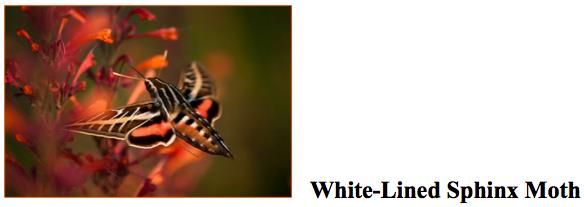
Many people think that moths are the nighttime equivalent of butterflies, but it is not quite that simple. Indeed, Butterflies fly only during the day but not all moths are strictly nighttime fliers. Hummingbird moths, which include several species of sphinx moths, eat nectar at flowers during the day. Others, including colorful Buck Moths [can fool the casual observer], are also seen when the sun shines.
The best way to tell the difference between a moth vs a butterfly is to look at the antennae. All butterflies have long, thin antennae that end in a thickened tip. But no North American moths sport these “clubbed” antennae. Instead, they have shorter, feathery antennae—especially prominent on males—that are beautifully plumed and designed to catch wafting pheromones released by females. Female moths typically have simple, thin antennae, similar to a butterfly at first glance but with a tapered tip.
Butterflies usually hold their wings folded up over their bodies when they rest. They may open and close their wings when feeding on nectar or hold them flat out when basking in the sunshine, but folded wings are most common. Nearly all moths rest with their wings flat or folded in a roof-like position over their bodies. Also, their bodies tend to be chubbier than those of butterflies.
Future Teaching
The Word “Changed” in Scripture:
G 236 (6 X’s) in New Testament: to change: to cause one thing to cease and another to take its place. [transform]
- 1 Corinthians 15:51-52 “Behold, I show you a mystery; We shall not all sleep, but we shall all be changed [G 236 transformed], 52 In a moment, in the twinkling of an eye, at the last trump: for the trumpet shall sound, and the dead shall be raised incorruptible, and we shall be changed [G 236 transformed].”
- 1 Corinthians 15:51-52 “Take notice! I tell you a mystery (a secret truth, an event decreed by the hidden purpose or counsel of God). We shall not all fall asleep (in death), but we shall all be changed [G 236 transformed] 52 In a moment, in the twinkling of an eye, at the (sound of the) last trumpet call. For a trumpet will sound, and the dead (in Christ) will be raised imperishable (free and immune from decay), and we shall be changed [G 236 transformed].” [AMP]
- Hebrews 1:12 “And as a vesture shalt thou fold them up, and they shall be changed [G 236]: but thou art the same, and thy years shall not fail.” [KJV]
G 3346 (1 X): to change; passive of an office the mode of conferring, which is changed,
- Hebrews 7:12 “For the priesthood being changed, there is made of necessity a change [G 3346] also of the law.”
3-13-2022 [Sunday Night]
3-14-2022 Monday Night – the Lord, “give a more detailed explanation.”
- Last night during my private time it was interesting [it is always interesting, for a simple Cajun it is simply hard to remember everything], the Lord said:
-
- Sheep: As sheep are fed, strengthened, and mature – they will never metamorphose into a goat.
- Goat: As goats are fed strengthened and mature – they will never metamorphose into sheep.

Definition of metamorphosing/metamorphosed
- 1a: to change into a different physical form, especially by supernatural means
- b: to change strikingly the appearance or character of TRANSFORM
- 2: to cause (rock) to undergo metamorphism
- To become transformed
The word metamorphosis derives from Greek μεταμόρφωσις, “transformation, transforming“, from μετα- (meta-), “after” and μορφή (morphe), “form“.
- It is a biological process by which an animal physically develops after birth or hatching, involving a noticeable and abrupt change in the animal’s body structure through cell growth and separation. Some insects, fish, amphibians, mollusks, crustaceans, cnidarians, echinoderms, and tunicates undergo metamorphosis, which is often accompanied by a change of nutrition source or behavior. Animals can be divided into species that undergo complete metamorphosis (“holometaboly”), incomplete metamorphosis (“hemimetaboly”), or no metamorphosis (“ametaboly”).
- Scientific usage of the term is technically precise, and it is not applied to general aspects of cell growth, including rapid growth spurts. Generally, organisms with a larva stage undergo metamorphosis, and during metamorphosis, the organism loses larval characteristics.
Metamorphosis (noun)
In the 1530s, “change of form or structure, action or process of changing in form,” originally especially by witchcraft, from Latin metamorphosis, from Greek metamorphōsis “a transforming, a transformation,” from metamorphoun “to transform, to be transfigured,” from meta, here indicating “change” (see meta-) + morphē “shape, form,” a word of uncertain etymology. The biological sense of “extensive transformations an animal (especially an insect) undergoes after it leaves the egg” is from the 1660s.
Metamorphose (verb)
“To change into a different form, alter or modify the shape or character of,” 1570s, from French métamorphoser, from metamorphose. From Latin metamorphosis Related: Metamorphosed. The Greek verb was metamorphoun.
Key to Understanding what the Lord was teaching in the Vision:
The King James Version, and many translations, have the word TRANSFORMED [G 3345] for Satan and false MINISTERS of righteousness. Those are incorrect as specified below:
SATAN
Transformation – MASQUERADING as Light or Ministers of Righteousness:
Transformed [G 3345] μετασχηματίζω metaschēmatízō, met-askh-ay-mat-id’-zo; from G3326 and a derivative of G4976. To transfigure or disguise; figuratively, to apply (by accommodation):—transfer, transform (self). Some translations have disguises or masquerades.
- 2 Corinthians 11:14 “And no marvel; for Satan himself is transformed [G 3345] into an angel of light.” [KJV]
- 2 Corinthians 11:14 “And it is no wonder, for Satan himself masquerades [G 3345] as an angel of light. [AMP]
- 2 Corinthians 11:15 “Therefore it is no great thing if his ministers also are transformed [G 3345] as the ministers of righteousness; whose end shall be according to their works.” [KJV]
- 2 Corinthians 11:15 “So it is not surprising if his servants also masquerade [G 3345] as ministers of righteousness. But their end will correspond with their deeds.” [AMP]
Transformation (Metamorphous)
Lambs to Nourished, Mature Sheep
Transformation [3339] (4 X’s): met-am-or-fo’-o; from G3326 and G3445; to transform (literally or figuratively, “metamorphose”), change, transfigure, transform. Used of the change of moral character for the better.
- Romans 12:2 “And be not conformed to this world: but be ye transformed [G 3339] by the renewing of your mind, that ye may prove what is that good, and acceptable, and perfect, will of God.” [KJV]
- Romans 12:2 “Do not be conformed to this world (this age), [fashioned after and adapted to its external, superficial customs], but be transformed (G 3339) by the [entire] renewal of your mind, so that you may prove [for yourselves] what is the good and acceptable and perfect will of God, even the thing which is good and acceptable and perfect [in His sight for you].” [AMP]
- Romans 12:2 “And do not be conformed to this world [this age] but be transformed [G 3339]by the renewing of your mind, so that you may prove [discover] what the will of God is, that which is good and acceptable [pleasing] and perfect.” [NASB]
- 2 Corinthians 3:18 “But we all, with open face beholding as in a glass the glory of the Lord, are changed (G 3339) into the same image from glory to glory, even as by the Spirit of the Lord.” [KJV]
- 2 Corinthians 3:18 “But we all, with unveiled face, beholding as in a mirror the glory of the Lord, are being transformed [3339] into the same image from glory to glory, just as from the Lord, the Spirit.” [NASB]
- Transformation [3339] (4 X’s): met-am-or-fo’-o; from G3326 and G3445; to transform (literally or figuratively, “metamorphose”), change, transfigure, transform. Used of the change of moral character for the better.
- Renewing [342] 2 X’s: effected by the Holy Spirit.
- Mind [G 3563] reason in the narrower sense, as the capacity for spiritual truth, the higher powers of the soul, the faculty of perceiving divine things, of recognizing goodness, and of hating evil. To be so changed that the spirit which governs the mind is renewed, Ephesians 4:23.
Ephesians 4:23 “And be constantly renewed [G 365] in the spirit of your mind [having a fresh mental and spiritual attitude].”
- Renewed G 365 (1 X): renew the mind, to be spiritually transformed, to take on a new mind.
- Spirit G 4151: the soul, a spirit, a simple essence, devoid of all or at least all grosser matter, and possessed of the power of knowing, desiring, deciding, and acting.
- Mind G 3563 (17 X’s): reason (German die Vernunft) in the narrower sense, as the capacity for spiritual truth, the higher powers of the soul, the faculty of perceiving divine things, of recognizing goodness, and of hating evil:
Becoming More Christlike

Becoming more like Christ is the desire of every believer, and we are encouraged knowing that our Father has the same desire for each of us. Nothing in our background or any works that we do can have merited the favor and love [Agape] of God our Father, The Son, Jesus Christ, and the Holy Spirit. The truth is simple, the Scriptures are clear, we have been “predestined [true believers] to be conformed to the likeness of his Son”
- Romans 8:29-31 “For those whom He foreknew [of whom He was aware and loved beforehand], He also destined from the beginning [foreordaining them] to be molded into the image of His Son [and share inwardly His likeness], that He might become the firstborn among many brethren. 30 And those whom He thus foreordained, He also called; and those whom He called, He also justified (acquitted, made righteous, putting them into right standing with Himself). And those whom He justified, He also glorified [raising them to a heavenly dignity and condition or state of being]. 31 What then shall we say to [all] this? If God is for us, who [can be] against us?” [AMP]
The process of becoming “Christlike” is the work of the Holy Spirit:
- Philippians 1:6 “And I am convinced and sure of this very thing, that He Who began an excellent work in you will continue until the day of Jesus Christ [right up to the time of His return], developing [that excellent work] and perfecting and bringing it to full completion in you.” [AMP]
The tugging that we (each of us) feel in our heart (soul) to change (metamorphous) from our old nature into the image of Jesus Christ is the continuing work of the Holy Spirit:
- Philippians 2:13 “[Not in your strength] for it is God who is all the while effectually at work in you [energizing and creating in you the power and desire], both to will and to work for His good pleasure and satisfaction and delight.”
The witness of the Spirit – not an appointment we make ourselves, but the Spirit comes from God:
- Romans 8:14-17 “For all who are led by the Spirit of God are sons of God. 15 For [the Spirit which] you have now received [is] not a spirit of slavery to put you once more in bondage to fear, but you have received the Spirit of adoption [the Spirit producing sonship] in which we cry, Abba (Father)! Father! 16 The Spirit Himself testifies together with our spirit, [assuring us] that we are children of God. 17 And if [being that we are] we are His children, then we are His heirs also: heirs of God and joint-heirs with Christ [sharing His inheritance with Him]; only we must share His suffering if we are to share His glory.” [AMP]
- Heirs G 2818: In Messianic usage, one who receives his allotted possession by right of sonship. Of Christians, as exalted by faith to the dignity of sons of Abraham and so of sons of God, and hence, to receive the blessings of God’s kingdom promised to Abraham.
- Joint-heirs G 4789 (4 X’s): one who obtains something assigned to himself with others, a joint participant.
- Ephesians 3:6 “That the Gentiles should be fellow heirs, [G 4789] and of the same body, and partakers of his promise in Christ by the gospel…”
- Hebrews 11:9 “By faith he sojourned in the land of promise, as in a strange country, dwelling in tabernacles with Isaac and Jacob, the heirs with him [G 4789] of the same promise.”
- 1Peter 3:7 “Likewise, ye husbands, dwell with them according to knowledge, giving honor unto the wife, as unto the weaker vessel, and as being heirs together [G 4789] of the grace of life; that your prayers be not hindered.”
- Suffer/suffering G 4841 (2 X’s): To suffer evils (troubles, persecutions) in the like manner with another.”
The Process
- Proverbs 29:18 “Where there is no vision [no redemptive revelation of God], the people perish; but he who keeps the law [of God, which includes that of man]—blessed (happy, fortunate, and enviable) is he.” [AMP]
- Hosea 4:6 “My people are destroyed for lack of knowledge; because you [the priestly nation] have rejected knowledge, I will also reject you that you shall be no priest to Me; seeing you have forgotten the law of your God, I will also forget your children.” [AMP]
- 2 Timothy 2:15 “Study and be eager and do your utmost to present yourself to God approved (tested by trial), a workman who has no cause to be ashamed, correctly analyzing and accurately dividing [rightly handling and skillfully teaching] the Word of Truth.” [AMP]
- Study G 4710: To exert oneself, endeavor, give difference.
- Approved G 1384/1380: The approved servant of Christ.
Knowing the truth (vision of redemption) of being transformed (or metamorphosed) into Christlikeness requires both divine power and our diligence in fulfilling human responsibility. In this hour, similar to the Church of Laodicea, the “woke” culture as well as “seeker-friendly” messages within the structural church have lulled those attending (watching/listening) to sleep with a false sense of security [i.e., once saved always saved]. For the true remnant, we cannot sit back and assume we will be carried to heaven “on flowery beds of ease.” The process of becoming more like Jesus Christ demands our willing corporation, diligence – and yes, persevering through the fiery ordeals we often encounter in our journey in fulfilling our purpose and destiny in Christ. [John 16:13, 1 Peter 1:6, 4:12, and Romans 8:18, 12:12]
Hebrews 9:24 “For Christ (the Messiah) has not entered into a sanctuary made with [human] hands, only a copy and pattern and type of the true one, but [He has entered] into heaven itself, now to appear in the [very] presence of God on our behalf.”
1 John 2:1-6 “My little children, I am writing these things to you so that you may not sin. And if anyone sins, we have an Advocate [one who intercedes for us] with the Father, Jesus Christ the righteous; 2 and He [Jesus] is the propitiation [atoning sacrifice] for our sins; and not for ours only, but also the sins of the whole world. 3 And this is how we may [daily] discern that we are coming to know Him [to perceive, recognize, understand, and become better acquainted with Him]: if we keep (bear in mind, observe, practice) His teachings. 4 The one who says, “I have come to know Him,” and does not keep His commandments, is a liar, and the truth is not in him; 5 but whoever follows His word, in him the love of God has truly been perfected. By this we know that we are in Him: 6 the one who says that he remains in Him ought, himself also, walk just as He walked.”
Deceived and Blinded
- Matthew 7:21-23 “Not everyone who says to me, ‘Lord, Lord,’ will enter the kingdom of heaven, but the one who does the will of my Father who is in heaven. 22 On that day many will say to me, ‘Lord, Lord, did we not prophesy in your name, and cast out demons in your name, and do many mighty works in your name?’ 23 And then will I declare to them, ‘I never knew you; depart from me, you workers of lawlessness.’”
Believe the saying says, “birds of a feather flock together.” You become like the people you spend most of the time with. If you want to become more like Christ, start by spending time with Him. Talk to Him in prayer. Read His Word. In this hour, which is becoming more difficult, spend time with others who love and seek to pattern their lives after Jesus. When you do this, you will know Him better and become more like Him, making you more confident in your faith.
Guidance from Scripture:
Psalm 119:18 “Open my eyes, that I may behold wonderful things from Your Law (a way that is pleasing to the Lord.” Ask our Father to make His Word come alive to you and what you read.
John 10:27–28 “My sheep hear my voice, and I know them, and they follow me. I give them eternal life, and they will never perish, and no one will snatch them out of my hand”
Romans 8:34 “Who is the one who condemns? Christ Jesus is He who died, but rather, was raised, who is at the right hand of God, who also intercedes for us.”
Hebrews 7:25 “Therefore He is also able to save forever [completely] those who come to God through Him since He always lives to make intercession for them.”
Galatians 5:16 “But I say, walk by the Spirit, and you will not carry out the desire of the flesh.”
Becoming more Christlike takes time, often adversity, and spending time in the Word of God and prayer.
- Deuteronomy 8:2 “And you shall remember all the way which the Lord your God has led you in the wilderness these forty years, in order to humble you, putting you to the test, to know what was in your heart, whether you would keep His commandments or not.”
The result of our growth in Christ is a process. When we are first saved, we are immature in [His] wisdom and [Scripture] knowledge and may not have experienced His grace and love [Agape – unconditional love]. But then we grow. In each of these things, our charge is to become stronger, mature, and more Christlike.
- 2 Peter 3:17-18 “You, therefore, beloved, knowing this beforehand, be on your guard so that you are not carried away by the error of unscrupulous people and lose your firm commitment, 18 but grow in the grace and knowledge of our Lord and Savior Jesus Christ. To Him be the glory, both now and to the day of eternity.”
‘Driven’ by the Spirit
Mark 1:9-12 “In those days Jesus came from Nazareth in Galilee and was baptized by John in the Jordan. 10 And immediately coming up out of the water, He saw the heavens opening, and the Spirit, like a dove, descending upon Him; 11 and a voice came from the heavens: “You are My beloved Son; in You, I AM well pleased [delighted]. 12 And immediately the Spirit [driveth] Him out into the wilderness. 13 And He was in the wilderness for forty days, being tempted by Satan; and He was with the wild animals, and the angels were serving Him.”
- Opening/opened [4977] (1 X): to cleave, cleave asunder, rend.
- Driveth [1544]: cast out
All three accounts of Jesus’ forty days in the desert tell us that it was the Spirit that led him into the wilderness. As I just read, Mark expresses this a little differently. He says that the “Spirit drove Jesus out into the desert,” Mark’s expression “drove Jesus,” is interesting. It is the same expression that is used when Jesus drove out demons. There is an element of coercion, of force. In this way, Mark underscores the power of the Spirit. The same Spirit that descended upon Jesus at baptism now drove him into the wilderness. This shows Jesus’ obedience, humility, and submission to God’s will. As the example of Israel in the wilderness and Jesus being driven into the wilderness, we must embrace Scriptural examples to contend in our “wilderness” and embrace our identity, purpose, and destiny in Jesus Christ. The Son of Man was available to the Spirit.
What does this mean for us? It means that too we must allow the Spirit “drive us.” In what way?
- Proverbs 3:1-8 “My son, do not forget my teaching, but have your heart comply with my commandments; 2 For the length of days and years of life and peace they will add to you. 3 Do not let kindness and truth leave you. Bind them around your neck, Write them on the tablet of your heart. 4 So you will find favor and a good reputation [understanding] in the sight of God and man. 5 Trust in the Lord with all your heart and do not lean on your understanding. 6 In all your ways acknowledge Him, And He will make your paths straight. 7 Do not be wise in your own eyes; Fear the Lord and turn away from evil. 8 It will be healing to your body [naval] and refreshment to your bones.”
Even though Mark does not elaborate regarding the temptations, he does say that Jesus was tempted, and whatever happened in the desert, Jesus came forth proclaiming, “The kingdom of God is at hand. Repent, and believe in the gospel.” As a “MAN,” we are assured that in the desert Jesus overcame the temptation to abandon his identity and his mission. On the contrary, his message as he emerged from the desert tells us that he embraced his identity and his mission in its totality. He overcame the temptation of one possibility and embraced another possibility in its totality. This is why Jesus’ message as he emerged from the desert is of critical importance. “The Kingdom of God is at hand,” he proclaimed. “Repent and believe in the gospel!” (Mark 1:15)
As I have been taught, look at the spiritual and natural understanding of the implication of this truth in all of its depth. Allowing the Spirit to drive us [you and me] means giving the Spirit free reign in our lives. It calls for humility, obedience, and total submission to God’s will. It compels us to relinquish any control we have and depend totally on God – like Jesus in the desert. Yes, at times it will defy logic or our natural senses (the brain – the CPU). It is an act of great faith because we do not know where the Spirit will lead us. It takes time in the Word and with the Word, yet we will leave to allow the Spirit to drive [or lead] us where the Spirit will. Life takes on a new meaning when we allow the Spirit to drive us.
Ephesians 4:14-16 “As a result, we are no longer to be children, tossed here and there by waves and carried about by every wind of doctrine, by the trickery of people, by craftiness in deceitful scheming; 15 but speaking the truth in love, we are to grow up in all aspects into Him who is the head, that is, Christ, 16 from whom the whole body, being fitted and held together by what every joint supplies, according to the working in the measure of each individual part, causes the growth of the body for the building up of itself in love.”
Communion
2 Corinthians 3:18 says “But we all, with open face beholding as in a glass the glory of the Lord, are changed into the same image from glory to glory, even as by the Spirit of the Lord.”
Correcting an Abuse of the Lord’s Supper
1 Corinthians 11:17-32 “In the following directives I have no praise for you, for your meetings do more harm than good. 18 In the first place, I hear that when you come together as a church, there are divisions among you, and to some extent I believe it. 19 No doubt there have to be differences among you to show which of you have God’s approval. 20 So then, when you come together, it is not the Lord’s Supper you eat, 21 for when you are eating, some of you go ahead with your own private suppers. As a result, one person remains hungry, and another gets drunk. 22 Don’t you have homes to eat and drink in? Or do you despise the church of God by humiliating those who have nothing? What shall I say to you? Shall I praise you? Certainly not in this matter!
23 For I received from the Lord what I also passed on to you: The Lord Jesus, on the night he was betrayed, took bread, 24 and when he had given thanks, he broke it and said, “This is my body, which is for you; do this in remembrance of me.” 25 In the same way, after supper he took the cup, saying, “This cup is the new covenant in my blood; do this, whenever you drink it, in remembrance of me.” 26 For whenever you eat this bread and drink this cup, you proclaim the Lord’s death until he comes.
27 So then, whoever eats the bread or drinks the cup of the Lord in an unworthy manner will be guilty of sinning against the body and blood of the Lord. 28 Everyone ought to examine themselves before they eat of the bread and drink from the cup. 29 For those who eat and drink without discerning the body of Christ eat and drink judgment on themselves. 30 That is why many among you are weak and sick, and a number of you have fallen asleep. 31 But if we were more discerning with regard to ourselves, we would not come under such judgment. 32 Nevertheless, when we are judged in this way by the Lord, we are being disciplined so that we will not be finally condemned with the world.”
1 Corinthians 11:28 “But let a man [woman] examine himself, and so let him eat of that bread, and drink of that cup.”
- Examine [G 1381]: 1. to test, examine, prove, scrutinize (to see whether a thing be genuine or not),
1 Corinthians 11:32 “But when we are judged, we are chastened of the Lord, that we should not be condemned with the world.”
- Judged [G 2919]: as in a court of law, forensic evidence, condemning and decreeing (or inflicting) penalty on one.
- Chastened [G 3811]: as in training a child, to chasten by the infliction of evils and calamities.
Kimberly 5:30 AM
Matthew 9:20-22 “20 And behold, a woman who had suffered from a flow of blood for twelve years came up behind Him and touched the fringe of His garment; 21 For she kept saying to herself, If I only touch His garment, I shall be restored to health. 22 Jesus turned around and, seeing her, He said, Take courage, daughter! Your faith has made you well. And at once the woman was restored to health.”
Mark 5:25-34
Blessings in Christ,
Joseph “Jim” Stockstill 
“National War Council” – Founder and Chairman
Jim5555@nationalwarcouncil.org
P.O. Box 931
Argyle, TX 76226
nwc@nationalwarcouncil.org
Jim5555@nationalwarcouncil.org
Donations to National War Council
“The two most important days in your life are the day you are born and the day you find out why.”
Mark Twain
0 Comments