

By Jim Stockstill
February 21, 2022
Jesus’ Sense of Humor
“Three-Six-Nine the goose drank wine…” Two weeks prior and then on Friday night.
February 18, 2022 – watching “Ghost Busters” with Luke. Shirley Ellis was an American soul music singer and songwriter of West Indian heritage. She passed away in October of 2005 at age 76. She is best known for her novelty hits “The Nitty Gritty,” “The Name Game,” and in 1965 “The Clapping Song.” “The Clapping Song” sold over one million copies and was awarded a gold disc.
Superstitions and Folklore
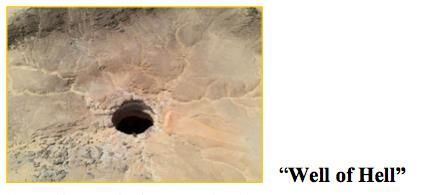
‘Well of Hell’ Shrouded in Mystery
A gaping hole in the Earth that has been shrouded in mystery for centuries has finally been explored. The natural wonder, popularly known as the “Well of Hell” has for years endured as an enigma in the desert of Yemen. The well measures 100 feet wide and reaches about 360 feet down.
Until recently, nobody had ever been to the bottom; however, there has been much conjecture about what might be lurking down there. Those who live near the hole officially named the “Well of Barhout,” have long believed anything that comes close to the pit would be sucked in without escape. Yemeni oral tradition passed down for centuries, calls the well “a prison of dark spirits sheltered by unbearable odors that come from its entrails.”
Yemeni officials admitted they did not know what might be down there. Stories of demons and other supernatural figures known as “Jinn’s” [Book of Quran] or genies that live in the well have circulated among locals throughout the centuries. Many nearby residents do not even like to talk about the hole, let alone visit it, for fear of bad luck.
Eight adventurous cave explorers rappelled down the hole last week, while two colleagues remained at the surface. Although oxygen levels are extremely low, they spent about six hours in the cave. After centuries of terrifying legends that inspired fear throughout generations, the footage they captured shows an incredibly beautiful and tranquil scene.
The video shows a waterfall raining down into the well, which opens into a fairly expansive area at the bottom. The cave is encircled by stunning sweeps of rock decorated with colorful stalagmites. The team also found and photographed strangely beautiful bright green formations known as “Cave Pears.”
“Cave pearls are concentric calcium carbonate deposits that form around nuclei under the falling water. These rings are smoothed by the movement of water falling for thousands of years until they form beautiful pearl shapes,”
So, what about imprisoned evil genies or other supernatural spirits legend has placed at the bottom of the hole?
No sign of them or any previous human explorations, the team revealed. “There were snakes, but they won’t bother you unless you bother them,” and the terrain at the bottom was largely pristine in terms of not having been touched by humans. The cavers collected samples of the birds as well as water, rocks, and soil, with the plan to analyze everything and report their findings to the public.
Seven Things God Hates
Proverbs 6:16-19 “There are six things that the Lord hates, seven that are an abomination to him:”
- Haughty eyes
- A lying tongue
- Hands that shed innocent blood
- A heart that devises wicked plans
- Feet that make haste to run to evil
- A false witness who breathes out lies
- One who sows discord among brothers
From the Apostle Paul
[See Addendum below]
Galatians 5:19-21 “Now the doings (practices) of the flesh are clear (obvious): they are immorality, impurity, indecency, 20 idolatry, sorcery, enmity, strife, jealousy, anger (ill temper), selfishness, divisions (dissensions), party spirit (factions, sects with peculiar opinions, heresies), 21 envy, drunkenness, carousing, and the like. I warn you beforehand, just as I did previously, that those who do such things shall not inherit the kingdom of God.”
James 3:16 “For where envying and strife are, there is confusion and every evil work.”
The Seven Deadly Sins
The “seven deadly sins” were originally based on a list of eight principal vices. The list was developed in the fourth century C.E. by the mystic Evagrius Ponticus, whose work inspired the writings of a monk and celibate John Cassian. In the sixth century, Pope Gregory I changed Cassian’s list of eight vices into the list of seven deadly, or cardinal, sins of Roman Catholic theology.

The seven deadly sins are pride, covetousness (also known as avarice or greed), lust, anger, gluttony, envy, and sloth.
- Pride: a sense of one’s self-worth that is out of proportion to reality. Pride is normally counted as the first of the deadly sins because it can and often does lead to the commission of other sins to feed one’s pride. Taken to the extreme, pride even results in rebellion against God, through the belief that one owes all that he has accomplished to his efforts and not at all to God’s grace. Lucifer’s fall from Heaven was the result of his pride, and Adam and Eve committed their sin in the Garden of Eden after Lucifer appealed to their pride.
- Covetousness: the fervent desire for possessions, especially for possessions that belong to another, as in the Ninth Commandment (“Thou shalt not covet thy neighbor’s wife”) and the Tenth Commandment (“Thou shalt not covet thy neighbor’s goods”). While greed and avarice are sometimes used as synonyms, they both normally refer to an overwhelming desire for things that one could legitimately possess.
- Lust: a desire for sexual pleasure that is out of proportion to the good of sexual union or is directed at someone with whom one has no right to a sexual union—that is, someone other than one’s spouse. It is possible even to have lust toward one’s spouse if one’s desire for him or her is selfish rather than aimed at the deepening of the marital union.
- Anger: the excessive desire to take revenge. While there is such a thing as “righteous anger,” that refers to a proper response to injustice or wrongdoing. Anger as one of the deadly sins may begin with a legitimate grievance, but it escalates until it is out of proportion to the wrong done.
- Gluttony: excessive desire, not for food and drink, but for the pleasure obtained by eating and drinking. While gluttony is most often associated with overeating, drunkenness is also a consequence of gluttony.
- Envy: sadness at the good fortune of another, whether in possessions, success, virtues, or talents. The sadness arises from the sense that the other person does not deserve the good fortune, but you do, and especially because of a sense that the other person’s good fortune has somehow deprived you of similar good fortune.
- Sloth: laziness or sluggishness when facing the effort necessary to perform a task. Sloth is sinful when one lets a necessary task go undone (or when one does it badly) because one is unwilling to make the necessary effort.
The Cherubim and The Gospels
Revelation 4:7-8 “And the first beast was like a lion, and the second beast like a calf and the third beast had a face as a man, and the fourth beast was like a flying eagle. And the four beasts had each of them six wings about him, and they were full of eyes within: and they rest not day and night, saying, Holy, holy, holy, LORD God Almighty, which was, and is, and is to come.”
John saw four “Living Beings,” called “beasts” in the King James Version, worshipping the Holy and Sovereign God in antiphon. The description of the four is akin to that of the Cherubim Ezekiel saw in his vision of God.
The Cherubim were the angels who with flaming swords guarded the way to the tree of life, after the fall of Adam and Eve, barring the couple from ever returning to the garden. The figures of the cherubim were embroidered into the Holy curtain in front of the Holy place of the tabernacle and the Holy of Holies also.
In the throne room of God, John encounters the actual beings, in all their splendid, Holy glory. We have noted that the faces, of Lion, Eagle, Ox, and man, are expressions of the highest orders of created life on earth.
The Lion is the “king” of wild animals, the Ox is the ultimate domesticated beast, the Eagle is the pinnacle of birdlife, and Man is the image-bearer of God himself, the crown of all creation.
But the Cherubim denote something even deeper than that. They are a living revelation of Jesus Christ and his work on this earth. There are four of them, four is the number associated with the earth. There are four directions, four seasons, and four gospels that proclaim the earthly sojourn of our savior, the Lord Jesus.
- The Face of a Lion – This corresponds to the gospel according to Matthew, with its heavy Hebraic emphasis. Jesus is the “Lion of the tribe of Judah,” the one Jacob prophesied of as a crouching lion.
- The Face of an Ox – The Gospel of Mark has no birth story for it is irrelevant how a lowly servant is born. This is the gospel of the servant of the LORD, who came to conduct his Father’s will.
The imperative word, Equus, translated,” immediately” is repeated in Mark. It is a word one would use on a servant, for in Mark, Jesus is hard at work, rushing to do God’s will. Like an Ox, he plods, on undeterred by opposition, suffering or death. He came to die, as a sacrificial OX, and as the strong, carrying the burdens of we, the weak and bankrupt.
Isaiah 53:4-6 “He is despised and rejected of men; a man of sorrows and acquainted with grief: and we hid as it were our faces from him; he was despised, and we esteemed him not. Surely, he hath borne our griefs, and carried our sorrows: yet we did esteem him stricken, smitten of God, and afflicted. But he was wounded for our transgressions, he was bruised for our iniquities: the chastisement of our peace was upon him, and with his stripes, we are healed.”
- The Face of an Eagle in John’s gospel, we are given something unique to the other three, we are given the Divine perspective of Jesus.
The eagle flies higher and sees clearer from farther away than any other creature on earth. Jesus is God. He came to us from above, he then descended to earth, that he might “bear us up” as on eagles’ wings.
John 3:13 “And no man hath ascended to heaven, but he that came down from heaven, even the Son of man which is in heaven.”
John 8:23-24 “And he said unto them, Ye are from beneath; I am from above: ye are of this world; I am not of this world. I said therefore unto you, that ye shall die in your sins: for if ye believe not that I am he, ye shall die in your sins.”
- The Face of a Man– Finally, in the gospel of Luke, Jesus is revealed as the ideal man, He is what mankind was always intended to be, and in him, our true humanity is redeemed and restored.
The genealogy in Luke goes back to Adam, for Jesus is the representative man. He fully enters all of man’s problems; poverty, oppression, suffering, hunger, temptation, weariness, and injustice, and as the representative man, he prevails, for he keeps faith with God his Father through it all.
Jesus tells us, of his mission, that “the Son of Man comes to seek and to save that which is lost,” and in this gospel, the threefold parable of the lost coin, the lost sheep, and the lost son is told.
The compassion of God for Lost and suffering humanity is shown in Luke’s preaching of Jesus, the true Son of Man.
Therefore the “Beasts” of the throne room of Revelation, do indeed reveal Jesus, in the aspect of the four gospels, and his earthly ministry. Jesus is Lord!
Why List Sins?
In the western world, we see a gap between the spiritual world and the natural world. In our eyes, the two are not connected. But this is not the case in many other cultures in places such as Africa, South America, and Haiti. The people of these cultures see the spiritual world and natural world as overlapping. Even in our own country, the Native Americans have always understood this to be the case.
Witch doctors, shamans, spells, and curses are all too real to people in these regions. And in many of these cultures, going to a shaman or a witch doctor instead of a medical doctor to stop a disease is normal.
Demonic activity is becoming “almost normal” or acceptable in sections of society and will increase as darkness increases. Sinful activity opens the door for a demon.
Examples in Scripture of sickness caused by demons:
- Matthew 8:17 “When evening came, they brought to Him many who were demon-possessed; and He cast out the spirits with a word and healed all who were ill.”
- Matthew 12:22 “Then a demon-possessed man who was blind and mute was brought to Jesus, and He healed him so that the mute man spoke and saw.”
- Matthew 17:18 “And Jesus rebuked him, and the demon came out of him, and the boy was cured at once.”
- Mark 1:34 “And He healed many who were ill with various diseases, and cast out many demons…”
- Mark 6:13 “And they were casting out many demons and were anointing with oil many sick people and healing them.”
- Luke 10:19-20 “I have given you authority to trample on snakes and scorpions and to overcome all the power of the enemy; nothing will harm you. However, do not rejoice that the spirits submit to you, but rejoice that your names are written in heaven.”
Lady with the demon from the pornographic store in New Orleans
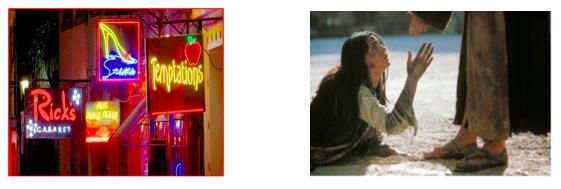
Luke 8:2 “And also, some women who had been cured of evil spirits and diseases: Mary, called Magdalene, from whom seven demons had been expelled…”
In the Gospels, there are 12 instances where Jesus is said to have “cast out a demon.” The following chart lists who had a demon (was demon-possessed) or “demons” and the verses for each.
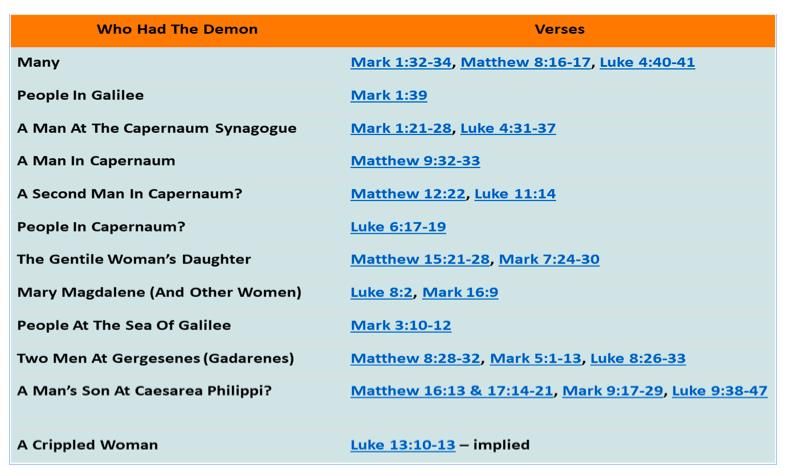
In Matthew 10:1,8, Mark 6:7,13, Luke 9:1, and Mark 3:15, Jesus gave His 12 disciples (and the 70 – Luke 10:1,17-20) “power over unclean spirits.”
In five instances, Jesus “spoke” to the demon in the process of casting it out.
Interesting to note that Jesus is never shown to cast out a demon or spoke to a demon in the Gospel of John. The book is symbolic of the Eagle (one of four heads on the Cherubim) – the Prophetic.
The Structure (Demonic) of Evil – [Partial Study]
Seven Fallen Angels:
Revelation 12:7-9 “And there was a great battle in heaven, Michael and his angels fought with the dragon, and the dragon fought, and his angels: And they prevailed not, neither was their place found any more in heaven. And that great dragon was cast out, that old serpent, who is called the devil and Satan, who seduces the entire world; and he was cast unto the earth, and his angels were thrown down with him.”
Isaiah 14: 11-17 “Your pride and the music of your harps have been brought down to Sheol; maggots are spread out as your bed beneath you and worms are your covering. 12 How you have fallen from heaven, you star of the morning [shining one], son of the dawn! You have been cut down to the earth, you who defeated the nations! 13 But you said in your heart, ‘I will ascend to heaven; I will raise my throne above the stars of God, and I will sit on the mount of assembly in the recesses of the north. 14 I will ascend above the heights of the clouds; I will make myself like the Most High.’ 15 Nevertheless you will be brought down to Sheol, To the recesses of the pit. 16 Those who see you will stare at you, they will closely examine you, saying, ‘Is this the man who made the earth tremble, who shook kingdoms, 17 Who made the world like a wilderness and overthrew its cities, who did not allow his prisoners to go home?’
When Luciel (Bearer of Light) rebelled against God and became Lucifer (Prince of Darkness) one entire choir of angels followed him and was lost to heaven. Many angels from other choirs also followed him in his rebellion.
For years, Hell has been organized by Lucifer into the ruling body called the Seven Princes, in which the leading seven would rule over different, vast areas of their lands. Each Prince was responsible for their subjects and lands. Many enjoyed how organized this system was, though a select few hated being forced at the bottom for their others to be on top. Their counterparts and rivals are the Seven Archangels.
The Princes of Hell are high-level demons that possess powers over all demons, totally transcending every lesser demon to the point where they [are said to be able to] destroy legions of low-level demons with the snap of a finger. [See the Three Choirs of Heaven PowerPoint]
The Seven Princes
- Lucifer – Pride (also Wrath)
- The name, Lucifer, means ‘day star,’ or ‘son of the morning.’ Many recognize it as an alternate name of Satan, the fallen angel. But before his downfall, Lucifer was a magnificent being with a unique ministry. Unfortunately, pride overtook his heart, and sin cost him everything. According to Ezekiel 28:13, a reference to Lucifer, we learn that he is an amazing being to behold:
- “You were the seal of perfection, full of wisdom and perfect in beauty. You were in Eden, the garden of God; every precious stone was your covering: the sardius, topaz, and diamond, beryl, onyx, and jasper, sapphire, turquoise, and emerald with gold. The workmanship of your timbrels and pipes was prepared for you on the day you were created.”
- The name, Lucifer, means ‘day star,’ or ‘son of the morning.’ Many recognize it as an alternate name of Satan, the fallen angel. But before his downfall, Lucifer was a magnificent being with a unique ministry. Unfortunately, pride overtook his heart, and sin cost him everything. According to Ezekiel 28:13, a reference to Lucifer, we learn that he is an amazing being to behold:
To dwell in the formidable presence of a perfect and holy God, Lucifer had to be perfect. There was nothing ordinary or plain about his appearance. Adorned with gold and precious stones, he truly fit the name, ‘Son of the Morning.’ He was a step above the other angels, not only in appearance but also in intellect. Lucifer’s wisdom far exceeded that of other angelic beings. He understood the ways of God. But Lucifer’s splendor and beauty did not last forever. While ministering, he began to consider his position of prominence. Lucifer became prideful, believing that he deserved more than what he already had. He wanted to become like the Most High.
Lucifer had wisdom, beauty, ability, perfection, and yet he wanted more; he wanted to be worshiped like God. But God does not share His glory, nor does He permit another to receive worship. So, before Lucifer had a chance to make his move, he was removed from the presence of God. Cast out of heaven like a bolt of lightning, Lucifer was stripped of his position and his rights to heaven. Satan’s constant attempt ever since has been to oppose the mighty plan of God. He even attempted to tempt Jesus to sin and worship him.
Beelzebub – Gluttony (also Pride and Sloth)
- The source for the name Beelzebub is in 2 Kings 1:2-3, 6, 16. Ba‘al Zəbûb is variously understood to mean “lord of the flies” or “lord of the (heavenly) dwelling”. Originally the name of a Philistine god, Ba’al, meaning “Lord” in Ugaritic, was used in conjunction with a descriptive name of a specific god. The Septuagint renders the name as Beelzebub and as Baal muian (βααλ μυιαν, “Baal of flies”), but Symmachus the Ebionite may have reflected a tradition of its offensive ancient name when he rendered it as Beelzebul.
- Asmodeus – Lust
- Demon of lust is responsible for twisting people’s sexual desires.
The demon is mentioned in some Talmudic legends, as in the story of the construction of the Temple of Solomon (Black Magick – Keys of Solomon). He was supposed by some Renaissance Christians to be the King of the Nine Hells.
The Asmodeus of the Book of Tobit is attracted to Sarah, Raguel’s daughter, and is not willing to let any husband possess her (Tobit 6:13); hence he slays seven successive husbands on their wedding nights, impeding the sexual consummation of the marriages. He is described as ‘the worst of demons’. When the young Tobias is about to marry her, Asmodeus proposes the same fate for him, but Tobias is enabled, through the counsels of his attendant angel Raphael, to render him innocuous. By placing a fish’s heart and liver on red-hot cinders, Tobias produces a smoky vapor that causes the demon to flee to Egypt, where Raphael binds him (Tobit 8:2-3). According to some translations Asmodeus is strangled. Asmodeus would thus seem to be a demon characterized by carnal desire, but he is also described as an evil spirit in general. It is possible, moreover, that the statement (Tobit 6:14), “Asmodeus loved Sarah,” implies that he was attracted not by women in general, but by Sarah specifically.
- Baphomet/Samael – Male/Female, Transgender
- The Sigil of Baphomet is the official insignia of the Church of Satan. It first appeared on the cover of The Satanic Mass LP in 1968 and later on the cover of The Satanic Bible in 1969. The sigil has been called a “material pentagram” representational of carnality and earthy principles. The Church describes the symbol as the “…preeminent visual distillation of the iconoclastic philosophy of Satanism.”
Baphomet is a deity allegedly worshipped by the Knights Templar that subsequently became incorporated into various occult and mystical traditions. The name Baphomet appeared in trial transcripts for the Inquisition of the Knights Templar starting in 1307. It first came into popular English usage in the 19th century during debate and speculation on the reasons for the suppression of the Templars.
Since 1856, the name Baphomet has been associated with the “Sabbatical Goat” image drawn by Éliphas which contains binary elements representing the “symbolization of the equilibrium of opposites” (e.g., half-human and half-animal, male and female, good and evil, etc.).
- Belphegor – Sloth (also Vanity)
- Belphegor is the chief demon of the deadly sin known as Sloth in the Christian tradition. He seduces people by suggesting to them ingenious inventions that will make them rich. According to some 16th-century demonologists, his power is stronger in April. Belphegor originated as the Assyrian Baal-Peor, the Moabites ‘god’ to whom the Israelites became attached in Shittim (Numbers 25:3), which was associated with licentiousness and orgies. It was worshipped in the form of a phallus.
- Sathanas/Satanail/Satan – Wrath (also Pride)
- The Second Book of Enoch, also called the Slavonic Book of Enoch, contains references to a Watcher called Satanael. It is a pseudepigraphic text of an uncertain date and unknown authorship. The text describes Satanael as being the prince of the Grigori who was cast out of heaven [The devil is the evil spirit of the lower places, as a fugitive he made Sotona from the heavens as his name was Satanail, thus he became different from the angels, but his nature did not change his intelligence as far as his understanding of righteous and sinful things” – 2 Enoch 31:4] and an evil spirit who knew the difference between what was “righteous” and “sinful”. In the Book of Wisdom, the devil is taken to be the being who brought death into the world, but originally the culprit was recognized as Cain. The name Samael, which is used in reference to one of the fallen angels, later became a common name for Satan in Jewish Midrash and Kabbalah.
- Abaddon/Apollyon – Destroyer
- The Hebrew term Abaddon, and its Greek equivalent Apollyon appear in the Bible as both a place of destruction and an archangel of the abyss. In the Book of Revelation of the New Testament, an angel called Abaddon is described as the king of an army of locusts; his name is first transcribed in Koine Greek (Revelation 9:11—”whose name in Hebrew is Abaddon,”) as Ἀβαδδών, and then translated Ἀπολλύων, Apollyon. The Vulgate and the Douay–Rheims Bible have additional notes not present in the Greek text, “in Latin Exterminans”, exterminans being the Latin word for “destroyer”.
Revelation 9:11 “They have as king over them, the angel of the abyss; his name in Hebrew is Abaddon [destruction], and in the Greek, he has the name Apollyon [destroyer].”
- Mammon – Greed
- Mammon in the New Testament of the Bible is material wealth or greed, most often personified as a deity, and sometimes included in the seven princes of Hell.
In the New Testament only Matthew 6:24, and Luke 16:9-13, the latter verse repeating Matthew 6:24. In Luke 16:9 and 11 Mammon is personified, hence the prevalent notion, emphasized by Milton, that Mammon was a deity. Nothing definite can be adduced from the “Fathers” in support of this; most of their expressions which seem to favor it may be easily explained by the personification in Luke, e.g., “Didascalia”, “Do solo Mammona cogitant, quorum Deus est sacculus”; similarly, St. Augustine, “Lucrum Punice Mammon dicitur” (Serm. on Mt., ii); St. Jerome in one place goes near to such an identification when (Dialogue Against the Luciferians 5) he quotes the words: “No man can serve two masters”, and then adds, “What concord hath Christ with Belial?” Riches in the heathen tongue of the Syrians are called Mammon. Mammon was commonly regarded as a deity in the Middle Ages; thus Peter Lombard (II, dist. 6) says, “Riches are called by the name of a devil, namely Mammon, for Mammon is the name of a devil, by which name riches are called according to the Syrian tongue.” Piers Plowman also regards Mammon as a deity.
Revelation 1:4 “Grace be unto you and peace from Him that is, and that was and that is to come, and from the Seven Spirits which are before the Throne.”
Tobias 12: 15 The Archangel Raphael expressly stated to Tobias that he was one of the seven: “I am Raphael, one of the seven who stand before the Lord.”
When Luciel (Bearer of Light) rebelled against God and became Lucifer (Prince of Darkness) one entire choir of angels followed him and was lost to heaven. Many angels from other choirs also followed him in his rebellion:
Revelation 12:7-9 “And there was a great battle in heaven, Michael and his angels fought with the dragon, and the dragon fought, and his angels: And they prevailed not, neither was their place found anymore in heaven. And that great dragon was cast out, that old serpent, who is called the devil and Satan, who seduces the entire world; and he was cast unto the earth, and his angels were thrown down with him.”
Lightly Covered on Broadcast
- Seven Archangels
- Seven Fallen Angels:
- Seven Deadly Sins
- Seven Plagues
Seven Archangels:
The Seven Angels
Revelation 8:2 does not identify them. Are these the “seven archangels who occupy a very particular role in the angelic hierarchy,” as David Aune suggests? (2:509). On the other hand, Beale finds it “tempting to identify them with the seven guardian angels of the seven churches” (Beale 454). John may have intended these seven angels standing before God to be the seven spirits that were before the throne of God in Revelation 1:4 and 4:5.
Other Second Temple Period literature refers to seven archangels, Michael and Gabriel being among them. For example, in Tobit 12:15, the angel Raphael says, “I am Raphael, one of the seven holy angels who present the prayers of the saints and enter into the presence of the glory of the Holy One” (RSV). The tradition of seven archangels is present in the apocryphal book of Tobit. In the Testament of Levi 8, Levi sees seven men clothed in white who prepare him to be a priest
In Greek Text in 1 Enoch 20 has seven angels: Michael, Gabriel, Uriel, Raphael, Raguel, Sariel, and Remeiel (missing in the Ethiopic text, see OTP 1:23–24).
Michael, one of the holy angels, for (he is) obedient in his benevolence over the people and the nations.
Gabriel is one of the holy angels who oversee the garden of Eden, the serpents, and the cherubim.
Uriel, [Suruel] one of the holy angels—for (he is) of eternity and of trembling.
Raphael, one of the holy angels, for (he is) of the spirits of man.
Raguel is one of the holy angels who take vengeance for the world and the luminaries.
Saraqael [Sariel] is one of the holy angels who are (set) over the spirits of mankind who sin in the spirit.
However, in Revelation 8:2 the angels are not named nor are they described as special in any way except they are given the honor of announcing the judgments by blowing on trumpets. There is another series of angels in Revelation 15-16 as the final seven bowl judgments are poured out on the earth.
- Michael
- “Who is like unto God?”
Daniel.10:13; 12:1; Jude 1: 9, and Revelation. 12:7-8
- Gabriel [Djibril or Jibril]
- “The Powerful or Strong Man of God,” “The Power or Strength of God”
Daniel.8:16; 9:21, and Luke1:19-26
- Uriel [Sariel, Suriel, or Muriel]
- “The Light or Fire of God”
A.V. II Esdras 4:1
- Raphael [Suruel or Israfel]
- “The Healing of God”
Tobit 3:17, and 12:15
- Raguel [Raziel]
- “The Friend of God.” Also called Raziel, which means “The Secrets of God.” Not to be confused with Raphael.
- Zadkiel [Sachiel, Satqiel, Tzadkiel, Zadakiel, Zidekiel.]
- “The Justice, Righteousness or Uprightness of God.”
He is the archangel of mercy and benevolence, perhaps because of his role in stopping Abraham from sacrificing his son, Isaac, as an offering to God.
- Remeiel
- Remiel, whose name means “Mercy of God” or “Compassion of God”, is an Archangel of whirlwinds, thunder, hope, and earthquakes who has various apocalyptic functions in Christian and Islamic lore. He is charged with leading souls to judgment and spreading the instructions of God to man. He knows which souls will be saved and which will be destroyed and will guide the souls that will be saved.
The words he conveys appear as visions to people and are often called the angel of “true visions.” When Remiel is near them, they are like to hear the rumble of distant thunder. He is an immensely powerful angel, so it is unlikely that someone calls upon him unless they are serious about making substantial changes in their life. He is said to have been the archangel responsible for the destruction of the armies of Sennacherib.
Archangels
[Study Only. Provided to view the different names – Aramaic, Greek, Hebrew, Latin spelling, and interpretations]
- Anael “The Grace or Joy of God.”
- Also called Aniel, Hanael, or Haniel.
- Barachiel “The Benediction or Blessings of God.”
- Also called Varachiel.
- Jedudiel “The Glory, Laudation or Praise of God.”
- Also called Jegudiel or Gudiel.
- Jeremiel “The Compassion, Exaltation or Mercy of God”
- V. II Esdras4:36. Also called Jeramiel, Jerahmiel, Jerehmiel, Ramiel, or Remiel.
- Jophiel “The Beauty of God.”
- Also called Orifiel, Jouphiel, Zouphiel, Zophiel, Zophkiel, Zaphiel,
- Raguel “The Friend of God.”
- Also called Raziel, which means “The Secrets of God.” Not to be confused with Raphael.
- Selaphiel “The Command, Communicant or Prayer of God,” since command and prayer represent the two forms, or types, of communication: the first one being descendant and the second ascendant.
- Also called Salathiel, Selathiel, Seraphiel, Sarakiel, Saraqael, Zarachiel, Zerachiel, or Zachariel.
- Zadkiel “The Justice, Righteousness or Uprightness of God.” Also called Sachiel, Tzadkiel, Zadakiel, Zedekiel, or Zedekul.
- Zaphkiel, Kaphziel, Cassiel, or Kepharel.
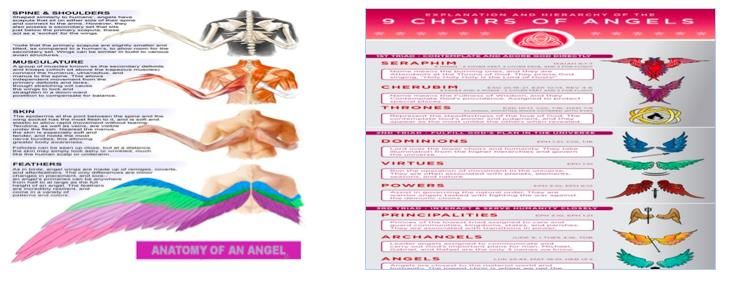
Angelology: The Doctrine of Angels
Though the doctrine of angels holds a prominent place in the Word of God, it is often viewed as a difficult subject because, while there is abundant mention of angels in the Bible, the nature of this revelation is without the same kind of explicit description we often find with other subjects developed in the Bible:
Every reference to angels is incidental to some other topic. They are not treated in themselves. God’s revelation never aims at informing us regarding the nature of angels. When they are mentioned, it is always to inform us further about God, what he does, and how he does it. Since details about angels are not significant for that purpose, they tend to be omitted.
While many details about angels are omitted, it is important to keep in mind three essential elements about the biblical revelation God has given us about angels.
- The mention of angels is included in Scripture. In the NASB translation, these celestial beings are referred to 196 times, 103 times in the Old Testament and 93 times in the New Testament.
- Further, these many references are scattered throughout the Bible are found in at least 34 books from the very earliest books (whether Job or Genesis) to the last book of the Bible (Revelation).
- Finally, there are numerous references to angels by the Lord Jesus, who is declared to be the Creator of all things, which includes the angelic beings. Paul wrote, “For by Him all things were created, both in the heavens and on earth, visible and invisible, whether thrones or dominions or rulers or authorities (a reference to angels)—all things have been created by Him and for Him.”
So, while the mention of angels may seem incidental to some other subject contextually, it is an essential element of divine revelation and should not be neglected, especially given the present craze and many misconceptions about angels. It is out of this extended body of Scripture, therefore, that the doctrine of angels, as presented in this study, will be developed. The objective is to make the Bible our authority rather than the speculations of men or their experiences or what may sound logical to people.
Though theologians have been cautious in their study of angels, in recent years we have been bombarded by what could easily be called Angelmania.
Ethereal of Fire and Breath of Jehovah
Angels seem so ethereal and mysterious compared to flesh-and-blood human beings. Unlike people, angels do not have physical bodies, so they can appear in a variety of ways. Angels can temporarily show up in the form of a person if a mission they are working on requires doing so. At other times, angels may appear as exotic creatures with wings, as beings of light, or in some other form.
That is all possible because angels are purely spiritual beings who are not bound by Earth’s physical laws. Despite the many ways they can appear, however, angels are created beings that have an essence. So, what are angels made of?
The Embodiment of Angels
Each angel whom God has made is a unique being, says Saint Thomas Aquinas in his book “Summa Theologica:” “Since angels have in them no matter [as we know it], they are pure spirits, they are not individuated. This means that each angel is the only one of its kind [think fingerprints or snowflakes]. It means that each angel is a species or essential kind of substantial being. Hence each angel is essentially different from every other angel.”
The Bible calls angels “ministering spirits” in Hebrews 1:14, and believers say that God has made each angel in the way that would best empower that angel to serve the people whom God loves.
Intellect of Angels
When God made angels, he gave them impressive intellectual capabilities. The Torah and the Bible mention in 2 Samuel 14:20 that God has given angels the knowledge about “all things that are on the earth.” God has also created angels with the power to see the future. In Daniel 10:14 of the Torah and the Bible, an angel tells the prophet Daniel: “Now I have come to explain to you what will happen to your people in the future, for the vision concerns a time yet to come.”
Angels’ intellect does not depend on any kind of physical matter, like human brains. In man, because the body is substantially united with the spiritual soul, intellectual activities (understanding and willing) presuppose the body and its senses. But an intellect, or as such, requires nothing bodily for its activity. The angels are pure spirits without a body, and their intellectual operations of understanding and willingness depend in no way at all upon material substance.
Strength of Angels
Even though angels do not have physical bodies, they can nevertheless exert great physical strength to perform their missions. The Torah and the Bible both say in Psalm 103:20: “Bless the LORD, you His angels, mighty in strength, who perform his word, obeying the voice of his word!”.
Angels who assume human bodies to perform missions on Earth are not limited by human strength but can exercise their great angelic strength while they are using human bodies, writes Saint Thomas Aquinas in “Summa Theologica:” “When an angel in human form walks and talks, he exercises angelic power and uses the bodily organs as instruments.”
Light
Angels are often lit from within when they appear on Earth, and many people believe that angels are either made from light or work within it when they visit Earth. The Bible uses the phrase “angel of light” in 2 Corinthians 11:4. Muslim tradition declares that God made angels out of light; the Sahih Muslim Hadith quotes the prophet Muhammad as saying: “The Angels were born out of light…”. New Age believers say that angels work within different electromagnetic energy frequencies that correspond to seven different light color rays.
Incorporated in Fire
Angels may also incorporate themselves in a fire. In Judges 13:9-20 of the Torah and the Bible, an angel visits Manoah, and his wife to give them some information about their future son Samson. The couple wants to thank the angel by giving him some food, but the angel encourages them to prepare a burnt offering to express thanks to God, instead. Verse 20 records how the angel used fire to make his dramatic exit: “As the flame blazed up from the altar toward heaven, the angel of the LORD ascended in the flame. Seeing this, Manoah and his wife fell with their faces to the ground.”
Communion
Revelation 5: 1-14 “And I saw lying on the open hand of Him Who was seated on the throne a scroll (book) written within and on the back, closed and sealed with seven seals. 2 And I saw a strong angel announcing in a loud voice, who is worthy to open the scroll? And [who is entitled and deserves and is morally fit] to break its seals? 3 And no one in heaven or on earth or under the earth [in the realm of the dead, Hades] was able to open the scroll or to take a [single] look at its contents. 4 And I wept audibly and bitterly because no one was found fit to open the scroll or to inspect it. 5 Then one of the elders of the heavenly Sanhedrin said to me, Stop weeping! See, the Lion of the tribe of Judah, the Root of David, has won (has overcome and conquered)! He can open the scroll and break its seven seals! 6 And there between the throne and the four living creatures (beings) and among the elders of the heavenly Sanhedrin I saw a Lamb standing, as though it had been slain, with seven horns and with seven eyes, which are the seven Spirits of God [the sevenfold Holy Spirit] Who have been sent [on duty far and wide] into all the earth. 7 He then went and took the scroll from the right hand of Him Who sat on the throne. 8 And when He had taken the scroll, the four living creatures and the twenty-four elders of the heavenly Sanhedrin prostrated themselves before the Lamb. Each was holding a harp, and they had golden bowls full of incense which are the prayers of God’s people (the saints). 9 And they sing a new song, saying, ‘You’ [Jesus] are worthy to take the scroll and to break the seals that are on it, for You were slain (sacrificed), and with Your blood You purchased men unto God from every tribe and language and people and nation. 10 And You have made them a kingdom royal race and priests to our God, and they shall reign [as kings] over the earth! 11 Then I looked, and I heard the voices of many angels on every side of the throne and of the living creatures and the elders [of the heavenly Sanhedrin], and they numbered ten thousand times ten thousand and thousands of thousands, 12 saying in a loud voice, deserving is the Lamb, who was sacrificed, to receive all the power and riches and wisdom and might and honor and majesty (glory, splendor) and blessing! 13 And I heard every created thing in heaven and on earth and under the earth [in Hades, the place of departed spirits] and on the sea and all that is in it, crying out together, To Him Who is seated on the throne and to the Lamb be ascribed the blessing and the honor and the majesty (glory, splendor) and the power (might and dominion) forever and ever (through the eternities of the eternities)! 14 Then the four living creatures (beings) said, amen)! And the elders [of the heavenly Sanhedrin] prostrated themselves and worshiped Him Who lives forever and ever.”
Blessings,
Joseph “Jim” Stockstill 
“National War Council” – Founder and Chairman
Jim5555@nationalwarcouncil.org
P.O. Box 931
Argyle, TX 76226
nwc@nationalwarcouncil.org
Jim5555@nationalwarcouncil.org
Donations to National War Council
“The two most important days in your life are the day you are born and the day you find out why.”
Mark Twain
0 Comments