

By Jim Stockstill
April 6, 2023
The Resurrection
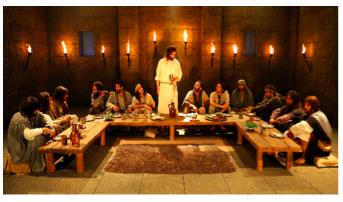
All those who also trust in God’s promise, will one day fully live in, and experience the presence of God
The upper room discourse [Chapters 13 – 18]
We are given the details of the Lord’s final meeting with his disciples. Jesus, knowing what is to take place anticipates being “betrayed with a kiss” and arrested later that night. In John 13, after giving Judas the “sop” [verse 27], the thief who kept the money bag is filled with Satan and departs […he immediately went out and it was night] the room. Another way to view the scene – the leaven departed the room [represents sin and must be removed from the house]. It is ironic that “Judas” is the Greek rendering of the Hebrew name Judah: Hebrew for “God is thanked.”
During Passover, observant Jewish people refrain from eating leaven. This tradition comes from God’s commandment to Israel in the Torah, “For seven days no leaven shall be found in your houses since whoever eats what is leavened, that same person shall be cut off from the congregation of Israel, whether he is a stranger or a native of the land. You shall eat nothing leavened; in all your dwellings you shall eat unleavened bread” (Exodus 12:19-20). As Jewish people prepare for Passover, each family removes the leaven from their home. Then, during a ceremony called Bedikat Chametz, every traditional household conducts a final search for leaven throughout the house, gathers it together, and burns it, after which the house is kosher for Passover.
Paul uses this Jewish practice as the background to his discussion in 1 Corinthians 5:6-8, “Your glorying is not good. Do you not know that a little leaven leavens the whole lump? Therefore, purge out the old leaven, that you may be a new lump since you truly are unleavened. For indeed Christ, our Passover, was sacrificed for us. Therefore, let us keep the feast, not with old leaven, nor with the leaven of malice and wickedness, but with the unleavened bread of sincerity and truth.”
As we continue, in the intimate setting of the upper room, Jesus comforts and reassures his beloved disciples – or as he says in John 15:15 – you are no longer servants, but I have called you, my friends. The love of the Shepherd for his sheep – who will offer himself as the lamb – is the same for you and me today.
John 14:1-3 “1 Let not your heart be troubled: ye believe in God, believe also in me. 2 In my Father’s house are many mansions: if it were not so, I would have told you. I go to prepare a place for you. 3 And if I go and prepare a place for you, I will come again, and receive you unto myself; that where I am, there ye may be also.”
The Father’s house in the verse is not talking about the Temple – he told the Pharisees their house [Temple] is left unto them desolate. (Matthew 23:38)
- House [G3614]: oikia, [Oiketerion] heaven, John 14:2; of the body as the habitation of the soul, 2 Corinthians 5:1. b. the inmates of a house, the family: Matthew 12:25, the household, the family of anyone.
- Mansion (G3438 1x): monē – a dwelling place.
John 3:5-6 “5 Jesus answered, Verily, verily, I say unto thee, Except a man be born of water and of the Spirit, he cannot enter into the kingdom of God. 6 That which is born of the flesh is flesh; and that which is born of the Spirit is spirit.”
Man can be born twice and die once, or he/she can be born once and die twice.
Mansions in Heaven
Over the years, from pulpits to radio and television evangelists, we have been told of the spectacular mansions on streets of gold that Jesus is preparing for each of us. Unfortunately, as often occurs, Scriptures are manipulated, or taken out of context, either from lack of knowledge or more likely less honorable reasons:
- 1 Corinthians 2:9 “But as it is written, Eye hath not seen, nor ear heard, neither have entered into the heart of man, the things which God hath prepared for them that love him.”
- Isaiah 64:4 “For since the beginning of the world men have not heard, nor perceived by the ear, neither hath the eye seen, O God, beside thee, what he hath prepared for him that waits for him.”
The entire passage is an encouragement to discouraged disciples. And the form of that encouragement is a promise of Jesus’ continual presence — in the present age and in the age to come. Once Jesus’ bodily presence departed from them, His presence was still with them through the Spirit.
- John 14:16-20 “16 And I will pray the Father, and he shall give you another Comforter, that he may abide with you forever, 17 Even the Spirit of truth; whom the world cannot receive, because it sees him not, neither knows him: but ye know him; for he dwelleth with you and shall be in you. 18 I will not leave you comfortless: I will come to you. 19 Yet a little while and the world sees me no more, but ye see me: because I live, ye shall live also. 20 At that day ye shall know that I am in my Father, and ye in me, and I in you.
And someday the disciples, and all those who also trust in God’s promise, will one day fully live in, and experience the presence of God. This is the abiding promise of the Good Shepherd.
Jewish Wedding
Ketubah
The betrothal
Ketubah signing. In Orthodox communities, after the Tish the ketubah (Jewish marriage contract) is signed by the groom, the rabbi, and two male witnesses. In Reform and Conservative congregations, the bride may also sign the ketubah, and additional lines can be added for female witnesses, too. Despite its testimony that the groom has “acquired” the bride, the ketubah is all about the bride’s rights and her willingness to take part in the marriage. The ketubah belongs solely to the bride and is hers to keep as proof of her rights and the groom’s responsibilities to her under Jewish law.
- The men sit around the table (the Tisch) that has been laid with food and usually lots of whiskey and generally speaking, the Groom enjoys some boy time before the ceremony. Singing, chanting and lively behavior are what occur whilst the Groom prepares for the wonderful event that is soon to follow.
- 1 Corinthians 11:23-26 “23 For I received from the Lord what I also delivered to you, that the Lord Jesus on the night when he was betrayed took bread, 24 and when he had given thanks, he broke it, and said, ‘This is my body, which is broken for you. Do this in remembrance of me.’ 25 In the same way also he took the cup, after supper, saying, ‘This cup is the new covenant in my blood. Do this, as often as you drink it, in remembrance of me.’ 26 For as often as you eat this bread and drink the cup, you proclaim the Lord’s death until he comes.”
Mohar
Price Paid
As among all other nations of antiquity, in Israel, the bridegroom named a price or ransom (Mohar) to the father of the bride. It is, however, doubtful whether this mohar was given in the form of a ransom to the father or as a gift to the bride. Both cases are mentioned in the Bible, e.g., Eliezer, the servant of Abraham, brought 10 camel’s laden costly gifts to Rebekah [City of Nahor] when he betrothed her for his master’s son, while Jacob served Laban for fourteen years for his two daughters. (Genesis 24:12, and Exodus 22:17)
With the Ketubah settled, and the contract [covenant] made, she was considered set apart for the bridegroom. To seal the covenant, they would both drink a glass of wine.
- 1 Corinthians 6:17-20 “17 But he who is joined to the Lord becomes one spirit with him. 18 Flee from sexual immorality. Every other sin a person commits is outside the body, but the sexually immoral person sins against his own body. 19 Or do you not know that your body is a temple of the Holy Spirit within you, whom you have from God? You are not your own, 20 for you were bought with a price. So, glorify God in your body.”
Today, we would consider the work of Christ in payment, and we are set apart or sanctified.
- 1 Corinthians 1:2 “To the church of God that is in Corinth, to those sanctified in Christ Jesus, called to be saints together with all those who in every place call upon the name of our Lord Jesus Christ, both their Lord and ours.” [Chapter 6:11]
- Hebrews 10:10 “And by that will we have been sanctified through the offering of the body of Jesus Christ once and for all.” [Chapter 13:12]
Holy Spirit: Sealed
- Ephesians 1:13-14 “13 In whom ye also trusted, after that, ye heard the word of truth, the gospel of your salvation: in whom also after that ye believed, ye were sealed [G4972: marked as God’s] with that holy Spirit of promise, 14 Which is the earnest of our inheritance until the redemption of the purchased possession, unto the praise of his glory.”
- 2 Corinthians 1:21-22 “21 Now he which established us with you in Christ, and hath anointed us, is God, 22 who hath also sealed us, and given the earnest of the Spirit in our hearts.”
- 2 Corinthians 5:5 “Now he that hath wrought us for the selfsame thing is God, who also hath given unto us the earnest of the Spirit.”
The Bridegroom Departs for His Father’s House
Preparing A Place for His Bride [an additional room]
As in the Eastern culture today, during the time of Jesus, the “father’s house” would have consisted of several generations living together. It was customary during the betrothal period for the bridegroom to prepare a place for his bride. He, and his friends, would build (prepare) an addition to his “father’s house” so they would all be together. The length of time it took to complete the new room was unknown, so the bride would prepare for his imminent return – she was kept in suspense anticipating his arrival. There was no precondition for his return – a year. Joseph and Mary. Once all preparations were complete, the groom would return and claim his bride.
The Bridegroom Comes for His Bride
Usually, a surprise gathering at midnight. As was the case of the ten virgins in Christ’s parable, the bridegroom himself went in person to bring her to his home for the wedding festivities. Before leaving the house that had been her home, she would receive the blessing of her relatives. Thus, Rebekah’s relatives sent her away with a typical Eastern marriage blessing, “Thou art our sister, be thou the mother of thousands of millions, and let thy seed possess the gate of those which hate them.” Genesis 24:60. The bride left her father’s house adorned and perfumed with a crown on her head. Ezekiel’s description of the bride is very appropriate, “I decked thee also with ornaments, and I put bracelets upon thy hands and a chain on thy neck. And I put a jewel on thy forehead, and earrings in your ears, and a beautiful crown upon your head.” Ezekiel 16:11-12.
The Wedding Procession
The bridegroom set out with his bride from the house of her parents, and there followed a grand procession to his house. The streets of Asiatic cities were dark, and anybody venturing forth at night needed to carry a lamp or torch. Those invited guests, who did not go to the bride’s home, were allowed to join the procession along the way and go with the whole group to the marriage feast. Without a torch or lamp, they could not join the procession or enter the bridegroom’s house.
The ten virgins waited for the procession to arrive. The five wise virgins were able to proceed because they had a reserve supply of oil for their lamps, but the foolish virgins lacked oil, so not being ready, they were barred from the wedding feast. Matthew 25:1–13.
With her face veiled, the bride allowed her hair to be loose and flowing while on the journey to the groom’s house. Her own relations preceded her in the procession, scattering ears of parched grain to the children along the way.
- 1 Thessalonians 4:14-17 “14 For since we believe that Jesus died and rose again, even so, through Jesus, God will bring with him those who have fallen asleep. 15 For this we declare to you by a word from the Lord, that we who are alive, who are left until the coming of the Lord, will not precede those who have fallen asleep. 16 For the Lord himself will descend from heaven with a cry of command, with the voice of an archangel, and with the sound of the trumpet of God. And the dead in Christ will rise first. 17 Then we who are alive, who are left, will be caught up together with them in the clouds to meet the Lord in the air, and so we will always be with the Lord.”
Arrival at Her New Home
After arriving at the bridegroom’s house, some of the older women had the task of arranging the bride’s hair. Her flowing locks were hidden beneath a thick veil. From this time on, the custom would dictate that her face was not to be unveiled in public. She was led to her place under a canopy, which was located either inside the house or, if the weather permitted, in the open air. Her place was beside her husband, where both would hear new words of benediction given by one of the fathers or by some important person who might be present.
- The huppah (chuppah) canopy is a symbol of God’s presence at a wedding and in the home being established under the canopy. It was said the divine Name hovers above it, sanctifying the space below. The only rule about the construction of a huppah is that it be a temporary structure made by human hands. Other than that, it is yours to create. In early Jewish weddings, it became the custom to marry under a tallit (prayer shawl), which was frequently a gift from the bride’s family to the groom. The tzitzit (ritual fringes) on the prayer shawl hanging above the couple’s heads were a reminder of the mitzvot (commandments) they represent and are regarded as a talisman against evil spirits.
- If you are not Jewish, you might have wondered what the meaning is of the glass that is smashed at the end of a Jewish wedding. It actually has a great deal of meaning tracing back millennia. The Jewish wedding ceremony ends with a famous bang. Stomping on a glass is one of the best-known features of Jewish weddings. Traditionally, the groom did the deed; today the couple often share the honor/pleasure, smashing one or two napkin-wrapped glasses.
The most traditional association with the breaking of the glass is the destruction of the Temple of Jerusalem. The symbol of the fall of the temple is present in the wedding ceremony to remind the newly married couple of the importance of their faith. The fragility of glass also suggests the frailty of human relationships. Since even the strongest love is subject to disintegration, the glass is broken as a kind of incantation: “As this glass shatters, so may our marriage never break.” Marriage is a covenant, which in Judaism is made by breaking or cutting something. At Sinai, tablets were broken; at a wedding, broken glass “cuts” the covenant.
The Wedding Feast
Every guest that attended the feast was required to wear a wedding garment (Matthew 22:12). The wedding banquet was presided over by the ruler of the feast. John 2:8-9. It was his duty to take care of all the preparations, and during the feast, he would mingle among the guests and see to it that they lacked nothing, instructing servants to carry out all the necessary details. The expression “children of the bride chamber” (Matthew 9:15), used by Jesus, simply means the guests at the wedding. The governor or ruler of the feast returned thanks at the dinner and pronounced benedictions at appointed times. He also blessed the wine. It was customary to tell riddles at these feasts as Samson did at his wedding (Judges 14:12–18). During the meal, mirthfulness prevailed, and the guests were expected to exalt the bride.
After the wedding feast was over, the husband was escorted by his friends into the apartment where his wife had previously been conducted. These wedding festivities with relatives and friends lasted for a whole week (Judges 14:17), but the entire number of what was called “the days of the marriage” was thirty.
Jesus and His Bride
Revelation 19:6-9 “6 And I heard as it were the voice of a great multitude, and as the voice of many waters, and as the voice of mighty thundering, saying, Alleluia: for the Lord God omnipotent reigns. 7 Let us be glad and rejoice and give honor to him: for the marriage of the Lamb is come, and his wife hath made herself ready. 8 And to her was granted that she should be arrayed in fine linen, clean and white for the fine linen is the righteousness of saints. 9 And he saith unto me, Write, Blessed are they which are called unto the marriage supper of the Lamb. And he saith unto me, These are the true sayings of God.”
Resurrected Bodies
The Temporal and Eternal
1 Corinthians 15:51-54 “51 Behold, I show you a mystery; We shall not all sleep, but we shall all be changed, 52 In a moment, in the twinkling of an eye, at the last trump: for the trumpet shall sound, and the dead shall be raised incorruptible, and we shall be changed. 53 For this corruptible must put on incorruption, and this mortal must put on immortality. 54 So when this corruptible shall have put on incorruption, and this mortal shall have put on immortality, then shall be brought to pass the saying that is written, Death is swallowed up in victory.”
Mystery: One of Seven [Romans – gentile nations]
Romans 16:25-26 “25 Now to him that is of power to establish you according to my gospel, and the preaching of Jesus Christ, according to the revelation of the mystery, which was kept secret [G4601: concealed] since the world began, 26 But now is made manifest, and by the scriptures of the prophets, according to the commandment of the everlasting God, made known to all nations for the obedience of faith.”
2 Corinthians 5:1-5 “1 For we know that if the earthly tent [our physical body] which is our house is torn down [through death], we have a building from God, a house not made with hands, eternal in the heavens. 2 For indeed in this house we groan, longing to be clothed with our [immortal, eternal] celestial dwelling, 3 so that by putting it on we will not be found naked. 4 For while we are in this tent, we groan, being burdened [often weighed down, oppressed], not that we want to be unclothed [separated by death from the body: Paul was eager for the second appearance], but to be clothed, so that what is mortal [the body] will be swallowed up by life [after the resurrection]. 5 Now He who has made us and prepared us for this very purpose is God, who gave us the [Holy] Spirit as a pledge [a guarantee, a down payment on the fulfillment of His promise].”
House [G 3613 (2x)]: oy-kay-tay’-ree-on. A habitation, a dwelling place for the spirit.
- Jude 1:6 “And the angels which kept not their first estate, but left their own habitation, he hath reserved in everlasting chains under darkness unto the judgment of the great day.
The rebel angels (watchers: Bene Elohim) left their habitation or dwelling (physically and positionally) to fulfill their lust and desire to procreate with earthly women. We, on the other hand, as the Ekklesia and Bride of Christ, anticipate having our home (dwelling) not built by human hands and being with Christ throughout eternity.
Naked [G 1131]: of the soul, whose garment is the body, stripped of the body, without a body.
1 John 3:2 “Beloved, now are we the sons of God, and it doth not yet appear what we shall be: but we know that, when he shall appear, we shall be like him; for we shall see him as he is.”
Yeshua: After the Resurrection
Jesus’ resurrection body had a unique atomic-like structure able to pass through solids and space, (John 20:19-26) and as we reviewed in 1 Corinthians 15:44. He had human form or appearance but not the nature of the material substance. (Matthew 28:9, Luke 24:15-18, 39, John 20:17). As he calmed the frightened disciples, he was flesh and bone but not blood (Luke 24:39-40, 1 Corinthians 15:50).
He could appear and disappear.
- Luke 24:15 “And it came to pass, that, while they communed together and reasoned, Jesus himself drew near and went with them.”
- Luke 24:36 “And as they thus spoke, Jesus himself stood in the midst of them, and saith unto them, Peace be unto you.”
- Acts 1:9 “And when he had spoken these things, while they beheld, he was taken up, and a cloud received him out of their sight.”
He could change his appearance to be unrecognizable or as his followers knew him beforehand. (Luke 24:16 and 31-35, John 20:14. 26-29)
- Appeared or Appearance [G 3700]: Optanomai. Optic or sight associated with the brain and where we get the word optometrist. The Greek root for this word is horao – to see as perception).
He could walk, eat, obviously breathe the earth’s atmosphere, and perhaps cook.
Luke 24:15-17 “15 And it came to pass, that, while they communed together and reasoned, Jesus himself drew near and went with them. 16 But their eyes were holden that they should not know him. 17 And he said unto them, What manner of communications are these that ye have one to another, as ye walk, and are sad?”
Luke 24:41-43 “41 And while they yet believed not for joy, and wondered, he said unto them, Have ye here any meat? 42 And they gave him a piece of a broiled fish, and a honeycomb. 43 And he took it and did eat before them.”
John 21:9-10 “9 As soon then as they were come to land, they saw a fire of coals there, and fish laid thereon, and bread. 10 Jesus saith unto them, Bring of the fish which ye have now caught.”
He returned to the third heaven to be seated at the right hand of God (Hebrews 1:3, Acts 2:33). Stephen saw Jesus standing there (Acts 7:55-56).
New Creation Temple
With what we covered, rather than luxurious mansions, ornate fountains of water, and trimmed lawns, I anticipate having the immortal, incorruptible, and glorious body as Jesus (the second Adam – a life-giving spirit). This body deteriorates [Ecclesiastes 12], it is subject to hunger, thirst, sickness, disease, weakness, fatigue, and sleep. Temporarily, we are as Paul stated:
- Romans 8:19-23 “19 For the earnest expectation of the creature waits for the manifestation of the sons of God. 20 For the creature was made subject to vanity, not willingly, but because of him who hath subjected the same in hope, 21 Because the creature itself also shall be delivered from the bondage of corruption into the glorious liberty of the children of God. 22 For we know that the whole creation groans and travails in pain together until now. 23 And not only they, but ourselves also, which have the firstfruits of the Spirit, even we groan within ourselves, waiting for the adoption, to wit, the redemption of our body.”
Family and Loved Ones – Babies
Job’s Character and Wealth
Job 1:1-3 “1 There was a man in the land of Uz whose name was Job, and that man was blameless and upright, and one who feared God [with reverence] and abstained from and turned away from evil [because he honored God]. 2 Seven sons and three daughters were born to him. 3 He also possessed 7,000 sheep, 3,000 camels, 500 yokes (pairs) of oxen, 500 female donkeys, and a very great number of servants, so this man was the greatest of all the men of the east (northern Arabia).
God Restores Job’s Fortunes
Job 42:10-15 “10 The Lord restored the fortunes of Job when he prayed for his friends, and the Lord gave Job twice as much as he had before. 11 Then all his brothers and sisters and all who had known him before came to him, and they ate bread with him in his house, and they consoled him and comforted him over all the [distressing] adversities that the Lord had brought on him. And each one gave him a piece of money, and each a ring of gold. 12 And the Lord blessed the latter days of Job more than his beginning; for he had 14,000 sheep, 6,000 camels, 1,000 yoke of oxen, and 1,000 female donkeys. 13 He had seven sons and three daughters. 14 And he called the name of the first [daughter] Jemima, and the name of the second Kezia, and the name of the third Keren-happuch. 15 In all the land there were found no women so lovely as the daughters of Job, and their father gave them an inheritance among their brothers.”
- Jemima [H 3224 (1x)]: “Day by Day” – from H3117 – warm – affectionate hence dove.
- Kezia [H 7103 (1x)]: “Cassia” from fragrance. The oil of gladness and the fire and the fragrance. It is one of the principal spices [myrrh, aloes] of the Holy Anointing Oil. It is used to scent garments in the Bible, and it is mentioned in Psalm 45 as one of the ingredients of the Oil of Gladness on the Robes of Messiah Jesus.
- Keren-happuch [H 7163 (1x)]: Horn of antimony [horn of cosmetic – beautifier]. Given the fact that their names all appear to reference their intrinsic beauty seem to convey the remarkable abundance of Job’s restoration. God did not just give Job 10 new children to replace the ones who died — He gave him the three most beautiful daughters in the land.
King David
Psalm 51:5 “I was brought forth in [a state of] wickedness. In sin, my mother conceived me [and from my beginning I, too, was sinful].”
2 Samuel 12:23 “But now he is dead; why should I [continue to] fast? Can I bring him back again? I will go to him [when I die], but he will not return [H 7725: restored] to me.”
Miscarriage, stillbirth, and infant loss are devastating and heartbreaking, and families who are grieving the death of a baby do not need to also be crushed under fear about the fate of that child. God is present for his people as they mourn, including when they mourn the loss of a baby.
The Orthodox Church in America, in their burial rite for miscarried babies, prays: “O Savior and Master of our life: comfort the faithful parents of this departed child with the knowledge that to innocent children, who have done no deeds worthy of tears, are granted the righteousness, peace, and joy of Thy kingdom.”
Charles Spurgeon
What about babies and young children who never attain the ability to make the personal choice to believe in Jesus? Some believe that those who die before reaching the age of intellectual or moral accountability are “automatically” saved by God’s grace in Christ. The reasoning is that, if someone is truly incapable of deciding for or against Christ, then that one is extended God’s mercy. Charles Spurgeon held this view: “I rejoice to know that the souls of all infants, as soon as they die, speed their way to Paradise. Think what a multitude there is of them!” (C. H. Spurgeon’s Autobiography, Vol. 1, Chapter 16, “A Defence of Calvinism,” Passmore and Alabaster, 1897, p. 175).
Elisabeth and the baby
Luke 1:41 “And it came to pass, that, when Elisabeth heard the salutation of Mary, the babe leaped in her womb; and Elisabeth was filled with the Holy Ghost.”
Rich Man and Lazarus
Luke 16:19-31
Recognized Abraham, Lazarus, knew his family (brothers), what it would take to avoid his punishment.
Addendum 1
Jewish Wedding
The betrothal
Ketubah signing. In Orthodox communities, after the Tish the ketubah (Jewish marriage contract) is signed by the groom, the rabbi, and two male witnesses. In Reform and Conservative congregations, the bride may also sign the ketubah, and additional lines can be added for female witnesses, too. Despite its testimony that the groom has “acquired” the bride, the ketubah is all about the bride’s rights and her willingness to take part in the marriage. The ketubah belongs solely to the bride and is hers to keep as proof of her rights and the groom’s responsibilities to her under Jewish law.
- The men sit around the table (the “Tisch”) that has been laid with food and usually lots of whiskey and generally speaking, the Groom enjoys some boy time before the ceremony. Singing, chanting and lively behavior are what occur whilst the Groom prepares for the wonderful event that is soon to follow.
- 1 Corinthians 11:23-26 “23 For I received from the Lord what I also delivered to you, that the Lord Jesus on the night when he was betrayed took bread, 24 and when he had given thanks, he broke it, and said, ‘This is my body, which is broken for you. Do this in remembrance of me.’ 25 In the same way also he took the cup, after supper, saying, ‘This cup is the new covenant in my blood. Do this, as often as you drink it, in remembrance of me.’ 26 For as often as you eat this bread and drink the cup, you proclaim the Lord’s death until he comes.”
Mohar
As among all other nations of antiquity, in Israel, the bridegroom named a price or ransom (“mohar”) to the father of the bride. It is, however, doubtful whether this mohar was given in the form of a ransom to the father or as a gift to the bride. Both cases are mentioned in the Bible, e.g., Eliezer, the servant of Abraham, brought 10 camel’s laden costly gifts to Rebekah [City of Nahor] when he betrothed her for his master’s son, while Jacob served Laban for fourteen years for his two daughters. (Genesis 24:12, and Exodus 22:17)
Once the bridegroom, parents of the potential bride, and the desired bride [Africa] settle on a purchase price and agree then they make a covenant. From that point on she was considered set apart for the bridegroom. To seal the covenant, they would both drink a glass of wine.
- 1 Corinthians 6:17-20 “17 But he who is joined to the Lord becomes one spirit with him. 18 Flee from sexual immorality. Every other sin a person commits is outside the body, but the sexually immoral person sins against his own body. 19 Or do you not know that your body is a temple of the Holy Spirit within you, whom you have from God? You are not your own, 20 for you were bought with a price. So, glorify God in your body.”
Today, we would consider the work of Christ in payment, and we are set apart or sanctified.
- 1 Corinthians 1:2 “To the church of God that is in Corinth, to those sanctified in Christ Jesus, called to be saints together with all those who in every place call upon the name of our Lord Jesus Christ, both their Lord and ours.” [Chapter 6:11]
- Hebrews 10:10 “And by that will we have been sanctified through the offering of the body of Jesus Christ once and for all.” [Chapter 13:12]
Bedeken
The first time a bride and groom see each other in an Orthodox wedding is during the Bedeken or veiling of the bride. Both fathers and all the men lead the groom to the bride’s room, where both mothers and all the women surround her. The groom lowers the veil over her face, setting her apart from everyone else and indicating that he is solely interested in her inner beauty. The ceremony is based on the biblical story in which Jacob did not see his bride’s face beforehand and was tricked into marrying the wrong sister, Leah.
Circling
When the couple first enters the chuppah, the bride circles the groom seven times, representing the seven wedding blessings and seven days of creation, and demonstrating that the groom is the center of her world. To make the ancient ritual reciprocal, many couples opt to circle each other.
Sheva Brachot
The sheva b’rachot, or seven blessings, consists of praise for God, a prayer for peace in Jerusalem, and good wishes for the couple. In Sephardic weddings, before the sheva b’rachot is recited, the parents wrap the couple in a tallit (prayer shawl), literally binding them together. The rabbi does not have to say all seven blessings. You can honor special guests by asking them to read—or even sing—some of the blessings. Adds Rabbi Portnoy Goldberg, “The blessings can be the traditional Hebrew sheva b’rachot or, if preferred, a more modern English set of blessings.”
Breaking of the Glass
Nothing says “Jewish wedding” more than the sound of breaking glass. But what is the point? Depending on whom you ask, the breaking of the wineglass is, among other things: a symbol of the destruction of the Temple in Jerusalem, a representation of the fragility of human relationships, and a reminder that marriage changes the lives of individuals forever. It is also the official signal to shout, “Mazel Tov!” and start partying. There is no law putting the man’s foot to the task. If you are game, the couple can break the glass together with one swift kick in unison.
Mazel Tov
Now it is time to shout, “Mazel Tov!” and start partying. Mazel Tov is used like “congratulations,” but means “good fortune,” which is a lovely wish for a new couple at the end of a Jewish wedding ceremony.
Yihud
In a day filled with chaos, the Yihud — or “seclusion” — is a standout ritual that lets you focus on the day’s true purpose: your new partnership. Immediately after the ceremony, the newlyweds retreat to a private room for 15 minutes of personal time. No in-laws, no seating arrangement charts, no videographer. Just you and your new spouse staring into each other’s eyes. In the days of old, the bride and groom would retreat to a nearby tent to consummate the marriage. This is not done much these days, but it is customary for newlyweds to seize the Yihud moment and feed each other a bite or two of their first meal together.
Jewish Wedding Reception Dances
Music and dancing are a big part of any Jewish wedding. Note that in some Orthodox communities, the men and women dance separately.
Hora
The traditional hora, or chair dance, is the highlight of a Jewish wedding reception. The wedding couple is lifted above the crowd on chairs, while guests sing “Hava Nagila” and circle the couple in a celebratory dance.
Mitzvah Dances
The mitzvah dances are meant to celebrate and entertain the newly married couple. The couple is traditionally seated (often on the chairs from the hora!) while loved one’s dance for them and make them laugh with costumes, props, and more. Get ready for some serious photo fodder.
Mezinke
In weddings where the parents of the couple have “married off” their last child, this dance is one of the concluding Jewish wedding traditions. Also called the krenzel—Yiddish for “crown”—for the crown of flowers placed in the mother’s hair, the Mezinke places these parents in the middle of the dance floor while guests dance around them, kissing them as they pass.
Jewish Wedding Reception Food
Serving delicious food is not just a nice tradition. Providing a wedding feast is part of Jewish law or a mitzvah.
Seudat Mitzvah
There is nothing better than a celebratory meal at any wedding. And per Jewish wedding traditions, you will almost always find chicken and fish, both symbols of fertility, at the seudat mitzvah. You may receive sutlach—a sweet rice pudding with coconut milk, honey, and almonds—as your first course to symbolize a sweet and prosperous life ahead. If you are keeping kosher, you will need to choose between a meal that contains meat or dairy, but not both. Pork and shellfish are typically not served.
Jewish Wedding Reception Blessings
During a Jewish wedding reception, honored guests will help recite blessings to give thanks for the festive meal and the couple’s new union.
Blessing the Challah
The wedding meal and reception start with a blessing, or hamotzi, over a beautiful loaf of challah, the traditional braided Shabbat, and holiday bread which symbolizes love.
Birkat Hamazon
The last of the Jewish wedding rituals is the Birkat Hamazon or Grace after Meals. This blessing is recited by the guests, often with booklets of prayers (benchers) handed out. The seven wedding blessings are then repeated. In the final blessing, the person leading the blessing blesses the wine, then pours wine from two cups into one, drinking from the original cup and handing the other two cups to the newlyweds to drink.
Traditional Jewish Wedding Gifts
If you are attending a Jewish wedding, there are numerous options when it comes to gift giving. Many guests choose to give cash or a check to the newlyweds, and its Jewish tradition to give monetary gifts in multiples of $18 ($72, $90, $108, etc.), a numeric symbol for “life”. Jewish couples may also have a wedding registry and often register for Judaica, or religious items, such as menorahs, Passover seder plates, Kiddush cups, Sabbath candlesticks, mezuzah, and more.
Blessings in Christ,
Joseph “Jim” Stockstill 
“National War Council” – Founder and Chairman
Jim5555@nationalwarcouncil.org
P.O. Box 931
Argyle, TX 76226
nwc@nationalwarcouncil.org
Jim5555@nationalwarcouncil.org
Donations to National War Council
“He hath shown thee what is good; and what doth the Lord require of thee, but to do justly, and to love mercy, and to walk humbly with thy God.”
Micah 6:8
0 Comments