

By Jim Stockstill
March 24, 2022
Jesus the “Anointed One”
Son of David – Son of Man

God (Elohim) the Father:
Jesus’ weeping is our Shepherd visibly expressing as a man what God himself feels over the plight of sin and human pain.
- Oneness with the “Father”:
- John 14:7-10 “If you had known Me, you would have known My Father also; from now on you know Him, and have seen Him.” 8 Philip said to Him, “Lord, show us the Father, and it is enough for us.” 9 Jesus said to him, “Have I been with you [plural – disciples] for so long a time, and yet you [singular – Philip] have not come to know Me, Philip? The one who has seen Me has seen the Father; how can you say, ‘Show us the Father’? 10 Do you not believe that I am in the Father, and the Father is in Me? The words that I say to you I do not speak on My own, but the Father, as He remains in Me, does His works.”
Genesis 6:5-7 “And God saw that the wickedness of man was great in the earth and that every imagination of the thoughts of his heart was only evil continually. 6 And it repented the Lord that he had made man on the earth, and it grieved him at his heart. 7 And the Lord said, I will destroy man whom I have created from the face of the earth; both man, and beast, and the creeping thing, and the fowls of the air; for it repentant me that I have made them.”
- Repent [H 5162] Arabic – breathe pantingly (of a horse), 1st singular person for ill done to others. To be sorry, i.e. (in a favorable sense) to pity, console or (reflexively) rue; or (unfavorably) to avenge (oneself):—comfort (self), ease (oneself), repent(self).
- Grieved [H 6087] To feel grieved, be vexed. Properly, to carve (as in fashion).
Psalms 78:40 “How often they rebelled against him in the wilderness and grieved him in the desert.”
Ezekiel 6:9 “And they that escape of you shall remember me among the nations whither they shall be carried captives, because I am broken with their whorish heart, which hath departed from me, and with their eyes, which go a whoring after their idols: and they shall loathe themselves for the evils which they have committed in all their abominations.”
- Broken [H 7665] Break, a rupture in the heart.
Jesus is giving a human expression to God’s emotions, visibly revealing the very heart and deep compassion of God for the plight of fallen humanity.
To conclude, Jesus became a true human being and in so doing experienced the weaknesses, limitations, and temptations that are common to humanity with one sole exception; Jesus was sinless and perfect. Thus, the statements that speak of Jesus’ human limitations do absolutely nothing to refute the clear Biblical witness that Jesus was also God. The Holy Bible teaches that Jesus is God and man. It is not that Jesus has to either be God or man but that he is both God and man at the same time. What was true of his humanity didn’t apply to his Deity and vice-versa, i.e., as a man he tired but as God, his energy and power are infinite and inexhaustible.
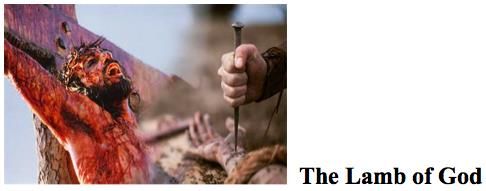
The Sin Offering
Isaiah 50:6 “I gave my back to those who struck me, and my cheeks to them that plucked off the hair [beard]: I hid not my face from shame and spitting.”
Isaiah 52:14 “As many were astonied at thee; his visage was so marred more than any man, and his form more than the sons of men.”
- Marred [H 4893] disfigurement of the face so as not to look human or recognizable.
Isaiah 53: 3 “He was despised and rejected by mankind, a man of suffering, and familiar with pain. Like one from whom people hide their faces he was despised, and we held him in low esteem.”
Isaiah 53:4-7,10:
4 “Surely, he took up our pain and bore our suffering, yet we considered him punished by God, stricken by him, and afflicted.”
5 “But he was pierced for our transgressions, he was crushed for our iniquities; the punishment that brought us peace was on him, and by his wounds, we are healed.”
6 “We all, like sheep, have gone astray, each of us has turned to our own way, and the Lord has laid on him the iniquity of us all.”
- 2 Corinthians 5:21 “For our sake He made Christ [virtually] to be sin Who knew no sin so that in and through Him we might become [endued with, viewed as being in, and examples of] the righteousness of God [what we ought to be, approved and acceptable and in right relationship with Him, by His goodness.”
7 “He was oppressed and afflicted, yet he did not open his mouth; he was led like a lamb to the slaughter, and as a sheep, before its shearers are silent, so he did not open his mouth.”
10 “Yet it was the Lord’s will to crush him and cause him to suffer, and though the Lord makes his life an offering for sin, he will see his offspring and prolong his days, and the will of the Lord will prosper in his hand.”
Apocrypha (Book of James) and Rabbinic tradition
Joseph
How old was Joseph when he married Mary? In another early text, The History of Joseph the Carpenter, which was composed in Egypt between the 6th and 7th centuries, Christ himself tells the story of his step-father, claiming Joseph was 90 years old when he married Mary and died at 111.
While unproven, some apocryphal accounts state that at the time of her betrothal to Joseph, Mary was 12–14 years old. According to ancient Jewish custom, Mary could have been betrothed at about 12. Hyppolitus of Thebes says that Mary lived for 11 years after the death of her son Jesus, dying in 41 AD.
- Hippolytus of Thebes was a Byzantine author of the late 7th or early 8th century. His Chronicle, preserved only in part, is an especially valuable source for New Testament chronology.
The Chronicle is cited twice in the “short chronological notes” compiled under Constantine V (r. 741–775). Epiphanius the Monk, writing in the early 9th century, names Hippolytus as one of his authorities on the Life of the Blessed Virgin. Another fragment reports that after the Ascension, Mary continued to live in Jerusalem in a house bought by John the Apostle with the inheritance from his father Zebedee. This tradition of a house of Mary in Jerusalem is first alluded to by Sophronius of Jerusalem (d. 638). Based on such evidence, the floruit of Hippolytus is placed roughly between AD 650 and 750.
Matthew 13:55-56 “Is this not the carpenter’s son? Is His mother not called Mary, and His brothers, James, Joseph, Simon, and Judas? 56 And His sisters, are they not all with us? Where then did this man acquire all these things?” [Mark 6:3] From historical research, Rachel (Rakhel) and Lea (Le’ah) were his sisters.
One common source of knowledge about Joseph and Mary is the Protoevangelium of James. This non-canonical gospel was composed sometime in the 2nd century AD. It is very known in most churches, including oriental churches. Of course, it is of dubious source, but it has been well known and illustrated in whole Christianity.
Also, consider what “old” means. It is a relative concept. Today, we could say that someone is old when he/she reaches their 70th birthday. But in ancient times, health was much weaker, and we usually married as young as possible. In Joseph’s era, the life expectancy was around 35 and few made it to 45! So, one may see himself as an “old man”, even a widower with grown children – being 35.
This is also the earliest text that explicitly claims that Joseph was a widower, with children, at the time that Mary is entrusted to his care. This feature is mentioned in a known Origen’s text, who adduces it to demonstrate that the ‘brethren of the Lord’ were sons of Joseph by a former wife.
The average life expectancy was around 35 years. However, this figure can be very misleading due to the high infant mortality rate. Assuming that someone lived to adulthood, their life expectancy jumped to around 55 years (for a Roman patrician), but there were undoubtedly individuals who lived well into their 80s or 90s. We can reasonably assume, for example, that most of Jesus’ original disciples remained active in the early Christian community until the mid-60s AD, with a few individuals remaining as late as 100 AD or even a few years later. Eye-witnesses who saw Jesus while they were children could add another ten to fifteen years to those estimates. All four of the gospels and most of the epistles were written within the plausible lifespan of eye-witnesses to Jesus, but we can assume that Jesus’ original disciples (who were said to have numbered around 500 people at the time of the crucifixion) were becoming scarce when Mark (70–80 AD), Matthew (80–90 AD), and Luke (80–90 AD) were written.
Related to Jesus
- Stollanus and Emerentia (Mary’s grandparents)
- Joachim and Anne (Mary’s mother and father)
- Anne – her sister was Sobe
- Mother of Elizabeth (Zechariah)
- John the Baptist – cousin (beheaded by Herod)
- Daughters of Anne
- Mary mother of Jesus
- Sons
- James – the less (thrown from the pinnacle of the temple and beaten to death)
- Joseph
- Simon
- Judas
- Daughters
- Rachel
- Lea
- Mary of Clopas
- Mary Salome (Zebedee) Aunt and Uncle to Jesus
- James – cousin beheaded in Jerusalem
- John – cousin (poisoned but lived. Island of Patmos – quarry pit’
- Sons
- Mary mother of Jesus
- Mother of Elizabeth (Zechariah)
- Anne – her sister was Sobe
Matthew 27:56 “Among them were Mary Magdalene, Mary the mother of James and Joseph, and the mother of the sons of Zebedee.”
Mark 15:40 “Now there were also some women watching from a distance, among whom were Mary Magdalene, Mary the mother of James the Less and Joseph, and Salome.”
John 19:25 “Now beside the cross of Jesus stood His mother, His mother’s sister, Mary the wife of Clopas, and Mary Magdalene.”
- That the two clauses “his mother’s sister” and “Mary of Clopas” are not in apposition, and that John meant to designate four persons as being present, namely, the mother of Jesus; her sister, to whom he does not assign any name; Mary of Clopas; and Mary Magdalene. It has been further suggested that this sister’s name was Salome, wife of Zebedee.
John the Baptist
- The cousin was imprisoned for nearly a year and then beheaded.
When the Holy Spirit first approached many years ago
My response remained the same for several years. One of my first questions.
When did you know you were the Son of God?
Psalm 22:9-10 “Yet You are He Who took me out of the womb; You made me hope and trust when I was on my mother’s breasts. 10 I was cast upon You from my very birth; from my mother’s womb You have been my God.”
Psalm 71:5-6 “For You are my hope; O Lord God, you are my trust from my youth and the source of my confidence. 6 Upon You have I leaned and relied from birth; You are He Who took me from my mother’s womb, and You have been my benefactor from that day. My praise is continually of You.”
Luke 11:27 “Now it occurred that as He was saying these things, a certain woman in the crowd raised her voice and said to Him, Blessed is the womb that bore You and the breasts that You sucked!”
Adhering to the requirements of the Law
Jesus is circumcised and later brought to the Temple.
After his birth, Joseph and Mary remain in Bethlehem rather than return to Nazareth. When Jesus is eight days old, they have him circumcised, as God’s Law to Israel commands. [Leviticus 12:2, 3] It is also the custom to give a baby boy his name on that day. They name their son Jesus, as the angel Gabriel had directed.
Luke 2:21-39 “When the time came for the purification rites required by the Law of Moses, Joseph and Mary took him to Jerusalem to present him to the Lord 23 (as it is written in the Law of the Lord, “Every firstborn male is to be consecrated to the Lord” [Exodus 13:2, 12] 24 and to offer a sacrifice in keeping with what is said in the Law of the Lord: “a pair of doves or two young pigeons.” [Leviticus 12:4, 8]
So, more than a month passes, and when Jesus is 40 days old his parents take him to the Temple which was only a few miles from where they are staying (Bethlehem). The Law [Leviticus 12:4-8] says that 40 days after giving birth to a son, a mother is required to present a purification offering at the temple.
Mary does that. As her offering, she brings two small birds. This tells us something about the economic situation of Joseph and Mary. According to the Law, a young ram and a bird should be offered. But if the mother cannot afford a ram, two turtledoves or two pigeons will suffice. That is Mary’s situation and what she offers.
- The gifts of the magi or wise men in Matthew 2:1-12 lets us know they brought gold, frankincense, and myrrh to honor the Christ child.
- Gold for a King
- Gold is obvious. It’s been the store of value for thousands of years. It’s rare and difficult to accumulate. It’s easy to work into shapes or very thin sheets. And it doesn’t rust or corrode. All of these recommend it as a store of value and its use is all over the Old Testament books of the Bible, especially in the description given for building the temple and the Ark of the Covenant (Exodus 25).
- Frankincense for a High Priest
- The high priest of Israel burned incense in the temple on the Day of Atonement. One particular interpretation of this act appeals to me. The smoke of the incense was intended to fill the Holy of Holies and hide God who dwelt on the mercy seat between the cherubim so that the high priest might be there in the presence of God without dying.
- When the magi brought frankincense to Jesus, they proclaimed him to be their high priest. The importance of this second gift is difficult to overstate. In the Old Testament tradition, the kings came from the tribe of Judah, while the priests came from the tribe of Levi. Thus, the two powers were to be kept separate. Yet, in the birth of Jesus, the two powers were combined and the presence of the two gifts together foreshadows Jesus’s role as both king and priest for the people.
- This is explained more fully in the New Testament book of Hebrews when the author claims that Jesus is of the order of Melchizedek, who was both priest and king to his people.
- Myrrh for a Sacrifice
- The last gift of the magi, myrrh, is the most solemn, but no less prophetic. An embalming oil, Myrrh symbolized Christ’s mortality as a man. In a prophetic gift, myrrh was given proclaiming his suffering and death of the Messiah.
- There are two interesting connections to myrrh to be found within the New Testament. The first is that the name Mary has myrrh as its root. Her name also turns out to be prophetic. When she presented Jesus at the temple, Simeon prophesies over Jesus and tells Mary that a sword will pierce her own heart as well.
- A second use of the word myrrh is found in the book of Revelation. When John is given the seven letters to seven churches, there is one church whose letter tells of suffering and persecution even to the point of death. The church is Smyrna, whose name comes from the root word myrrh.
- With this last gift, the magi proclaimed that all three powers God had ordained in the Old Testament had come together in the birth and person of Jesus Christ and would be fulfilled.
Wisdom Warriors (and true intercessors)
Luke 2:25-33 “Now there was a man in Jerusalem called Simeon, who was righteous and devout. He was waiting for the consolation of Israel, and the Holy Spirit was on him. 26 It had been revealed to him by the Holy Spirit that he would not die before he had seen the Lord’s Messiah. 27 Moved by the Spirit, he went into the temple courts. When the parents brought in the child Jesus to do for him what the custom of the Law required, 28 Simeon took him in his arms and praised God, saying:
- 29 “Sovereign Lord, as you have promised, you may now dismiss your servant in peace. 30 For my eyes have seen your salvation, 31 which you have prepared in the sight of all nations: 32 a light for revelation to the Gentiles, and the glory of your people Israel.” 33 The child’s father and mother marveled at what was said about him. 34 Then Simeon blessed them and said to Mary, his mother: “This child is destined to cause the falling and rising of many in Israel, and to be a sign that will be spoken against, 35 so that the thoughts of many hearts will be revealed. And a sword will pierce your soul too.” While holding Jesus, Simeon thanks God, saying: “Now, Sovereign Lord, you are letting your slave go in peace according to your declaration, because my eyes have seen your means of salvation that you have prepared in the sight of all the peoples, a light for removing the veil from the nations and a glory of your people Israel.”
Luke 2:36-40 “There was also a prophet, Anna, the daughter of Penuel, of the tribe of Asher. She was very old; she had lived with her husband seven years after her marriage, 37, and then was a widow until she was eighty-four. She never left the temple but worshiped night and day, fasting and praying. 38 Coming up to them at that very moment, she gave thanks to God and spoke about the child to all who were looking forward to the redemption of Jerusalem. 39 When Joseph and Mary had done everything required by the Law of the Lord, they returned to Galilee to their town of Nazareth. 40 And the child grew [G 837 of infants] and became strong [G 2900 to empower, increase in vigor be (wax) strong]; he was filled with wisdom, and the grace of God was on him.”
Gold proclaimed Jesus to be our King, the one who would rule over his people, and indeed the whole of creation, forever and ever. Frankincense announced that He would be our High Priest, intervening with God, on our behalf, offering prayers and intercessions. And finally, myrrh reveals that our King and Priest, God forever, was a mortal man and was destined to die in the place of his people.
The Boy Jesus at the Temple
Luke 2:41-52 “Every year Jesus’ parents went to Jerusalem for the Festival of the Passover. 42 When He was twelve years old, they went up to the festival, according to the custom. 43 After the festival was over, while his parents were returning home, the boy Jesus stayed behind in Jerusalem, but they were unaware of it. 44 Thinking he was in their company, they traveled on for a day. Then they began looking for him among their relatives and friends. 45 When they did not find him, they went back to Jerusalem to look for him. 46 After three days they found him in the temple courts, sitting among the teachers, listening to them, and asking them questions. 47 Everyone who heard him was amazed at his understanding and his answers. 48 When his parents saw him, they were astonished. His mother said to him, “Son, why have you treated us like this? Your father and I have been anxiously searching for you.” 49 “Why were you searching for me?” he asked. “Didn’t you know I had to be about my father’s business. 50 But they did not understand what he was saying to them. 51 Then he went down to Nazareth with them and was obedient to them. But his mother treasured all these things in her heart. 52 And Jesus grew in wisdom and stature, and in favor with God and man.”
Jesus Is Baptized by John
Matthew 3:13-17 “Then Jesus came from Galilee to the Jordan River. He came to John, wanting John to baptize him. 14 But John tried to stop him. John said, “Why do you come to me to be baptized? I should be baptized by you. 15 Jesus answered, “Let it be this way for now. We should do whatever God says is right.” Then John agreed. 16 So Jesus was baptized. As soon as he came up out of the water, the sky opened, and he saw God’s Spirit coming down on him like a dove. 17 A voice from heaven said, “This is my Son, the one I love. I am very pleased with him.” [no miracles up to this point]
Luke 3:23 “Now Jesus himself was about thirty years old when he began his ministry.”
The First Miracle
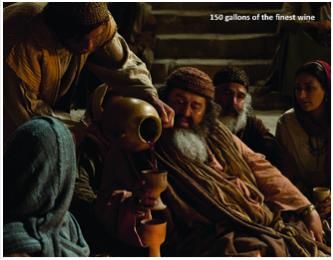
John 2:11 “What Jesus did here in Cana of Galilee was the first of the signs through which he revealed his glory, and his disciples believed in him.”
Between 120 and 180 gallons [150 gallons of new wine]
Wine Pro Club: approximately 25.4 [750 ml) per bottle. 133 oz per gallon
133 X 150 = 19,950 / 25.4 = 785 bottles
His Humanity
Normal birth and life of a baby
In the hurried pace of the 21st century, few read their bibles or even think about the birth and early life of Jesus Christ. As the Lord told Jeremiah, I knew you in the womb. And Jesus, like Jeremiah, was formed in the womb for the full gestation period and then was delivered like billions of mankind.
Luke 2:6-7 “While they were there, the time came for her [Mary] to give birth. 7 And she gave birth to her firstborn son; and she wrapped Him in cloths and laid Him in a manger [feeding trough] because there was no room for them in the inn.”
Jesus – Tired/Weary. God is omniscient, omnipresent, omnipotent, yet in a human body, he felt weary, tired.
John 4:5-6 “So He arrived at a Samaritan town called Sychar, near the tract of land that Jacob gave to his son Joseph; 6 and Jacob’s well was there. So, Jesus, tired as He was from His journey, sat down by the well. It was then about the sixth hour (noon).”
Matthew 8:23-26 “Then he got into the boat and his disciples followed him. 24 Suddenly a furious storm came up on the lake so that the waves swept over the boat. But Jesus was sleeping. 25 The disciples went and woke him, saying, “Lord, save us! We’re going to drown!” 26 He replied, “You of little faith, why are you so afraid?” Then he got up and rebuked the winds and the waves, and it was completely calm.”
He Cried/Wept
Two passages in the Gospels and one in the Epistles teach that Jesus wept. In the Gospels, our Lord wept as He looked on man’s misery, and both instances demonstrate our Lord’s (loving) human nature, His compassion for people, and the life He offers to those who believe. When Jesus wept, He showed all these things.
- Before continuing, I want to point out something for us to consider as we look into his humanity. As He experienced this life in a human body, Jesus can empathize with our pain, suffering, and frailties that we as humans suffer. He is not a savior who tells us to “suck it up,” “grow up,” or other dismissive platitudes.
Hebrews 11:7-8 “In the days of His humanity, He offered up both prayers and pleas with loud crying and tears to the One able to save Him from death, and He was heard because of His devout behavior. 8 Although He was a Son, He learned obedience from the things which He suffered.”
John 11:1–45 concerns the death and resurrection of Lazarus, the brother of Mary and Martha and a friend of our Lord.
Jesus wept (John 11:35) when He gathered with the sisters and others mourning Lazarus’s death. Jesus did not weep over the death itself since He knew Lazarus would soon be raised and ultimately spend eternity with Him in heaven. Yet He could not help but weep when confronted with the wailing and sobbing of Mary, Martha, and the other mourners (John 11:33). The original language indicates that our Lord wept “silent tears” or tears of compassion for His friends (Romans 12:15).
If Jesus had been present when Lazarus was dying, His compassion would have caused Him to heal His friend (John 11:14–15). But preventing a death might be considered by some to be a chance circumstance or just a “minor” miracle, and this was not a time for any doubt. So, Lazarus spent four days in death’s grave before Jesus publicly called him back to life. The Father wanted these witnesses to know that Jesus was the Son of God, that Jesus was sent by God, and that Jesus and the Father had the same will in everything (John 11:4, 40–42). Only the one true God could have performed such an awesome and breathtaking miracle, and through this miracle, the Father and the Son were glorified, and many believed (John 11:4, 45).
Luke 19:41–44 The Lord is taking His last trip to Jerusalem shortly before He was crucified at the insistence of His own people, the people He came to save. Earlier, the Lord had said, “O Jerusalem, Jerusalem, the city that kills the prophets and stones those sent to her! How often I wanted to gather your children together, just as a hen gathers her brood under her wings, and you would not have it” (Luke 13:34). As our Lord approached Jerusalem and thought of all those lost souls, “He saw the city and wept over it” (Luke 19:41). Here, wept is the same word used to describe the weeping of Mary and the others in John 11:33, so we know that Jesus cried aloud in anguish over the future of the city. That future was less than 40 years distant; in AD 70 more than 1,000,000 residents of Jerusalem died in one of the most gruesome sieges in recorded history.
Our Lord wept differently in these two instances because the eternal outcomes were entirely different. Martha, Mary, and Lazarus had eternal life because they believed in the Lord Jesus Christ, but most in Jerusalem did not believe and therefore did not have life. The same is true today: “Jesus said to her, ‘I am the resurrection and the life; he who believes in Me will live even if he dies” (John 11:25).
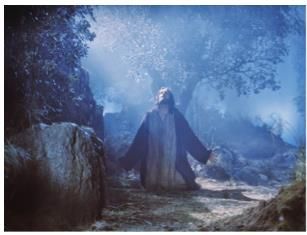
A man of sorrows (not fear):
Matthew 26:37-39 “And He took Peter and the two sons of Zebedee with Him and began to be grieved and distressed. 38 Then He said to them, “My soul is deeply grieved, to the point of death; remain here and keep watch with Me.” 39 And He went a little beyond them, and fell on His face and prayed, saying, “My Father, if it is possible, let this cup pass from Me; yet not as I will, but as You will.”
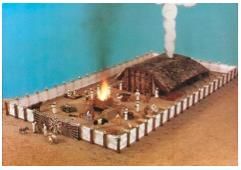
Tabernacle in the Wilderness
John 1:1-5 “In the beginning was the Word, and the Word was with God, and the Word was God. 2 The same was in the beginning with God. 3 All things were made by him, and without him was not anything made that was made. 4 In him was life, and the life was the light of men. 5 And the light shineth in darkness; and the darkness comprehended it not.”
14 “And the Word was made flesh, and dwelt among us, (and we beheld his glory, the glory as of the only begotten of the Father,) full of grace and truth.” [KJV]
John 1:1 “In the beginning [before all-time] was the Word (Christ), and the Word was with God, and the Word was God Himself.”
- Revelation 19:13, 16
- In John’s vision in Revelation, he sees Christ returning as Warrior-Messiah-King, and “the title by which He is called is The Word of God… and Lord of Lords.”
John 1:14 “And the Word (Christ) became flesh (human, incarnate) and tabernacled (fixed His tent of flesh, lived awhile) among us; and we [actually] saw His glory (His honor, His majesty), such glory as an only begotten son receives from his father, full of grace (favor, loving-kindness) and truth.”
- Dwelt/Dwell [G 4637]: To fix one’s tabernacle, have one’s tabernacle, abide (or live) in a tabernacle (or tent), tabernacle. God σκηνώσει ἐπ’ αὐτούς, will spread his tabernacle over them, so that they may dwell in safety and security under its cover and protection, Revelation 7:15.
Revelation 7:15 “Therefore are they before the throne of God and serve him day and night in his temple: and he that sits on the throne shall dwell [G 4637] among them.”
Different Use of dwelt:
- John 1:39 “He saith unto them, Come and see. They came and saw where he dwelt [G 3306 – abide, continue, and remain in position], and abode with him that day: for it was about the tenth hour.”
Blessings in Christ,
Joseph “Jim” Stockstill 
“National War Council” – Founder and Chairman
Jim5555@nationalwarcouncil.org
P.O. Box 931
Argyle, TX 76226
nwc@nationalwarcouncil.org
Jim5555@nationalwarcouncil.org
Donations to National War Council
“The two most important days in your life are the day you are born and the day you find out why.”
Mark Twain
0 Comments
Trackbacks/Pingbacks