

By Jim Stockstill
Arch of Baal: Gateway of Evil
Gateways of Evil: Forerunners of the Antichrist – Part two
Arch of Baal – Evil Throughout the Land
Part 2
June 9, 2022

The Doom of Babylon
Revelation 17:1-6 “1 Then one of the seven angels who had the seven bowls came and spoke with me, saying, “Come here, I will show you the judgment and doom of the great prostitute who is seated on many waters [influencing nations], 2 she with whom the kings of the earth have committed acts of immorality, and the inhabitants of the earth have become intoxicated with the wine of her immorality.” 3 And the angel carried me away in the Spirit into a wilderness; and I saw a woman sitting on a scarlet beast that was entirely covered with blasphemous names, having seven heads and ten horns. 4 The woman was dressed in purple and scarlet, and adorned with gold, precious stones, and pearls, and she was holding in her hand a gold cup full of the abominations and the filth of her [sexual] immorality. 5 And on her forehead, a name was written, a mystery: “BABYLON THE GREAT, THE MOTHER OF PROSTITUTES (false religions, heresies) AND OF THE ABOMINATIONS OF THE EARTH.” 6 I saw that the woman was drunk with the blood of the saints (God’s people), and with the blood of the witnesses of Jesus [who were martyred]. When I saw her, I wondered in amazement!”
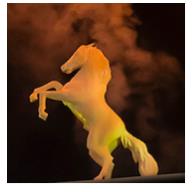
Evil on a White Horse
Revelation 6:1-2 “1 Then I saw as the Lamb broke open one of the seven seals, and as if in a voice of thunder I heard one of the four living creatures call out, Come! 2 And I looked, and saw there a white horse whose rider carried a bow. And a crown was given him, and he rode forth conquering and to conquer.”
Compared To:
Righteousness on a White Horse
Revelation 19:11-16 “11 After that, I saw heaven opened, and behold, a white horse [appeared]! The One Who was riding it is called Faithful (Trustworthy, Loyal, Incorruptible, Steady) and True, and He passes judgment and wages war in righteousness (holiness, justice, and uprightness). 12 His eyes [blaze] like a flame of fire, and on His head are many kingly crowns (diadems), and He has a title (name) inscribed which He alone knows or can understand. 13 He is dressed in a robe dyed by [a]dipping in blood, and the title by which He is called is The Word of God. 14 And the troops of heaven, clothed in fine linen, dazzling and clean, followed Him on white horses. 15 From His mouth goes forth a sharp sword with which He can smite (afflict, strike) the nations; and He will shepherd and control them with a staff (scepter, rod) of iron. He will tread the winepress of the fierceness of the wrath and indignation of God the All-Ruler (the Almighty, the Omnipotent). 16 And on His garment (robe) and His thigh He has a name (title) inscribed, king of kings and Lord of lords.”
Next Broadcast
- End-time spiritual land. We had briefly covered the Daughter of Babylon before; I will show in Scripture it is an end-time nation – the spiritual land of the Daughter.
An Apostate Generation
Matthew 24:3-15 “3 While He was seated on the Mount of Olives, the disciples came to Him privately and said, Tell us, when will this take place, and what will be the sign of Your coming and the end (the completion, the consummation) of the age? 4 Jesus answered them, Be careful that no one misleads you [deceiving you and leading you into error]. 5 For many will come in My name saying, I am the Christ (the Messiah), and they will lead many astray. 6 And you will hear of wars and rumors of wars; see that you are not frightened or troubled, for this must take place, but the end is not yet. 7 For nation will rise against nation, and kingdom against kingdom, and there will be famines and earthquakes in place after place; 8 All this is but the beginning [the early pains] of the birth pangs [of the intolerable anguish]. 9 Then they will hand you over to suffer affliction and tribulation and put you to death, and you will be hated by all nations for My name’s sake. 10 And then many will be offended and repelled and will begin to distrust and desert [Him – Jesus] and will stumble and fall away and betray one another and pursue one another with hatred. 11 And many false prophets will arise and deceive and lead many into error. 12 And the love of the great body of people will grow cold because of the multiplied lawlessness and iniquity, 13 But he who endures to the end will be saved. 14 And this good news of the kingdom (the Gospel) will be preached throughout the whole world as a testimony to all the nations, and then will come the end. [Age, Dispensation, last nation]”
- 15 “So when you see the appalling sacrilege [the abomination that astonishes and makes desolate], spoken of by the prophet Daniel, standing in the Holy Place—let the reader take notice and [g]ponder and consider and heed [this]“—
Jesus (the Messiah) identified four types of end-time signs before His return (see also Mark 13 and Luke 21):
- Signs in the world: wars, rumors of war, famines, earthquakes, and wild weather [beginning of birth pains]. Lawlessness will increase and the love of most will grow cold. Hatred will abound.
- Signs in the church: deliver you to tribunals [courts], persecution for your faith (belief system in Scripture), apostasy, false teachers will mislead many, signs and wonders so as to deceive the very elect. And finally, the gospel of the Kingdom will be proclaimed to the [uninhabited] nations.
- Signs in Israel: severe persecution of Jews, invasion, and the ultimate desecration: Abomination of Desolation in the Holy Place (Daniel).
- Signs in the heavens: fearful solar and cosmic disturbances, asteroids
Jesus stressed that it was important to watch for these signs as written:
Matthew 25:13 “Watch therefore [give strict attention and be cautious and active], for you know neither the day nor the hour when the Son of Man will come.”
After describing some end-time signs to anticipate, He finishes with a mysterious parable. Jesus associates the observation of the signs with the Parable of the Fig Tree. Why? It turns out that understanding the parable is the key to unlocking the mystery of what is currently happening on the world stage. A major Old Testament prophet foretold of a very important sign for the nations:
The Righteous Branch
Isaiah 11:1-5 “1 And there shall come forth a Shoot out of the stock of Jesse [David’s father], and a Branch out of his roots shall grow and bear fruit. 2 And the Spirit of the Lord shall rest upon Him—the Spirit of wisdom and understanding, the Spirit of counsel and might, the Spirit of knowledge and the reverential and obedient fear of the Lord— 3 And shall make Him of quick understanding, and His delight shall be in the reverential and obedient fear of the Lord. And He shall not judge by the sight of His eyes, neither decide by the hearing of His ears; 4 But with righteousness and justice shall He judge the poor and decide with fairness for the meek, the poor, and the downtrodden of the earth; and He shall smite the earth and the oppressor with the rod of His mouth, and with the breath of His lips He shall slay the wicked. 5 And righteousness shall be the girdle of His waist and faithfulness the girdle of His loins.”
The Prophet and the Fig Tree:
Luke 21:29-31 “29 And He told them a parable, Behold the fig tree and all the trees, 30 as soon as they put forth leaves, you see it and know for yourselves that summer is now near. 31 Even so you, too, when you see these things happening, recognize [know] that the Kingdom of God is near.”
The lesson of the Fig Tree:
Matthew 24:32-42 “32 From the fig tree learn this lesson: as soon as its young shoots become soft and tender and it puts out its leaves, you know of a surety that summer is near. 33 So also when you see these signs, you may know of a surety that He is near, at the very doors. 34 Truly I tell you, this generation (the whole multitude of people living at the same time, in a definite, given period) will not pass away till all these things take place. 35 Sky and earth will pass away, but My words will not pass away. 36 But of that [exact] day and hour no one knows, not even the angels of heaven, nor the Son, but only the Father. 37 As were the days of Noah, so will be the coming of the Son of Man. 38 For just as in those days before the flood they were eating and drinking, marrying and being given in marriage until the [very] day when Noah went into the ark, 39 And they did not know or understand until the flood came and swept them all away, so will be the coming of the Son of Man. 40 At that time two men will be in the field; one will be taken and one will be left. 41 Two women will be grinding at the hand mill; one will be taken, and one will be left. 42 Watch, therefore [give strict attention, be cautious and active], for you do not know in what hour [G 5610: a certain definite time or season, a twelfth part of the daytime, an hour] your Lord is coming.”
Summer [International Standard Bible]
- Summer [G 2330] (3 X’s): “to cut off,” “to pluck or gather fruit,” hence, the time of fruit, summer. The summer was the dry season extending from April to October when usually no rain falls. Hence, the drought of summer:
- Psalm 32:4 “For day and night Your hand [of displeasure] was heavy upon me; my moisture was turned into the drought of summer.”
First, we need to know that many varieties of fruit were ripe and used during the summer.
- 2 Samuel 16:1 “And when David was a little past the top of the hill, behold, Ziba the servant of Mephibosheth met him, with a couple of asses saddled, and upon them two hundred loaves of bread, and a hundred bunches of raisins, and a hundred of summer fruits, and a bottle of wine.”
- Jeremiah 40:10 “As for me, behold, I will dwell at Mizpah to serve the Chaldeans, which will come unto us: but ye, gather ye wine, and summer fruits, and oil, and put them in your vessels, and dwell in your cities that ye have taken.”
- Jeremiah 48:32 “O vine of Sibmah, I will weep for thee with the weeping of Jazer: thy plants are gone over the sea, they reach even to the sea of Jazer: the spoiler is fallen upon thy summer fruits and upon thy vintage.”
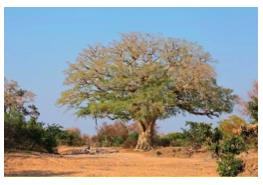
Brief on the Fig Tree
Israel is known as a land of fig trees
Deuteronomy 8:7-9 “For the Lord your God is bringing you into a good land, a land of brooks of water, of fountains and springs, flowing forth in valleys and hills; a land of wheat and barley, of vines and fig trees and pomegranates, a land of olive oil and honey; a land where you will eat food without scarcity, in which you will not lack anything; a land whose stones are iron, and out of whose hills you can dig copper.”
Bible verses about figs – learn more
The Mystery of Israel the Fig Tree
The approach of summer is indicated by shooting out of leaves on trees
Matthew 24:32-33 “32 Now learn this parable from the fig tree: When its branch has already become tender and puts forth its leaves, you know that summer is near. 33 So you also, when you see all these things, know that it is near – at the doors!”
Why did Jesus associate a fig tree with the end time signs? Some argue that Jesus was just using a simple horticultural observation. Quite simply – the fig tree is one of the last trees to bud in the spring and so when it’s leaves are budding we know that summer is just around the corner! So, they argue, Jesus was simply saying; “when the fig tree buds you know that summer is near – likewise, when you see all these things happening, know that the end is near.” They deny that there is any positive association of Israel with a budding fig tree. On the other hand, Jesus used the concept of a parable, implying that underneath He was teaching a deep truth. Was He referring to Israel in the last days? Should we view the Parable of the Fig Tree as The Parable of Israel the Fig Tree?
The Fig Tree
As Europeans began colonizing America, figs were brought along with them. In the United States, figs are probably most well-known as being a main ingredient in the popular “Fig-Newton” cookies. It is also not uncommon to see figs being sold dried, candied, or fresh in supermarkets throughout the world.
The common Ficus Carica [ker -a -ka] or edible fig is native to the Mediterranean/Israel region and is known for its thick leave foliage during the summer. The carica averages ten to fifteen feet in height and under the right conditions will start producing figs in the first three to five years.
There are four Hebrew words to refer to the different stages of growth of the Ficus carica:
- Song of Solomon 2:13 Pag
- Hosea 9:10 Bikkurah “first ripe or early fig”
- Jeremiah 9:10 Teenum – first as fruit
- 2 Kings 20:7 Debelah – a cake or dried figs
Green or “unripe figs”
Pag or Breba Figs
Song of Songs 2:13 “The fig tree forms its early fruit vines spread their fragrance. Arise, come, my darling; my beautiful one, come with me.”
In the spring, the Ficus tree often has figs before the leaves. If it has leaves – but no fruit, it is barren. The majority of green figs will fall to the ground with every gust of wind. They are known as “untimely figs” or “winter figs” which form on the branches from the previous year’s main fig crop production.
- Isaiah 34:4 “All the host of the heavens shall be dissolved and crumble away, and the skies shall be rolled together like a scroll, and all their host [the stars and the planets] shall drop like a faded leaf from the vine, and like a withered fig from the fig tree.”
- Jeremiah 29:17 “Thus says the Lord of hosts: Behold, I am sending on them the sword, famine, and pestilence, and I will make them like vile figs which are so bad they cannot be eaten.”
- Revelation 6:13 “And the stars of the sky dropped to the earth like a fig tree shedding its untimely fruit] out of season when shaken by a strong wind.”
- Untimely fig [G 3653] in the following manner: untimely fig (1x): an unripe fig that grows during the winter yet does not come to maturity but falls off in the spring.
Jesus and the fig tree:
- Mark 11:13-14 “13 And seeing in the distance a fig tree [covered] with leaves, He went to see if He could find any [fruit] on it [fruit appears on the fig tree at the same time as the leaves]. But when He came up to it, He found nothing but leaves, for the “time of figs” [season] had not yet come [ripen fruit]. 14 And He said to it, No one ever again shall eat fruit from you…”
Spiritual Depth/Implication
Luke 19:29 “When He came near Bethphage and Bethany at the mount called [the Mount of] Olives, He sent two of His disciples.” [donkey’s colt tied]
- Bethphage [G 967] (3 X’s); house of unripe fig [approximately 1 mile from Jerusalem]
Hosea 9:10 “I found Israel like grapes in the wilderness; I saw your fathers as the first ripe fruit on the fig tree in its first season, but they went to Baal-Peor and consecrated themselves to that shameful thing [Baal], and they became detestable and loathsome like that which they loved.”
Jeremiah 24:1-10 “1 After Nebuchadnezzar king of Babylon had taken into exile Jeconiah son of Jehoiakim king of Judah and the princes of Judah, with the craftsmen and smiths from Jerusalem, and had brought them to Babylon, the Lord showed me [in a vision] two baskets of figs set before the temple of the Lord. 2 One basket had very good figs, like the figs that are first ripe; but the other basket had very bad figs, so bad that they could not be eaten. 3 Then the Lord said to me, What do you see, Jeremiah? And I said, Figs—the good figs very good, and the bad very bad, so bad that they cannot be eaten. 4 Again the word of the Lord came to me, saying, 5 Thus says the Lord, the God of Israel: Like these good figs, so will I regard the captives of Judah whom I have sent out of this place into the land of the Chaldeans for their good. 6 For I will set My eyes upon them for good, and I will bring them again to this land, and I will build them up and not pull them down, and I will plant them and not pluck them up. 7 And I will give them a heart to know (recognize, understand, and be acquainted with) Me, that I am the Lord; and they will be My people, and I will be their God, for they will return to Me with their whole heart. 8 And as for the bad figs, which are so bad that they cannot be eaten, surely thus says the Lord, So will I give up Zedekiah king of Judah and his princes and the residue of Jerusalem who remains in this land and those who dwell in the land of Egypt. 9 I will even give them up to be a dismay and a horror and to be tossed to and fro among all the kingdoms of the earth for evil, to be a reproach, a byword or proverb, a taunt, and a curse in all places where I will drive them. 10 And I will send the sword, famine, and pestilence among them until they are consumed from off the land that I gave to them and their fathers.”
Again, as Fig horticulture identifies the first of the summer figs as being poor, unripe, and often inedible figs. The significant point here is that the Bible associates these qualities with the people of Israel. For instance, the ‘fathers of Israel’ or Patriarchs are seen as the best figs – the first-fruits of the summer crop:
God sees this minority of Israel as the first and best of the nation in contrast to the green, inedible figs. Both types of fig symbolize the people of Judah before their deportation to Babylon; they are seen as good and bad figs.
We read where Jesus approached the fig tree looking for “fruit” and found it to be barren or fruitless, He then cursed [judged] the tree [nation]. In the spiritual realm (remember He spoke a parable), Jesus was looking for the fruit of righteousness in the nation and its leaders (teachers of the law – Pharisees and Sadducees) but found only leaves. The curse therefore was a prophetic word that was later fulfilled when Israel was scattered by the Romans in 70 AD.
- The Jewish Wars began in 66 A.D., and they were a direct revolt by the Jews against Rome’s authority. General Titus of Rome replaced Vespasian, a decorated general, who was sent to initially quell the Judean rebellion. The legions of Rome arrived at the outermost northern Wall of Jerusalem, on Passover of 70 A.D. and with famine through the city and machines of war [embankments of dirt and battering rams], the soldiers killed one million jews and took 95,000 prisoners.
Compared to His judgement of those in 1st century Israel, two thousand years later, the Lesson of the Fig Tree is clear. The consequences of a “barren tree” or “bad figs” [rebellion, defiance, immorality, and lawlessness] will be severe and without mercy.
Jeremiah 8:13 “I will gather and sweep them away, utterly consuming them, says the Lord. [I will find] no grapes on the vine, nor figs on the fig tree, and even the leaf is withered; and the things that I have given them shall pass away from them [for I have appointed to them those who shall pass over them].”
Hosea 9:10, 16 “10 I found Israel like grapes in the wilderness; I saw your fathers as the first ripe fruit on the fig tree in its first season, but they went to Baal-Peor and consecrated themselves to that shameful thing [Baal], and they became detestable and loathsome like that which they loved. 16 “Ephraim is smitten, their root is dried up, they shall bear no fruit. Yes, though they bring forth, yet will I slay even their beloved children.”
Micah 7:1-9 “1 Woe is me! For I am as when the summer fruits have been gathered, as when the vintage grapes have been gleaned and there is no cluster to eat, no first-ripe fig for which my appetite craves. 2 The godly man has perished from the earth, and there is none upright among men. They all lie in wait for blood; each hunts his brother with a net. 3 Both their hands are put forth and are upon what is evil to do it diligently; the prince and the judge ask for a bribe, and the great man utters his evil desire. Thus they twist between them [the course of justice]. 4 The best of them is like a brier; the most upright or the straightest is like a thorn hedge. The day of your watchmen, even of [God’s] judgment and your punishment, has come; now shall be their perplexity and confusion. 5 Trust not in a neighbor; put no confidence in a friend. Keep the doors of your mouth from her who lies in your bosom. 6 For the son dishonors the father, the daughter rises up against her mother, the daughter-in-law against her mother-in-law—a man’s enemies are the men (members) of his own house. 7 But as for me, I will look to the Lord and confident in Him I will keep watch; I will wait with hope and expectancy for the God of my salvation; my God will hear me. 8 Rejoice not against me, O my enemy! When I fall, I shall arise; when I sit in darkness, the Lord shall be a light to me. 9 I will bear the indignation of the Lord because I have sinned against Him, until He pleads my cause and executes judgment for me. He will bring me forth to the light, and I shall behold His righteous deliverance.”
Luke 13:6-9 “6 A man had a fig tree, planted in his vineyard, and he went to look for fruit on it, but did not find any. 7 So he said to the man who took care of the vineyard, “For three years now I’ve been coming to look for fruit on this fig tree and haven’t found any. Cut it down! Why should it use up the soil?” 8 “Sir,” the man replied, “leave it alone for one more year, and I’ll dig around it and fertilize it. 9 If it bears fruit next year, fine! If not, then cut it down.”
The common or edible fig (Ficus carica L.) is native to the Mediterranean/Israel region, where it can produce three crops per year. The first, Breba figs develop in the Spring (May) on the previous year’s shoot growth and are generally inferior to the main crop. The Breba are often discarded to encourage the growth of the main crop. Two main crops follow in July through November with pollinated (caprified) [A method of assuring pollination of various edible figs in which groups of pollen-bearing caprifigs are hung from trees of edible figs of the same species, allowing the fig wasp Blastophaga psenes to carry pollen from the caprifigs to the female flowers of the edible varieties] figs in August and September. Pollination (caprification) of the common fig can distinctly increase fig size and is done by fig wasps transporting pollen from Capri fig flowers. In contrast to most fruit trees, the Autumn figs (the main crop) develop on the new wood that grows in Spring. (Source)
Ficus Carica was cultivated for its fruit thousands of years ago and figs are often referred to in the Old Testament. Scripture refers to three crops of figs:
Early, first ripe, first fruit before the summer is very good figs. These are relatively small crops with the best flavor, June-July.
- 2022/5782 (June 5th Sunday) Pentecost (“the fiftieth day”) is a Christian holiday commemorating the descent of the Holy Spirit upon the Apostles on the fiftieth day after the resurrection of Jesus Christ. The Apostles began to speak in many languages and received other spiritual gifts. The event was foretold by Jesus before his Ascension.
In Christian tradition Pentecost is a moveable feast observed exactly seven weeks after Easter Day, i.e. 50 days after Easter (inclusive, 49 + Easter). It always falls on the seventh Sunday after Easter Day. In Eastern churches, the date of Pentecost is calculated in the same manner but it usually differs due to the use of the Julian calendar instead of the Gregorian.
Isaiah 28:4 “And the fading flower of its glorious beauty, which is on the head of the rich valley, will be like the early [Hasty fruit in KJV] fig before the fruit harvest, which, when anyone sees it, he snatches and eats it up greedily at once.” [So in an amazingly short time will the Assyrians devour Samaria, Israel’s capital.]
- Hasty [H 1061] (1 X): bread made from new grain offered at Pentecost, the first fruit of Pentecost, and ripened fruit was gathered and offered to Jehovah according to the Torah.
Jeremiah 24:2-3 “2 One basket had very good figs, like the figs that are first ripe; but the other basket had very bad figs, so bad that they could not be eaten. 3 Then the Lord said to me, What do you see, Jeremiah? And I said, Figs—the good figs very good, and the bad very bad, so bad that they cannot be eaten.”
Hosea 9:10 “I found Israel like grapes in the wilderness; I saw your fathers as the first ripe fruit on the fig tree in its first season, but they went to Baal-Peor and consecrated themselves to that shameful thing [Baal], and they became detestable and loathsome like that which they loved.”
Sweetness and good fruit, the season for figs and the main crop, August-September.
Cakes during the winter:
- 1 Samuel 25:18 “Then Abigail made haste and took 200 loaves, two skins of wine, five sheep already dressed, five measures of parched grain, 100 clusters of raisins, and 200 cakes of figs, and laid them on donkeys.”
Judges 9:7-11 “7 When it was told to Jotham, he went and stood at the top of Mount Gerizim and shouted to them, Hear me, men of Shechem, that God may hear you. 8 One time the trees went forth to anoint a king over them, and they said to the olive tree, Reign over us. 9 But the olive tree said to them, Should I leave my fatness, by which God and man are honored, and go to wave over the trees? 10 Then the trees said to the fig tree, You come and reign over us. 11 But the fig tree said to them, Should I leave my sweetness and my good fruit and go to wave over the trees?”
Mark 11:13 “And seeing in the distance a fig tree [covered] with leaves, He went to see if He could find any [fruit] on it [for in the fig tree the fruit appears at the same time as the leaves]. But when He came up to it, He found nothing but leaves, for the fig season had not yet come.”
Green, or bad winter figs which are unripened, unsweetened, and inedible.
Song of Solomon 2:10-13 “10 My beloved speaks and says to me, rise, my love, my fair one, and come away. 11 For, behold, the winter is past; the rain is over and gone. 12 The flowers appear on the earth; the time of the singing [of birds] has come, and the voice of the turtledove is heard in our land. 13 The fig tree puts forth and ripens her green figs, and the vines are in blossom and give forth their fragrance. Arise, my love, my fair one, and come away.”
Jeremiah 24:2 “One basket had very good figs, like the figs that are first ripe; but the other basket had very bad figs, so bad that they could not be eaten.”
Fig trees, or Ficus carica plants, are in season during the summer months from June through September. The fruit ripens around July or August. In general, fruits ripen in response to warmer temperatures so an ideal time for harvesting would be mid-summer when the temperature is at its peak or near its peak.
Spiritual Implication: the End-Time Budding of Israel
Israel the fig tree
Fig horticulture identifies good sweet figs, the first of the summer figs, and poor, unripe and often inedible figs. The significant point here is that the Bible associates these qualities with the people of Israel. For instance, the ‘fathers of Israel’ or Patriarchs are seen as the best figs – the first-fruits of the summer crop:
I found Israel .. your fathers as the first fruits on the fig tree (Hos 9.10)
God sees this minority of Israel as the first and best of the nation. These figs contrast with the green, inedible figs. Both types of fig symbolize the people of Judah before their deportation to Babylon; they are seen as good and bad figs:
The LORD said to me ‘What do you see, Jeremiah?’ And I said, ‘Figs, the good figs, very good, and the bad, very bad (Jer 24.3)
Israel the fig tree
Jeremiah 24:5-8 shows that God is referring to those Jews who are whole-hearted followers of God (the good figs), and to those rebellious Jews who had rejected God (the bad figs). Likewise, in the time of Christ, most Jews rejected Him and remained dead in their works and legalism. They were like green, unripened, unsweetened figs. Today, most Jews can be seen as green figs, whilst a few (the messianic Jews) are like sweetened ripe figs.
The consequences of rebellion against God is well illustrated in the incidence of the ‘Withered fig tree’ (Mat 21.18,19). Jesus found no fruit (apparently, not even the unripe breba crop), and so He cursed it and it died. This was prophetic, looking to the destiny of the Jews when they were to be scattered by the Romans in 70 AD. Like the cursed fig tree, the nation of Israel seemingly died. In contrast, Jesus gave an extremely important prophecy that applies to our time. To repeat:
Matthew 24:32-33 “32 Now learn this parable from the fig tree: When its branch has already become tender and puts forth its leaves, you know that summer is near. 33 So you also, when you see all these things, know that it is near – at the doors!”
Luke 21:29-31 “29 Look at the fig tree, and all the trees. 30 When they are already budding you see and know for yourselves that summer is now near. 31 So you also, when you see these things happening, know that the kingdom is near.”
Note that Jesus refers to the tender branch, implying new wood and the coming good summer fruit on the new wood. Since the fruit of the fig tree is established in the Old Testament as symbolizing the spiritual state of the people of Israel, many see this coming ‘summer crop’ as the restoration of the people of Israel (generically referred to as ‘Jews’) to their own land. The fruitless dead wood of scattered Israel is replaced by fruit on new wood. It is likened to a people drawn back into their own land and a nation that becomes a sign to the Gentiles. A remnant of this people become ‘the good, sweet crop’. This process has been underway now for over 100 years.
So when we refer to ‘Israel the fig tree’ we see both Old Testament Israel, and modern re-gathered or ‘budding’ Israel. The ‘good crop’ could include the 144,000 Messianic Jews drawn from the twelve tribes of Israel who will evangelize the gentile nations at the very end of this age (Rev 7.4-8). The result is the salvation of a countless number of Gentiles during the Great Tribulation:
I looked and saw a great multitude … of all the nations … clothed with white robes … these are the one’s who come out of the great tribulation (Rev 7.9,14).
The Message behind the Parable:
Regathered Israel is a Sign to the Nations
It seems that when Jesus spoke of the appearance of new shoots on the fig tree as signalling that summer is near, He was actually alluding to the restoration of Israel and His imminent return. He was saying that when we see Israel regathered in her own land and ‘budding like a fig tree’ then His return is near – even ‘at the doors.’ This will be the time of the coming of the fullness of the Kingdom of God on earth.
Israel and the Timeline for the Last Days
In Luke 21 Jesus said ‘look at the fig tree (Israel) and ‘all the trees’ (the Gentile nations) and so observe the signs of the times. He implied that Israel will be the vortex of the nations. So let’s now apply the parable of Israel the fig tree to the observed world scenario and ask the question, ‘When did the fig tree (Israel) start to bud?’ ‘When did Israel emerge onto the world scene?’ When we trace a timeline of world events from this time we find that many issues of today are closely linked to Israel! We see that Israel is increasingly the vortex of the world.
Yeshua went to a fig tree looking for food to eat (Matthew 21:18-22; Mark 11:12-14, 20-21). When he saw that there were no figs on the tree he cursed it. The problem with this story is that it wasn’t the season for figs according to Mark 11:13.
So it was evident to Yeshua, when He turned aside to see if there were any of these taqsh on the fig-tree to satisfy His hunger, and the absence of the taqsh meant that also there would be no figs when the time of figs should come.
What I have learned is that at the Passover season in late March or early April, fig trees are often in leaf on the eastern side of the Mount of Olives. At this time of year, such fig trees contained only green early figs. The early unripe fruit begins to show itself even before the spring leaves appear on the branches and before Passover. If there is no early green figs there will be no figs later.
It is more prophetic than just the identifying of Israel with the fig tree, it has more to do with the spiritual fruit Yeshua is expecting when the time of the spiritual harvest comes.
“The time of the fig is not yet,’ says Mark, for it was just before Passover, about six weeks before the fully-formed fig appears. The fact that Mark adds these words shows that he knew what he was talking about. When the fig leaves appear about the end of March, they are accompanied by a crop of small knobs, called taqsh by the Arabs, a sort of fore-runner of the real figs. These taqsh are eaten by peasants and others when hungry. They drop off before the real fig is formed. But if the leaves appear unaccompanied by taqsh, there will be no figs that year. So it was evident to our Lord, when He turned aside to see if there were any of these taqsh on the fig-tree to assuage His hunger for the time being, that the absence of the taqsh meant that there would be no figs when the time of figs came. For all its fair foliage, it was a fruitless and a hopeless tree.”
“Bruce, Are The New Testament Documents Reliable?” [Intervarsity Press; Downers Grove, Ill, fifth revised edition 1992], pp. 73-74
In the words of Messianic scholar David Stern:
“… If Yeshua’s cursing and drying up the fig tree had been a petulant reaction to disappointment because he couldn’t satisfy his hunger, it would be unworthy of anyone, let alone the Messiah. But Yeshua is making a point by means of prophetic drama, acted-out parable (possibly Lk 13:6-9). Tanakh examples include Yirmiyahu, who bought and broke a clay bottle (Jeremiah 19), and Yechezk’el, who made and then burned up a model of Jerusalem (Ezekiel 4-5); for a later New Testament instance see Ac 21:10-11.
Even out of season a fig tree in leaf – it must have been in leaf to be seen in the distance (v. 12) – holds forth the promise of fruit. The normal early season for figs in Israel is June, but the early unripe fruit (Song of Songs 2:13) begins to show itself even before the spring leaves appear on the branches, often before Passover.
End of Days: The Spirit Land of Babylon
Jeremiah 50:11-12 “11 The word that the Lord spake against Babylon and the land of the Chaldeans by Jeremiah the prophet. 12 Your mother shall be sore confounded; she that bare you shall be ashamed: behold, the hindermost of the nations shall be a wilderness, a dry land, and a desert.”
- Hindermost [H 319]: end, the latter time (prophetic for a future time), the last [of the nations].
Genesis 49:1 “And Jacob called for his sons and said, Gather yourselves together [around me], that I may tell you what shall befall you in the latter or last days.”
- Last Days [H 0319]: end, the latter time (prophetic for a future time), the last
Scriptures in Jeremiah 50:12 and Genesis 49:1: interpret as the “last of nations.”
Daughter of Babylon
Isaiah 47:1, 5: “1 Come down, and sit in the dust, O Virgin Daughter of Babylon; sit on the ground [in abject humiliation]; there is no throne for you, O Daughter of the Chaldeans, for you shall no longer be called dainty and delicate. 5 Sit in silence and go into darkness, O Daughter of the Chaldeans; for you shall no more be called the lady and mistress of kingdoms.”
- Chaldeans [H 3778]: “Clod-breakers”, living on the lower Euphrates and Tigris, especially people ruled by Nebuchadnezzar.
Babylon is taken
Jeremiah 50:2-3 “2 Declare ye among the nations, and publish, and set up a standard; publish, and conceal not: say, Babylon is taken, Bel is confounded, Merodach is broken in pieces; her idols are confounded, her images are broken in pieces. 3 For out of the north there cometh up a nation against her, which shall make her land desolate, and none shall dwell therein: they shall remove, they shall depart, both man and beast.”
- Merodach [H 4781] (1 X): Rebellion, chief diety of Babylon
Remember
- Nimrod [H 5248] (4 X’s): Rebellion
Vengeance of the Lord
Jeremiah 50:15-16 “15 Raise the battle cry against her round about! She gives her hand [in agreement] and surrenders; her supports and battlements fall, and her walls are thrown down. For this is the vengeance of the Lord: take vengeance on her; as she has done [to others], do to her. 16 Exterminate the sower from Babylon and the one who handles the sickle in the time of harvest. For fear of the sword of the oppressor, everyone shall return to his people, and everyone shall flee to his own land.”
Jeremiah 50:42 “They lay hold of bow, lance, and spear; they are cruel and have no mercy or compassion. They sound like the roaring of the sea; they ride upon horses, every man equipped like a man [ready] for the battle against you, O Daughter of Babylon.”
Rabbinic and Scriptural Principle:
- Termed the “Golden Rule” by some.
- Matthew 7:12 “So then, whatever you desire that others would do to and for you, even so, do also to and for them, for this is (sums up) the Law and the Prophets.”
- Galatians 6:7 “Do not be deceived and deluded and misled; God will not allow Himself to be sneered at (scorned, disdained, or mocked), for whatever a man sows, that and that only is what he will reap.”
- Numbers 24:9 “He couched, he lay down as a lion; and as a lioness, who shall rouse him? Blessed [of God] is he who blesses you [who prays for and contributes to your welfare] and cursed [of God] is he who curses you [who in word, thought, or deed would bring harm upon you].”
- Genesis 49:9 “Judah, a lion’s cub! With the prey, my son, you have gone high up [the mountain]. He stooped down, he crouched like a lion, and like a lioness. Who dares provoke and rouse him?”
- Genesis 12:3 “And I will bless those who bless you [who confer prosperity or happiness upon you] and curse him who curses or uses insolent language toward you; in you will all the families and kindred of the earth be blessed.”
- Psalm 122:6 “Pray for the peace of Jerusalem! May they prosper who love you [the Holy City].”
As a leader and/or nation treat Israel, so will they be treated by their protector – Jehovah Sabaoth (Lord of the Host Armies of Heaven). To appease Hamas (Palestinians), as the list details of U.S. Presidents, leading the efforts to divide Jerusalem will (and has) brought a curse on the individual and/or nation.
Isaiah 50:4-11
“4 In those days, and in that time, saith the LORD, the children of Israel shall come, they and the children of Judah together, going and weeping: they shall go, and seek the LORD their God. 5 They shall ask the way to Zion with their faces toward her, saying, Come, and let us join ourselves to the LORD in a perpetual covenant that shall not be forgotten. 6 My people hath been lost sheep: their shepherds have caused them to go astray, they have turned them away on the mountains: they have gone from mountain to hill, they have forgotten their resting-place. 7 All that found them have devoured them: and their adversaries said, We offend not, because they have sinned against the LORD, the habitation of justice, even the LORD, the hope of their fathers. 8 Remove out of the midst of Babylon, and go forth out of the land of the Chaldeans, and be as he-goats before the flocks. 9 For, lo, I will raise and cause to come up against Babylon an assembly of great nations from the north country: and they shall set themselves in array against her; from thence she shall be taken: their arrows shall be as of a mighty expert man; none shall return in vain. 10 And Chaldea shall be a spoil: all that spoil her shall be satisfied, saith the LORD. 11 Because ye were glad because ye rejoiced, O ye destroyers of mine heritage, because ye are grown fat as the heifer at grass, and bellow as bulls;”
Jeremiah 51:1 raise up against her a destroying wind
Jeremiah 51:11 the vengeance of the Lord
Jeremiah 51:33 Lord of Host, God of Israel daughter of Babylon
Isaiah 14:4 term for the Kingdom of Darkness
Isaiah 14:12 did weaken the nations
End of first segment
Nahum 3:4 Because of the multitude H7230 of the whoredoms H2183 of the well favoured H2896 H2580 harlot, H2181 the mistress H1172 of witchcrafts, H3785 that selleth H4376 nations H1471 through her whoredoms, H2183 and families H4940 through her witchcrafts. H3785
STRONGS H1172:
Abbreviations† I. [בַּעֲלָה] noun feminine
- mistress, בַּעֲלַת הַבַּיִת mistress of the house 1 Kings 17:17.
- relative noun אוב ב׳ necromancer 1 Samuel 28:7 (twice in verse); כשׁפים ב׳ sorceress, Nahum 3:4.
Spiritual Characteristics of the Babylon System
Described as a whore
Isaiah 47:1 and 3 uncovered nakedness is associated with sexual immorality
Genesis 9:21
Leviticus 20:17 his sister’s nakedness
Revelation 17:1 a great whore
Revelation 17:5 mother of harlots
Associated with being the glory of Kingdoms
Isaiah 13:1
Isaiah 13:19 the glory of kingdoms
Associated with be the Lady of Kingdoms
Isaiah 47:1, 5 the lady of kingdoms
Babylon does not think it will be destroyed
Isaiah 47:7 and you “said” I shall be a lady forever
Isaiah 47:8 I AM and there is none beside me, I shall not be a widow or loss of children
Babylon does not believe she will be judged (experience judgement)
Revelation 18:2 and 7 – I sit as a queen and shall see no sorrow
Babylon is associated with a land of pleasures
Isaiah 47:1, 8 you who are given to pleasures
Babylon is associated with deceit
Isaiah 21:2,3 and 9
Treacherously (H 898) to act treacherously deceitfully
Babylon trust in her wickedness and thinks no one sees – does what she does and get away with it
Isaiah 47:1, 10
Babylon is associated with idols and graven images
Isaiah 21:9
Jeremiah 50:2 and 38
Babylon is associated with witchcraft and sorceries
Isaiah 47:1, 9
Sorceries will not be able to save her
Isaiah 47:1, 12, 13, 15
Babylon means confusion by mixing Good and evil
Genesis 11:5, 8, 9 Babel (894), confounded (1101)
Hosea 7:8 mixed (1101) among the people
Isaiah 47:6 God’s people are in bondage – task masters [beginning of teaching]
Jeremiah 50: 1, 33 God’s people oppressed, took captive
Isaiah 14:4 – oppressor (5065) in Babylon
I Samuel 14:24 distressed (5065)
Exodus 3:7 5065 – translated as taskmaster – will occur in Babylon (oppression and distress) spiritually how God sees it.
NOTE: G numbers listed below refer to Strong’s Greek Lexicon: example – G1722
1Pe 5:13 –
The church that is at G1722 Babylon, G897 elected together with G4899 you, salute G782 you; G5209 and G2532 so doth Marcus G3138 my G3450 son. G5207
Rev 14:8 –
And G2532 there followed G190 another G243 angel, G32 saying, G3004 Babylon G897 is fallen, G4098 is fallen, G4098 that great G3173 city, G4172 because G3754 she made G4222 ➔ all G3956 nations G1484 drink G4222 of G1537 the wine G3631 of the wrath G2372 of her G846 fornication. G4202
Rev 16:19 –
And G2532 the great G3173 city G4172 was divided G1096 into G1519 three G5140 parts, G3313 and G2532 the cities G4172 of the nations G1484 fell: G4098 and G2532 great G3173 Babylon G897 came in remembrance G3415 before G1799 God, G2316 to give G1325 unto her G846 the cup G4221 of the wine G3631 of the fierceness G2372 of his G846 wrath. G3709
Rev 17:5 –
And G2532 upon G1909 her G846 forehead G3359 was a name G3686 written, G1125 MYSTERY, G3466 BABYLON G897 THE GREAT, G3173 THE MOTHER G3384 OF HARLOTS G4204 AND G2532 ABOMINATIONS G946 OF THE EARTH. G1093
Rev 18:2 –
And G2532 he cried G2896 mightily G2479 with G1722 a strong G3173 voice, G5456 saying, G3004 Babylon G897 the great G3173 is fallen, G4098 is fallen, G4098 and G2532 is become G1096 the habitation G2732 of devils, G1142 and G2532 the hold G5438 of every G3956 foul G169 spirit, G4151 and G2532 a cage G5438 of every G3956 unclean G169 and G2532 hateful G3404 bird. G3732
Rev 18:10 –
Standing G2476 afar G3113 off G575 for G1223 the fear G5401 of her G846 torment, G929 saying, G3004 Alas, G3759 alas, G3759 that great G3173 city G4172 Babylon, G897 that mighty G2478 city! G4172 for G3754 in G1722 one G3391 hour G5610 is G2064 ➔ thy G4675 judgment G2920 come. G2064
Rev 18:21 –
And G2532 a G1520 mighty G2478 angel G32 took up G142 a stone G3037 like G5613 a great G3173 millstone, G3458 and G2532 cast G906 it into G1519 the sea, G2281 saying, G3004 Thus G3779 with violence G3731 shall G906 ➔ that great G3173 city G4172 Babylon G897 be thrown down, G906 and G2532 shall be found G2147 no more G3364 at all. G2089
Isaiah 9:8-21
Amplified Bible, Classic Edition
“8 The Lord has sent a word against Jacob [the ten tribes], and it has lighted upon Israel [the ten tribes, the kingdom of Ephraim].
9 And all the people shall know it—even Ephraim and the inhabitants of Samaria [its capital]—who said in pride and stoutness of heart,
10 The bricks have fallen, but we will build [all the better] with hewn stones; the sycamores have been cut down, but we will put [costlier] cedars in their place.
11 Therefore the Lord has stirred up the adversaries [the Assyrians] of Rezin [king of Syria] against [Ephraim], and He will stir up their enemies and arm and join them together,
12 The Syrians [compelled to fight with their enemies, going] before [on the east] and the Philistines behind [on the west]; and they will devour Israel with open mouth. For all this, [God’s] anger is not [then] turned away, but His hand is still stretched out [in judgment].
13 Yet the people turn not to Him Who smote them, neither do they seek [inquire for or require as their vital need] the Lord of hosts.
14 Therefore the Lord will cut off from Israel head and tail [the highest and the lowest]—[high] palm branch and [low] rush in one day;
15 The elderly and honored man, he is the head; and the prophet who teaches lies, he is the tail.
16 For they who lead this people cause them to err, and they who are led [astray] by them are swallowed up (destroyed).
17 Therefore the Lord will not rejoice over their young men, neither will He have compassion on their fatherless and widows, for everyone is profane and an evildoer, and every mouth speaks folly. For all this, [God’s] anger is not turned away, but His hand is still stretched out [in judgment].
18 For wickedness burns like a fire; it devours the briers and thorns, and it kindles in the thickets of the forest; they roll upward in a column of smoke.
19 Through the wrath of the Lord of hosts the land is darkened and burned up, and the people are like fuel for the fire; no man spares his brother.
20 They snatch in discord on the right hand, but are still hungry [their cruelty not diminished]; and they devour and destroy on the left hand, but are not satisfied. Each devours and destroys his own flesh [and blood] or his neighbor’s.
21 Manasseh [thirsts for the blood of his brother] Ephraim, and Ephraim [for that of] Manasseh; but together they are against Judah. For all this, [God’s] anger is not turned away, but His hand is still stretched out [in judgment].”
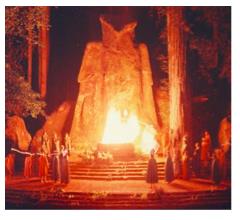
The Bohemian Club, founded in 1872, is a private men’s only club in the giant redwood forest 75 miles north of San Francisco. Membership is secret and compromised by many prominent U.S. and global leaders. These include U.S. presidents (usually before they are elected to office), many cabinet officials, military leaders, and CEOs of large corporations, including major financial institutions. Major military contractors, oil companies, banks (including the Federal Reserve), utilities, and national media also have high-ranking officials as club members or guests.
Every year the club hosts an annual two-week camp at Bohemian Grove which is notable for its illustrious guest list and its vile Cremation of Care ceremony involving a mock human sacrifice at the feet of a forty-foot owl.
The primary activities taking place at the Grove are varied and expensive entertainment, such as an elaborate Grove Play (known as “High Jinx”) and musical comedies (“Low Jinx”) where female roles are played by men in drag produced by the members and associate members of the Club.
The ceremony takes place next to a towering concrete owl statue. During the ceremony, audio plays through nearby speakers providing the illusion of a speaking statue. The voice of the former-newsman Walter Cronkite, a member of the Bohemian Club, is used as the voice of “The Owl” during the ceremony.
Other Bohemian members and guests include George P. Shultz, Gerald R. Ford, Henry Kissinger, William F. Buckley, Jr., Merv Griffin, Joseph Coors, Edward Teller, Ronald Reagan, George Bush, Casper W. Weinberger, Colin Powell, Newt Gingrich, Frank Popoff, Danny Glover, Alexander Haig, Chuck Yeager, Donald Rumsfeld, TV personality Chris Matthews, gay porn star Chad Savage, Charlton Heston, Jack London, Art Linkletter, Jimmy Carter, Dwight Eisenhower, and hundreds of other prominent politicos, businessmen, military leaders, and foreign heads of state and dignitaries.
These strange pagan two-week rituals of mock human sacrifice and gross immorality are conducted by high-level elitists who are barons of governments, politics, military, industry, and media. Interestingly, many of these movers and shakers are also members of the Mormon church, other institutions of Religion, Freemasons, Skull and Bones, and similar ghastly and secret fraternities.
Is not the spiritual attitude of the leaders of the western world also accepted and in concert with the rest of society? Have you seen or witnessed any major Christian denomination speak out against such rank heathenism practiced by the very men they support and elect to lead our nations? Does not “the Church” overwhelmingly support and elect candidates who are members of such secret fraternities founded upon rank heathenism. If I were to share my vision (two) and the lists of members, you would be shocked.
Judge for yourselves. Is it immoral and sinful for the leaders of our banks, news media, entertainment, industry, military, and government; foreign heads of state; and our Presidents to participate in heathen practices as “sanctifying themselves and purifying themselves in the gardens behind a tree in the midst?”
Sacrificing a human being in effigy to a towering statue of an Owl? We will replace the sycamores with stronger cedars of Lebanon.
As quoted in Isiah, man’s (humankind) defiance of God is like Nimrod (Rebellion) and Merodach [H 4781] (1 X): (Rebellion), chief deity of Babylon.
Addendum: The Vatican Document
The following is a paragraph from an official document signed on February 14, 2019.
“The firm conviction that authentic teachings of religions invite us to remain rooted in the values of peace; to defend the values of mutual understanding, human fraternity, and harmonious coexistence; to re-establish wisdom, justice, and love; and to reawaken religious awareness among young people so that future generations may be protected from the realm of materialistic thinking and from dangerous policies of unbridled greed and indifference that are based on the law of force and not on the force of law.” From the Vatican’s “Universal Peace” document.
- 1 Thessalonians 5:3 “For when they shall say, Peace and safety; then sudden destruction cometh upon them, as travail upon a woman with child; and they shall not escape.” [KJV]
If you have studied any prophecy at all related to the upcoming time of Jacob’s trouble, spent any time at all in either Daniel 9 or Matthew 24, then you know exactly what type of language that is. That is the end times language of the Antichrist and his coming false peace. This pathetic ‘peace covenant’ between the Vatican and Islam is a nice little appetizer to the main course of the coming prophesied false peace that the Antichrist will broker between Israel and the Palestinians. Count on it.
“This Document, in accordance with previous International Documents that have emphasized the importance of the role of religions in the construction of world peace”
Back in 2015, when Pope Francis addressed the United Nations, he said a very unusual thing. Speaking to the General Assembly, the Catholic leader said that he had come “in my own name” to speak with them. Not being Catholic, I understand it is taught that the “holy father” is the “Vicar of Christ,” and is the representative of Jesus Christ on the earth. The Bible tells us, of course, that the pope is no such thing, but the Catholic Church says that he is, right. So why on Earth did he not say that he had come ‘in the Name of Jesus of Nazareth’?
John 5:42-43 “42 But I know you and recognize and understand that you have not the love of God in you. 43 I have come in My Father’s name and with His power, and you do not receive Me [your hearts are not open to Me, you give Me no welcome]; but if another comes in his own name and his own power and with no other authority but himself, you will receive him and give him your approval.”
Let us look at what transpired in February 2019. Pope Francis signs a ‘peace covenant‘ with the leader of Sunni Islam, Sheikh Ahmed al-Tayeb. Not only does this document make multiple references to assembling all the world’s religions, but it also references God in only a generic sense. There are no Bible verses quoted or referred to, no connection between the word ‘god’ and Abraham, Moses, or any of the other Bible patriarchs. Why would the Catholic Church, which claims to be the ‘true church’ only refer to God generically? Simple. Because the document does not invoke or refer to the God of Abraham, Issac and Jacob found in the Holy Bible, it refers to the generic ‘god’ of Islam, otherwise known as Allah. Which is to say no God at all.
One World Religion: Pope Francis Signs Historic Covenant With Islam
Sheikh Ahmed al-Tayeb is considered to be the most important imam in Sunni Islam, and he arrived at the signing ceremony in Abu Dhabi with Pope Francis “hand-in-hand in a symbol of interfaith brotherhood.” But this wasn’t just a ceremony for Catholics and Muslims. According to a British news source, the signing of this covenant was done “in front of a global audience of religious leaders from Christianity, Islam, Judaism, and other faiths”…
- “The pope and the grand imam of al-Azhar have signed a historic declaration of fraternity, calling for peace between nations, religions, and races, in front of a global audience of religious leaders from Christianity, Islam, Judaism, and other faiths.”
Their appearance was a concerted effort to make sure that all of the religions of the world were represented at this gathering.
According to the official Vatican website, a tremendous amount of preparation went into the drafting of this document, and it encourages believers from all religions “to shake hands, embrace one another, kiss one another, and even pray” with one another.”
- Ephesians 5:6-14 “6 Do not let anyone fool you by telling you things that are not true, because these things will bring God’s anger on those who do not obey him. 7 So have nothing to do with them. 8 In the past you were full of darkness, but now you are full of light in the Lord. So live like children who belong to the light. 9 Light brings every kind of goodness, right living, and truth. 10 And try to learn [in your experience] what is pleasing to the Lord. 11 Take no part in and have no fellowship with the fruitless deeds and enterprises of darkness, but instead expose and reprove and convict them. 12 For it is a shame even to speak of or mention the things that [such people] practice in secret. 13 But when anything is exposed and reproved by the light, it is made visible and clear; and where everything is visible and clear there is light. 14 Therefore He says, Awake, O sleeper, and arise from the dead, and Christ shall shine upon you and give you light.”
The document, signed by Pope Francis and the Grand Imam of al-Azhar, Ahmed el-Tayeb, was prepared “with much reflection and prayer,” the Pope said. The one great danger at this moment, he continued, is “destruction, war, hatred between us.” “If we believers are not able to shake hands, embrace one another, kiss one another, and even pray, our faith will be defeated,” he said. The Pope explained that the document “is born of faith in God who is the Father of all and the Father of peace; it condemns all destruction, all terrorism, from the first terrorism in history, that of Cain.”
There is a lot of language about peace in this document, but it goes way beyond just advocating for peace. Over and over again, the word “God” is used to simultaneously identify Allah and the God of Christianity. Here is just one example…
“We, who believe in God and the final meeting with Him and His judgment, based on our religious and moral responsibility, and through this Document, call upon ourselves, upon the leaders of the world as well as the architects of international policy and world economy, to work strenuously to spread the culture of tolerance and of living together in peace; to intervene at the earliest opportunity to stop the shedding of innocent blood and bring an end to wars, conflicts, environmental decay and the moral and cultural decline that the world is presently experiencing.”
On top of that, the document also boldly declares that “the diversity of religions” that we see in the world was “willed by God.”
“Freedom is a right of every person: each individual enjoys the freedom of belief, thought, expression and action. The pluralism and the diversity of religions, colour, sex, race and language are willed by God in His wisdom, through which He created human beings. This divine wisdom is the source from which the right to freedom of belief and the freedom to be different derives. Therefore, the fact that people are forced to adhere to a certain religion or culture must be rejected, as too the imposition of a cultural way of life that others do not accept;”
In essence, this is saying that it is the will of God that there are hundreds of different religions in the world and that they are all acceptable in His sight.
Figs below
Untimely fig in Strong’s
The KJV translates Strong’s G3653 in the following manner: untimely fig (1x).
an unripe fig which grows during the winter, yet does not come to maturity but falls off in the spring
Rev 6:13 And G2532 the stars G792 of heaven G3772 fell G4098 unto G1519 the earth, G1093 even as G5613 a fig tree G4808 casteth G906 her G846 untimely figs, G3653 when she is shaken G4579 of G5259 a mighty G3173 wind. G417
The Mystery of Israel the Fig Tree
Now learn this parable from the fig tree: When its branch has already become tender and puts forth its leaves, you know that summer is near. So you also, when you see all these things, know that it is near – at the doors!
(Mat 24.32,33)
Why did Jesus associate a fig tree with the end time signs? Some argue that Jesus was just using a simple horticultural observation. Quite simply – the fig tree is one of the last trees to bud in the spring and so when it’s leaves are budding we know that summer is just around the corner! So, they argue, Jesus was simply saying; “when the fig tree buds you know that summer is near – likewise, when you see all these things happening, know that the end is near.” They deny that there is any positive association of Israel with a budding fig tree, link. On the other hand, Jesus used the concept of a parable, implying that underneath He was teaching a deep truth. Was He referring to Israel in the last days? Should we view the Parable of the Fig Tree as The Parable of Israel the Fig Tree?
Consider A Little Horticulture
Israel the fig tree
The common or edible fig (Ficus carica L.) is native to the Mediterranean/Israel region, where it can produce three crops per year. Breba figs develop in the Spring (May) on the previous year’s shoot growth. They are generally inferior to the main crop and are often discarded to encourage growth of the main crop. Two main crops follow in July-November, with pollinated (caprified) figs in August-September. Pollination (caprification) of the common fig can markedly increase fig size, link and is done by fig wasps transporting pollen from Capri fig flowers. In contrast to most fruit trees, the Autumn figs (the main crop) develop on the new wood that grows in Spring.
Ficus carica was cultivated for its fruit thousands of years ago and figs are often referred to in the Old Testament. It is interesting to note that the Bible also refers to three crops of figs:
‘early, first ripe, first fruit before the summer, very good figs’ (Isa 28.4; Jer 24.2,3; Hos 9.10) – a relatively small crop with the best flavour, June-July
‘sweetness and good fruit, the season for figs’ (Judg 9.11, Mk 11.13) – main crop, August-September. Made into cakes for winter use (1 Sam 25.18)
‘green, bad, inedible figs’ (Song 2.13; Jer 24.2,3; Jer 29.17) – green or winter figs, small, unripened, unsweetened, inedible fruit, link, link
Spiritual Implication: the End-Time Budding of Israel
Israel the fig tree
Fig horticulture identifies good sweet figs, the first of the summer figs, and poor, unripe and often inedible figs. The significant point here is that the Bible associates these qualities with the people of Israel. For instance, the ‘fathers of Israel’ or Patriarchs are seen as the best figs – the first-fruits of the summer crop:
“I found Israel .. your fathers as the first fruits on the fig tree” (Hos 9.10)
God sees this minority of Israel as the first and best of the nation. These figs contrast with the green, inedible figs. Both types of fig symbolize the people of Judah before their deportation to Babylon; they are seen as good and bad figs:
“The LORD said to me ‘What do you see, Jeremiah?’ And I said, ‘Figs, the good figs, very good, and the bad, very bad.” (Jer 24.3)
Israel the fig tree
Large ripe figs
Jeremiah 24.5-8 shows that God is referring to those Jews who are whole-hearted followers of God (the good figs), and to those rebellious Jews who had rejected God (the bad figs). Likewise, in the time of Christ, most Jews rejected Him and remained dead in their works and legalism. They were like green, unripened, unsweetened figs. Today, most Jews can be seen as green figs, whilst a few (the messianic Jews) are like sweetened ripe figs.
The consequences of rebellion against God is well illustrated in the incidence of the ‘Withered fig tree’ (Mat 21.18,19). Jesus found no fruit (apparently, not even the unripe breba crop), and so He cursed it and it died. This was prophetic, looking to the destiny of the Jews when they were to be scattered by the Romans in 70 AD. Like the cursed fig tree, the nation of Israel seemingly died. In contrast, Jesus gave an extremely important prophecy that applies to our time. To repeat:
“Now learn this parable from the fig tree: When its branch has already become tender and puts forth its leaves, you know that summer is near. So you also, when you see all these things, know that it is near – at the doors!” (Mat 24.32,33)
“Look at the fig tree, and all the trees. When they are already budding you see and know for yourselves that summer is now near. So you also, when you see these things happening, know that the kingdom is near.” (Lk 21.29-31)
Israel the fig tree
Note that Jesus refers to the tender branch, implying new wood and the coming good summer fruit on the new wood. Since the fruit of the fig tree is established in the Old Testament as symbolizing the spiritual state of the people of Israel, many see this coming ‘summer crop’ as the restoration of the people of Israel (generically referred to as ‘Jews’) to their own land. The fruitless dead wood of scattered Israel is replaced by fruit on new wood. It is likened to a people drawn back into their own land and a nation that becomes a sign to the Gentiles. A remnant of this people become ‘the good, sweet crop.’ This process has been underway now for over 100 years, link.
So when we refer to ‘Israel the fig tree’ we see both Old Testament Israel, and modern re-gathered or ‘budding’ Israel. The ‘good crop’ could include the 144,000 Messianic Jews drawn from the twelve tribes of Israel who will evangelize the gentile nations at the very end of this age (Rev 7.4-8). The result is the salvation of a countless number of Gentiles during the Great Tribulation:
“I looked and saw a great multitude … of all the nations … clothed with white robes … these are the one’s who come out of the great tribulation.” (Rev 7.9,14).
The Message behind the Parable:
Regathered Israel is a Sign to the Nations
It seems that when Jesus spoke of the appearance of new shoots on the fig tree as signalling that summer is near, He was actually alluding to the restoration of Israel and His imminent return. He was saying that when we see Israel regathered in her own land and ‘budding like a fig tree’ then His return is near – even ‘at the doors.’ This will be the time of the coming of the fullness of the Kingdom of God on earth.
Israel and the Timeline for the Last Days
In Luke 21 Jesus said ‘look at the fig tree (Israel) and ‘all the trees’ (the Gentile nations) and so observe the signs of the times. He implied that Israel will be the vortex of the nations. So let’s now apply the parable of Israel the fig tree to the observed world scenario and ask the question, ‘When did the fig tree (Israel) start to bud?’ ‘When did Israel emerge onto the world scene?’ When we trace a timeline of world events from this time we find that many issues of today are closely linked to Israel! We see that Israel is increasingly the vortex of the world.
Yeshua went to a fig tree looking for food to eat (Matthew 21:18-22; Mark 11:12-14, 20-21). When he saw that there were no figs on the tree he cursed it. The problem with this story is that it wasn’t the season for figs according to Mark 11:13 or the chart Lulav presented in another thread.
‘The time of the fig is not yet,’ says Mark, for it was just before Passover, about six weeks before the fully-formed fig appears. The fact that Mark adds these words shows that he knew what he was talking about. When the fig leaves appear about the end of March, they are accompanied by a crop of small knobs, called taqsh by the Arabs, a sort of fore-runner of the real figs. These taqsh are eaten by peasants and others when hungry. They drop off before the real fig is formed. But if the leaves appear unaccompanied by taqsh, there will be no figs that year.
So it was evident to Yeshua, when He turned aside to see if there were any of these taqsh on the fig-tree to satisfy His hunger, and the absence of the taqsh meant that also there would be no figs when the time of figs should come.
What I have learned is that at the Passover season in late March or early April, fig trees are often in leaf on the eastern side of the Mount of Olives. At this time of year, such fig trees contained only green early figs. The early unripe fruit begins to show itself even before the spring leaves appear on the branches and before Passover. If there is no early green figs there will be no figs later.
Song of Songs 2:13 “The fig tree forms its early fruit vines spread their fragrance. Arise, come, my darling; my beautiful one, come with me.”
Jeremiah 8:13 “I will take away their harvest, declares the LORD. There will be no grapes on the vine. There will be no figs on the tree, AND THEIR LEAVES WILL WITHER. What I have given them will be taken from them.”
Hosea 9:10,16 “When I found Israel, it was like finding grapes in the desert; when I saw your fathers, IT WAS LIKE SEEING THE EARLY FRUIT ON THE FIG TREE. But when they came to Baal Peor, they consecrated themselves to that shameful idol and became as vile as the thing they loved… 16 Ephraim is blighted, their root is withered, they yield no fruit. Even if they bear children, I will slay their cherished offspring.”
Micah 7:1 “What misery is mine! I am like one who gathers summer fruit at the gleaning of the vineyard; there is no cluster of grapes to eat, none of the early figs that I crave. The godly have been swept from the land; not one upright man remains. All men lie in wait to shed blood; each hunts his brother with a net. Both hands are skilled in doing evil; the ruler demands gifts, the judge accepts bribes, the powerful dictate what they desire- they all conspire together. The best of them is like a brier, the most upright worse than a thorn hedge. The day of your watchmen has come, the day God visits you. Now is the time of their confusion.”
Luke 13:6 “A man had a fig tree, planted in his vineyard, and he went to look for fruit on it, but did not find any. So he said to the man who took care of the vineyard, “For three years now I’ve been coming to look for fruit on this fig tree and haven’t found any. Cut it down! Why should it use up the soil?” “Sir,” the man replied, “leave it alone for one more year, and I’ll dig around it and fertilize it. If it bears fruit next year, fine! If not, then cut it down.”
It is more prophetic than just the identifying of Israel with the fig tree, it has more to do with the spiritual fruit Yeshua is expecting when the time of the spiritual harvest comes.
In the words of Messianic scholar David Stern:
“… If Yeshua’s cursing and drying up the fig tree had been a petulant reaction to disappointment because he couldn’t satisfy his hunger, it would be unworthy of anyone, let alone the Messiah. But Yeshua is making a point by means of prophetic drama, acted-out parable (possibly Lk 13:6-9). Tanakh examples include Yirmiyahu, who bought and broke a clay bottle (Jeremiah 19), and Yechezk’el, who made and then burned up a model of Jerusalem (Ezekiel 4-5); for a later New Testament instance see Ac 21:10-11.
Even out of season a fig tree in leaf – it must have been in leaf to be seen in the distance (v. 12) – holds forth the promise of fruit. The normal early season for figs in Israel is June, but the early unripe fruit (Song of Songs 2:13) begins to show itself even before the spring leaves appear on the branches, often before Passover.
Blessings in Christ,
Joseph “Jim” Stockstill 
“National War Council” – Founder and Chairman
Jim5555@nationalwarcouncil.org
P.O. Box 931
Argyle, TX 76226
nwc@nationalwarcouncil.org
Jim5555@nationalwarcouncil.org
Donations to National War Council
“The two most important days in your life are the day you are born and the day you find out why.”
Mark Twain
0 Comments