

By Jim Stockstill
The Truth of Easter – It is Not About the Bunny: Part One
April 7, 2022
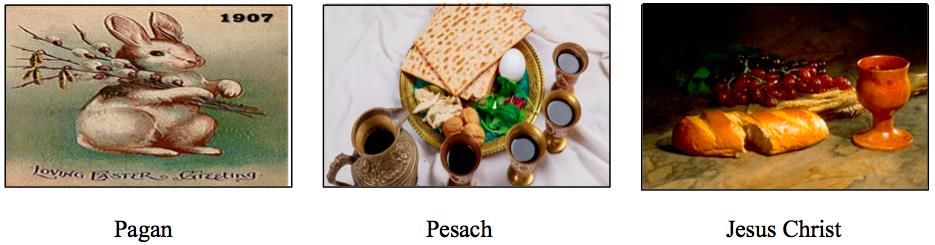
Pagan Celebration
Bereans – regarding the birth of Tammuz and Polytheism. Below are results of research and scriptural references. This is not from one of the teachings the Lord has given me over the past decade. It is presented for study and review. Part 2 on Pesach (Passover) and Jesus Christ (death, burial, and resurrection) are directly from the Bible.
An Easter Story
I remember, when I was a kid, the fun we had at Easter. Most every year we would buy a dyeing kit from the grocery store and color hard-boiled Easter eggs in many different shades and colors on the Saturday evening before Easter. Waking up on Easter morning and finding a large basket for each one of us kids, though not quite equal to the thrills of Christmas morning, was nevertheless exciting. Each basket would contain colored “grass,” usually green, and many-colored eggs, which mom insisted we eat within the first day or so lest they should go bad. And lots of jellybeans. And small chocolate bunnies and candies. And the prize item – a large, sometimes solid sometimes hollow, chocolate Easter bunny.
We would also get dressed up special that day for church. The girls had brand new spring dresses and big hats. And I (as a small boy) dressed up in a suit and a hat. My dad would always want to take a picture of everyone dressed up and holding their Easter baskets full of goodies. So, we would line up on the front porch steps and pose with our best smiles.
Sunday services that day were special, too. The church would usually be packed with all the regulars and the folks who, out of some sense of obligation, would show up only on Christmas and Easter. They figured that it would be better to go at least a couple of times a year than not at all. God would have to look at that act of righteousness with some sort of favor! After all, it was the celebration of the resurrection of Christ. Or so we thought.
What we were doing was in line with a tradition that the Christian church had been doing for over 1600 years. And, with a long history, the thought of changing what we have been taught and celebrated is often difficult. So, in an honest desire for truth (Bereans) and a careful study of history, we may find that Scripture does not always support traditions.
The celebration of Easter is not biblical after all. The Torah, Elohim’s instructions to his covenant people, does not teach the celebration of Easter. Jesus never taught his disciples to celebrate Easter. Nor did the apostle Paul, other apostles, or disciples in the Bible. The celebration of Easter is not in the Bible because it is not from our Heavenly Father.
Ishtar (Easter)
Ishtar, a goddess of both fertility and war, is the Akkadian name of the Sumerian goddess Inanna and the Semitic goddess Astarte, the three names referring to the same deity in diverse cultural contexts. She inspired great devotion in the ancient Babylonian empire, as evidenced by the many grand temples, altars, inscriptions, and art objects devoted to her.
Etymology
- The name Ishtar is likely Semitic in origin and was identified in ancient times with Canaanite goddess Ashtoreth or Astarte (Biblical Hebrew עשתרת). The underlying stem may be the same as that of Assur, meaning the “leading one” or “chief.” The older Sumerian name, Inanna, means “Great Lady of An”—An (or Anu) being the god of the sky or heaven.
In reading history, it is not hard to find information about the customs of Easter. The word Easter is derived from the ancient name Ishtar, a pagan goddess, and an abomination. It turns out the modern-day version of Easter is just a remake of some very ancient pagan traditions and practices. If a faithful follower of Christ is told the truth regarding the source of “Easter,” he/she would most certainly detest the origins of pagan worship.
- 1 Samuel 7:3-4 “Samuel said to all the house of Israel, ‘If you are really turning to Jehovah with all your hearts, remove from among you the foreign ‘elohim’ and the images of Ashtoreth. Give your hearts to Jehovah and serve only him. Then he will deliver you from the hand of the Philistines.’ So, the people of Israel removed the Baals and images of Ashtoreth. They served only Jehovah.”
These “images” are referring to the idols and statues of Ishtar, the fertility goddess of the Philistines with large, bare breasts. The record of Samuel refers to her again later:
- 1 Samuel 12:10 “Then they cried out to Jehovah saying, we have sinned, for we have forsaken Jehovah and have served the Baals and the images of Ashtoreth. Now deliver us from the hand of our enemies so that we may serve you.”
Ishtar | Astarte | Ashtoreth
Ishtar, Astarte, and Ashtoreth are all name variations of the same female counterpart of the Babylonian “Holy Trinity” (Baal, Ashtoreth & Tummuz [more on him in a minute]). Those familiar with Sacred Scripture have seen Baal & Ashtoreth repeatedly mentioned in the negative, as Canaanite deities. These deities root in the ancient Babylon of King Nimrod, whose legend morphed into Marduk – the “sun-god,” known by the Canaanites as Baal. His Queen, Semiramis, represents the moon goddess named Ishtar, known by the Canaanites as Ashtoreth. Last but not least is the immaculately conceived “divine son” Tammuz, believed to be the reincarnation of the “sun-god” Baal.
The “Divine Queen-Mother” moon-goddess, Ishtar, represents the grand goddess of love, sex, beauty, and fertility – according to the Morning Star, and according to the Evening Star – the goddess of war & hunting. Known as Ashtart by the Phoenicians, and Ashtoreth by Canaanites. Asarte is the Greek transliteration of Ashtart, which different Greek factions rendered other variations such as Aphrodite and Dianna.
The scattering from Babylon caused divisions of people with different languages to carry the same deity figures with different names and character variations which multiplied to create polytheism. Even with the many variations among the different religious systems, there remained fundamental characteristics, symbolism & themes which synchronized to keep a common thread. Hence, the various world religions are different renditions of the same Babylonian system.
Different names of Ashtoreth:
ISIS- by the Egyptians
Ishtar – by the Canaanites
Aphrodite – by the Grecians
Venus – by the Romans
Diana – by the Ephesians
Athtar – by the Arabians
Kali – by the Indians (India) [Raiders of the Lost Ark]
Columbia – by North Americans
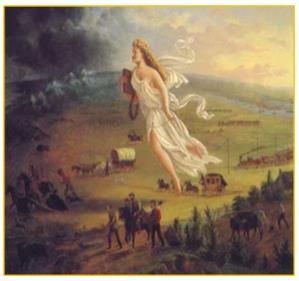
Columbia advances towards the darkness of the West, bringing light and civilization in her wake.
- Columbia’s figure appears on or within many state and federal buildings constructed in the 19th century, usually cast in bronze, and often pointing or facing West. She adorns the Wisconsin Capitol building, sculpted by the same Daniel Chester French who constructed the greatest rendition of Columbia in history, the 65-foot-tall statue of the Republic commissioned for the 1893 World’s Columbian Exposition held in Chicago, Illinois. She reposes atop the Texas Capitol holding the sword of Justice and raising aloft a blazing golden star. She lends her name to numerous towns across America, she is the patron of Columbia University and the seat of governmental power stands in a district built in her honor: The District of Columbia.
Columbia as a symbol is far too complex and deeply rooted to be ascribed as a creation of political machinations. Columbia is only the latest name given to a goddess who is older than recorded history and can be traced in her modern form to the early Egyptian dynasties. She has been known throughout history variously as Inanna and Ishtar by the Sumerians, Kali by the Hindus, Freya by the Norse, and most notably as Isis by the ancient Egyptians. She is the goddess of love, wisdom, warfare, and destiny and is venerated by all cultures as the mother of civilization.
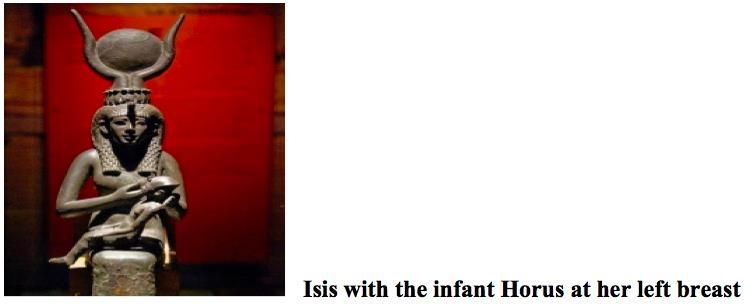
In the original Egyptian telling of her tale, Isis is also the goddess of magic, a friend of slaves, and an aristocrat by equal measure. It was Isis that kept the veil of night cloaked about the light of wisdom and it was her name invoked in the rites and rituals of the numerous fertility cults that sprang up along the banks of the Nile. The pentagram, or five-pointed star, is the primary symbol of magical and initiatory societies across the world, in the shape traced in the heavens by the transit of the planet Venus throughout the year.
- She has also enjoyed considerable veneration throughout history as a figurehead of Freemasonry or as Manly Palmer Hall put it, “The Virgin of The World.” Numerous Masonic writers have expounded lengthy treatises on the Masonic symbolism inherent in the legend of Isis, it being so closely tied to the inner curriculum of Masonry.
The different names rendered by different people & languages do not necessarily have etymological relation, but it is the continuity of distinct themes & characteristic relations of this certain goddess, which is represented through different people of different languages.
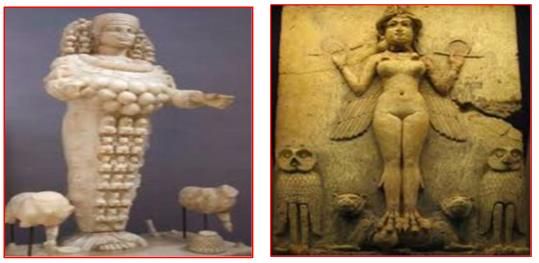
Ashtoreth, the “moon goddess” has also been referred to by certain nicknames such as:
- Divine Mother
- Mother Nature
- Mother of God
- Queen of Heaven
- Virgin Mother
The Origins of Ashtoreth/Semiramis
From Scripture, we know that images, statues, and idols of the “goddess of fertility” were sinful and offensive to Jehovah. Israel, in their rebellion against their Creator, worshipped Ashtoreth – “Easter.” As followers of Christ, we are to have nothing to do with the customs and practices of pagans worshipping their gods.
There is heated debate on the conclusion presented below:
- The Saternalia [below] originated as the birth date of Tammuz, the illegitimate (fornication – out of wedlock) son of Semiramis [below], the widow of Nimrod of biblical evil fame. After Shem cut Nimrod into pieces, Babylonian legend insists that he ascended into the heavens and became the sun god himself. The rays of the sun implanted the seed into his widow. Thus, the son of the sun god was [supposedly] miraculously conceived, as was the adoration of the mother and child evident in every culture on the earth. On the winter solstice, Tammuz was born as were most of the traditions surrounding “the child-mass” season. Tammuz, the reincarnation of the sun god – Nimrod, was killed in a hunting accident when he was gored to death by a wild boar in his 40th year. Those who worshipped the son of “the sun god” then set aside 40 days of weeping for Tammuz. They celebrated “Lent” one day for each year of his incarnation – in which they would deny worldly pleasure for his pleasure in the afterworld.
- Ezekiel 8:16 “And he brought me into the inner court of the Lord’s house, and behold, at the door of the temple of the Lord, between the porch and the altar, were about five and twenty men, with their backs toward the temple of the Lord, and their faces toward the east; and they worshipped the sun toward the east.”
After many years, his mother Semiramis died. The gods looked favorably on “the mother of god” and sent her back to earth as the spring fertility goddess – always depicted as an exaggeratedly endowed bare-breasted queen of sexual desire. Semiramis, the queen of heaven, was “born again” as the goddess Easter (Ashtarte) as she emerged from a giant egg that landed in the Euphrates River at sunrise on the “sun” day after the vernal equinox. To proclaim her divine authority, she changed a bird into an egg-laying rabbit. As the cult developed, the priests of Easter would impregnate young virgins on the altar of the goddess of fertility at sunrise on Easter Sunday. A year later (9 months of pregnancy) the priests of Easter would sacrifice those three-month-old babies on the altar at the front of the Sanctuary and dye Easter eggs in the blood of the sacrificed infants.
The forty days of Lent – or weeping for Tammuz, starts the Easter fertility season. The festivities culminate on Easter Sunday when the priests of Easter slaughtered the “wild boar that killed Tammuz” and the entire congregation would eat the “ham” on Easter Sunday. [Rabbi Rood]
- [The Saturnalia was an enduring Roman festival dedicated to the agricultural god Saturn which was held between the 17th and 23rd of December each year during the winter solstice. Originating from archaic agricultural rituals the Roman festivities came to include a general round of gift-giving, merrymaking, and role-reversals so that it became one of the most popular celebrations in the calendar and certainly the jolliest. The similarities of some of its features and the timing – pushed later into December over time – suggest a strong influence on the Christian celebration of Christmas.] (Source)
- [The Birth of Tammuz and Polytheism. A video from The Fuel Project tells the story of Tammuz. Semiramus had become pregnant with an illegitimate son and Nimrod threatened to dethrone her and expose her past as a prostitute. She apparently then plotted to have Nimrod killed. Afterwards, she presented her son Tammuz as an immaculately conceived reincarnation of Nimrod. She presented him as the seed of the woman presented in Genesis 3, the Messiah, and so Tammuz was the first Christ impostor, the first antichrist. After his death, Nimrod was revered as the god Marduk, also known as Baal – The Sun God, which is the primary name that other people would come to worship Marduk. Semiramus was revered as the Moon Goddess, Great Mother, Divine Mother and Virgin Mother.] (Source)
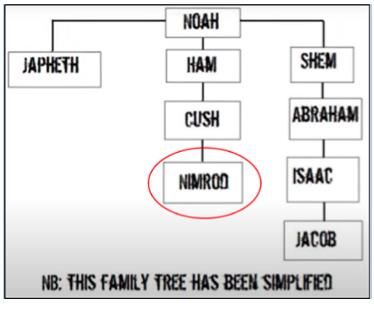
Know Your Enemy (Part 9 – The Birth of Tammuz & Polytheism)
Jehovah has told us that worship of pagan deities is sinful and separated the Israelites from Him. As followers of Christ, who celebrate the true, and only resurrection of the “only begotten Son of God” [John 1:14, 18; John 3:16, 18, and 1 John 4:9], many in “Christendom” are not aware of the pagan origin of worshiping Tammuz on Easter.
Elohim described the abominations that were going on by the priests and in the temple of those who worshiped Tammuz. The prophet Ezekiel was brought, in vision, into the temple of Jehovah and was shown what abominable things were happening there:
§ Ezekiel 8:13-14 “Again, he said, ‘You will see them doing things that are even more detestable.’ Then He brought me to the entrance to the north gate of the house of Jehovah, and I saw women sitting there, mourning for Tammuz.”
The modern-day season of Lent is founded on the 40 days of weeping for Tammuz. As we read in Ezekiel, the Lord is not pleased for those, even in the House of God, who worship false deities like Tammuz. For true followers of Christ, the celebration over Easter can only be of the lamb (risen from the dead) and not an egg-laying rabbit.
Dagon (Good Friday)
Another aspect of the Easter season is “Good Friday.” Theologians do a lot of interpretive gymnastics to arrive at a Friday death of the Messiah, followed by a Sunday morning resurrection. This contradicts what Jesus said about the length of time he would be in the grave. He specifically and repeatedly instructed his disciples that he would be in the tomb for three days and three nights. Thus, Friday and Sunday were significant days when the pagans practiced the worship of their god-idols.
Friday was the pagan day honoring the “fish-god” Dagon. Scripture speaks of Dagon, the fish god:
§ Judges 16:23 “The rulers of the Philistines gathered to offer a great sacrifice to Dagon their ‘elohim’ and to celebrate. They said, ‘Our ‘elohim’ has handed Samson, our enemy, over to us.’”
And again,
§ 1 Samuel 5:2-5 “The Philistines took the ark of Elohim and brought it to the temple of Dagon, where they positioned it beside Dagon. When the residents of Ashdod got up early the next day, Dagon was lying on the ground before the ark of Jehovah. So, they took Dagon and set him back in his place. But when they got up early the next day, Dagon was again lying on the ground before the ark of Jehovah. The head of Dagon and his two hands were sheared off and were lying at the threshold. Only Dagon’s body was left intact. For this reason, to this very day neither Dagon’s priests nor anyone else who enters Dagon’s temple steps on Dagon’s threshold in Ashdod.”
In later years “Good Friday,” the day that the Philistines sacrificed to Dagon, the Philistine fish god, also became an integral part of the Easter pageantry. Years ago, in the American school system, fish was served every Friday and observed by many. This satanic festival is the pinnacle of the abominations that God had pronounced to the Children of Israel before they entered the Promised Land.
During the time of the Messiah and afterward, Friday was well known in pagan circles to be a celebration of Dagon. And so, as the Scriptural practices of appointed times were being abandoned and the pagan sun-god and other deity worship began to get melded into the worship practices of followers of the Messiah, too, the blending of Dagon\fish-god worship into true worship of the Jesus Christ proceeded.
For Another Time:
Three Days and Nights – Johan in the belly of the fish. At what hour was Jesus crucified?
§ The third hour, Mark 15: 25, “And it was the third hour when they crucified Him.”
§ In the sixth hour, John 19:14-15, “Now it was the day of preparation for the Passover; it was about the sixth hour. And he said to the Jews, “Behold, your King!” 15 They, therefore, cried out, “Away with Him, away with Him, crucify Him!” Pilate said to them, “Shall I crucify your King?” The chief priests answered, “We have no king but Caesar.’”
What Hour Was Jesus Crucified? Resolving an Apparent Bible Contradiction
Satanic Wicca
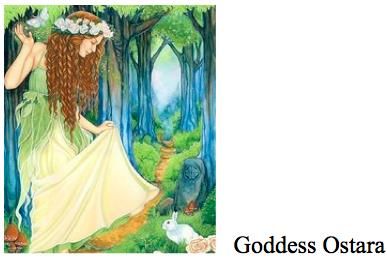
The Goddess Ostara is the German maiden Goddess who is celebrated at the spring equinox and also the Anglo Saxon Goddess of the dawn named Eostra pronounced East-ra. The word oestrus (referring to an animal in heat) is also derived from Eostra which can be defined as East and shining, related to the Greek Goddess Eos who is the Goddess of the dawn and love in their pantheon.
There is not much lore about Her. We know that she was a fertility Goddess of the Northern European people whose springtime rites were taken and changed by the newly “Christianized” Roman invaders into Easter and the legend of [truth] of Christ’s resurrection. The Moon still determines the timing of the Christian Easter. Easter is celebrated on the first Sunday after the first Full Moon after the Vernal Equinox.
Ostara is the maiden Goddess of the growing light of spring; her consort is a white hare. Once, when spring was late in coming, a little girl found a bird close to death from the cold. The child prayed to Ostara for help for the bird. A rainbow bridge appeared, and Ostara came, clothed in her red robe of warm, vibrant sunlight which melted the snow. Spring arrived. The little bird was wounded beyond repair, so Ostara changed it into a snow hare that brought rainbow-colored eggs. As a sign of spring, Ostara instructed the child to watch for the snow hare.
Sacred to Ostara
Animals – Rabbits, butterflies
Symbols –Spring, Eggs, Dawn, East, Rainbows, Keys, Moon
Colors – White
Month –April
Consort – Hare (Source)
Commercialization – it is all about the Money

NOT ACCOUNTING FOR THE HIGHEST INFLATION IN DECADES!
The costs of Easter baskets, egg hunts, and Sunday brunches can add up — Americans are expected to spend $21.6 billion on Easter in 2021, according to the National Retail Federation. That breaks down to an average of $179.70 per person. So, where exactly is that money going? And how does that spending compare to previous years? Hop ahead to find out. (Source)
Crafting a Pagan Ritual into Christianity
Our ancestors started the tradition of celebrating Easter with eggs, and we have carried it on through the centuries. In early spring, Christians celebrate the rebirth of Jesus Christ, while Jewish people observe Passover. During this season, the flowers are in full bloom, and animals give birth to their young. The Easter egg symbolism represents the rebirth and fertility that takes place in spring.
Families worldwide use eggs to celebrate Easter in unusual ways, such as Easter egg hunts, decorating, giving eggs as gifts, or taking part in games with eggs. You may have some favorite traditions with your loved ones to enjoy this springtime holiday. Explore the history of Easter eggs and how you can integrate them into your crafts, games, and decorations.
Origin of Easter Eggs
Easter eggs’ origin seems to date back to medieval Europe, whether it was the idea of early Christians or rooted in Anglo-Saxon traditions. Anglo-Saxons worshiped the goddess Eastre as they celebrated the spring equinox, which demonstrated nature’s rebirth after a cold, barren winter. They would usually eat eggs at the festival and would even bury them in the ground to promote fertility among the people. For Christians, Easter eggs symbolized the resurrection of Jesus Christ.
Christian missionaries to European countries sought to integrate their Holy Week traditions with these pagan festivals to encourage the locals to convert. [saw the same thing in Belize and Ecuador] They wanted to give these traditions with Easter eggs a new meaning that focused on their beliefs about the resurrection. We might also celebrate Easter with eggs because of the dietary restrictions during the Christian season of Lent. In modern times, church members are supposed to fast during Lent by abstaining from meat and focusing on Easter’s meaning.
In the early Christian church, fasting conditions during Lent were stricter. Church leaders encouraged Christians to avoid eating any animal byproducts, including eggs, in preparation for Easter. When chickens would lay eggs during this time, those who celebrated Lent would hard-boil them and store them until the 40-day period ended. After Lent was over, Christians would distribute their eggs to the community during Easter, especially to the poor who could not afford meat to celebrate this holiday.
The symbolism of an Egg
Easter is a springtime holiday that celebrates the beginning of blooming plants and the birth of baby animals. For Christians, it also represents the resurrection of Jesus Christ and his emergence from the tomb. Since eggs represent rebirth and fertility, the Easter egg meaning fits the theme surrounding this holiday.
Easter eggs, or resurrection eggs, have their roots in pagan traditions during the spring equinox. Over time, they have come to be part of the Christian holiday celebrating eternal life in Jesus Christ through his resurrection. Some of the practices that families perform worldwide point to religious themes. For example, egg-rolling contests symbolize the stone rolling away from Christ’s tomb.
The Traditions of Easter Eggs Around the World
As people worldwide celebrate the resurrection of Christ and the arrival of the exciting spring season, they integrate eggs into their traditions with the following practices:
Egg Rolling
Egg-rolling contests have become a worldwide phenomenon, including here in the United States, and we can thank the Scottish people for coming up with this idea. On Easter Sunday, Scottish families boil and paint their eggs, which they take to a local park and roll them down a hill. The winner is the one with the decorated egg that goes the farthest while remaining intact. Usually, kids play this game, but it is also a popular activity for adults. Rolling the eggs down the hill is symbolic of the stone moving away from Christ’s tomb after his resurrection.
The annual egg-rolling contest became an official activity in the United States thanks to President Rutherford B. Hayes’ wife, First Lady Lucy Hayes. During this exciting event, children and their parents visit the White House lawn to roll their eggs on the Monday after Easter. Initially, this activity took place at the U.S. Capitol Building on Easter Monday in the early 1870s.
After some time, Congress expressed concern about the number of people on Capitol Hill and the damage they could do to the grounds. In 1876, President Ulysses S. Grant and Congress passed a law prohibiting egg rolling on Capitol Hill. A year later, a young boy asked President Hayes to conduct an egg-rolling contest on the White House lawn. The President and First Lady held the first annual event there in 1878, and it remains a tradition to this day.
Egg Dancing
People in Germany have incorporated egg dancing with their loved ones during Easter for centuries. The egg dance game involves placing lots of raw eggs all over the lawn or floor and having friends and family dance around them. The winner is the one who breaks the fewest number of eggs. Families can make this activity more challenging for older participants by blindfolding them.
Egg Tapping
Holy Week is the most sacred time in Greece, where citizens take part in various Easter traditions involving eggs. The Greeks created a game that consists of tapping Easter eggs together with the people around the dinner table. The winner of this activity gets good luck for a year.
During their extensive family gatherings on Easter Sunday, Greeks will dye hard-boiled eggs and pass them around the table. Each person taps their egg’s pointed part against the egg next to them until one of them breaks. Whoever is the last person with their egg still intact after going around the whole table is the winner. After the game is over, they will eat their hard-boiled eggs.
This tradition started in Greece, and it has become famous around the world. In England, egg tapping involves having two pointed ends of their eggs collide to determine which hard-boiled egg is the hardest. The same practice is prevalent in Latvia, where they tend to make potato salad including the leftover hard-boiled eggs the next day.
Egg Darts
The U.S. Another fun outdoor activity you could play with your family during Easter involves throwing eggs at a target. Make a wooden or plastic target and throw raw eggs at it instead of darts. It is helpful to use plastic surfaces because they are easier to clean if you want to play this game again next year. Even though egg darts could get messy, it will be easy for you to see where the egg hit the target. Like the egg toss, you can provide fun prizes for adults and children.
Egg Toss
The U.S. Bring the festivities outdoors by hosting a fun egg toss with your loved ones. Every participant needs a partner to play the game. The team members stand across from each other and toss a raw egg back and forth. After each successful toss, the person who catches the egg takes a step backward. Players are out of the game when they drop their eggs or let them crack on the ground. The winning team is the last one with a whole egg.
Egg Roof Tile Rolling
Besides rolling eggs down a hill or on a lawn, families in Sweden slide their eggs down roof tiles. Friends, family members, and neighbors give eggs as gifts to children. The kids use these eggs to roll down roof tiles at an angle on the floor. The point of the game is to be the player whose egg goes the farthest. If an opponent’s egg hits yours, you get to keep it.
Giant Chocolate Egg
Argentina holds an annual celebration where they unveil a giant chocolate egg on Easter Sunday. This hollow chocolate egg features thousands of pounds of chocolate, and it serves as a spectacle for locals and tourists. After it gets cracked open, thousands of people gather around the egg to get a piece of chocolate.
On Easter Sunday, people in Argentina exchange eggs and eat a dessert with chocolate eggs on top of it. Many families in Argentina have a feast with grilled meats, including lamb. After dinner, children will look around for the giant chocolate egg that their parents hid for them somewhere in the house. Whoever finds it breaks it into pieces and shares it among the family.
Egg Showers
People in Mexico and parts of the southern United States celebrate Easter by filling hollow eggs with confetti and breaking them over someone’s head to bring them good luck. When families go to the park on Easter Sunday, the children hide their confetti-filled eggs and look for an unsuspecting friend or family member to play their “victim.” Some parents may also hide the eggs around the house or lawn and break the eggs over their children’s heads when they find them.
This Easter tradition came to Mexico through the Spaniards after Marco Polo brought it to Europe. During his expedition in China, he became familiar with the custom of filling hollow eggs with perfumed powder. The Italian Renaissance also featured this practice that involved men tossing hollow eggs with fragrant powder at the women they were courting.
Egg Decorating
Decorating Easter eggs has been a popular tradition around the world since the 13th century. Various cultural groups worldwide paint or adorn their Easter eggs in the following ways.
- Painting their eggs red: Orthodox Christians dye their Easter eggs red to symbolize the blood Jesus shed on the cross. Greeks also used to color Easter eggs red and put them throughout their houses to ward off evil spirits.
- Using wax for creative designs: People in Ukraine, Poland, Russia, and other Eastern European countries use the wax-resistant batik method to decorate their Easter eggs. They make designs on their eggs using hot beeswax and a stylus before dipping the eggs into the dye. The waxed parts resist the dye and maintain a unique pattern.
- Decorating eggs with onion skins and vinegar: Today, we use Easter egg dyeing kits to color our eggs. However, the traditional method for coloring Easter eggs is using onion peels and vinegar. After boiling the onion skins in water and vinegar and adding the eggs to the concoction, the eggs take on a reddish-brown color.
- Painting horseshoes on eggs: People in Hungary paint horseshoes on their eggs as a symbol of good luck.
- Copper wire on eggs: People in the Czech Republic use copper wire to decorate their hard-boiled or plastic eggs.
- Decorating beaded eggs: Romanians place beads on their Easter eggs in a traditional pattern to decorate them. These eggs often get blessed at church.
Using Eggs as Decorations
Worldwide, people who celebrate Easter have found ways to use colorful eggs in their festive decor. In Germany, families decorate the traditional Easter tree or bush with eggs that look like fruits. This tradition symbolizes the end of winter and the beginning of spring. In other countries, families may use a smaller version of the Easter tree as their centerpieces and decorate them with candy. They may also put out a decorative bowl of Easter eggs as a centerpiece for the dining room table.
Collecting Eggs
Like American kids do when they trick-or-treat for Halloween, children in other countries collect eggs from neighbors to celebrate Easter. On Easter Saturday, kids in Sweden, Finland, and Bosnia and Herzegovina dress up as good witches, give cards to their neighbors, and wish them a happy Easter. Their neighbors will gift them with candy and eggs in return for their cards. Kids will also exchange decorated eggs with their friends and family members and play an egg-tapping game to celebrate the end of the day.
Giving Eggs as Gifts
Besides the traditional Easter basket, families worldwide give eggs as gifts to their loved ones during Easter. In Poland, families give blessing baskets filled with food and colored eggs to a priest. The priest’s blessing marks the end of Lent. Orthodox church leaders will also bless Easter eggs and hand them out to the congregation. Sometimes, churchgoers will bring their blessed eggs to the cemetery to place on their deceased loved ones’ graves.
People give their loved one’s egg-shaped gifts along with traditional or decorated eggs. Fabergé eggs were ornate Easter gifts that Russian czars would give to their wives. These detailed works of art typically had a surprise inside. In Italy, families give hollowed-out chocolate eggs filled with jewelry and other valuable items.
The History of the Easter Egg Hunt
The egg hunt became an Easter tradition in 16th-century Germany. Martin Luther held egg hunts at the church for his congregation, where the women and children would look for eggs that the men hid around the property. This practice is symbolic of the women who discovered that the tomb was empty after the resurrection. According to German Lutheran tradition, the Easter Bunny — or the Easter Hare — would bring a basket of brightly colored eggs as a gift for all the good children, hiding them around the house and lawn for them to find.
This Easter tradition became popular in England during the 19th century thanks to the future Queen Victoria, whose mother would hide Easter eggs throughout Kensington Palace. When she became an adult, Victoria and her husband Albert continued the tradition by hiding eggs for their children on Maundy Thursday, the Thursday before Easter. The eggs had initially been hard-boiled and decorated, but artificial eggs eventually became popular in London in the 1850s. Chocolate eggs also gained popularity in France and Germany in the early 19th century.
As family life became more of a priority throughout Europe, the middle class had more disposable income. The Easter egg hunt tradition then became more about family and children than it did about religious practices. Confectionery companies also used this practice to promote their sugary products. Today, families fill plastic eggs with candy or money and hide them around their houses or backyard for their children to find.
Blessings in Christ,
Joseph “Jim” Stockstill 
“National War Council” – Founder and Chairman
Jim5555@nationalwarcouncil.org
P.O. Box 931
Argyle, TX 76226
nwc@nationalwarcouncil.org
Jim5555@nationalwarcouncil.org
Donations to National War Council
“The two most important days in your life are the day you are born and the day you find out why.”
Mark Twain
0 Comments
Trackbacks/Pingbacks