

Christ’s crucifixion was an act of sheer brutality and barbarism, yet many don’t understand the horrific physical torture He suffered
By Jim Stockstill
“He keeps all his bones; not one of them is broken.” Psalms 34:20
(NWC) We know that Jesus Christ is the word of God made flesh (John 1:14). Therefore, if the bones of Jesus Christ were broken, then it means that the Scriptures can be broken. Jehovah had inspired His written word decades before Jesus Christ came in the flesh – clearly declaring that none of His bones would be broken.
Foreshadowed in the old testament (Exodus 12:43:46, Numbers 9:12), God specifically told the people to ensure that the sacrifice was not to be left outside overnight and that the bones of sacrificial animals should not be broken. This coincides with exactly what happened to the body of Jesus Christ. As those that follow Christ, we know Jesus was a very special and unique “sacrificial” offering for the sins of the world (Hebrews 9:28, 1 John 2:2). Specifically, the bones of this “lamb” were not to be broken. As the only begotten Son of God, and Second Adam, it was much more important to fulfill the Scripture quoted by the Psalmist.
The Flogging and Crucifixion
Christ’s crucifixion was an act of sheer brutality and barbarism, yet many people today still don’t know the horrific details of the physical torture He suffered at the hands of Roman soldiers. The torture inflicted on Christ was so intense that at the time, no word existed that could capture the essence of His suffering. Lee Strobel, a former legal journalist for the Chicago Tribune, teamed up with Dr. Alexander Metherell to discuss the gruesome details of Christ’s torture and crucifixion, and describe what His physical body endured before he died.
Flogging
Some people may have a general understanding of how Christ was tortured. Maybe they’ve seen the 2004 film “The Passion of the Christ” — which depicts how the Savior suffered, bled, and died for mankind and figure they have seen all that they need to know regarding the extent of His pain. The following details from Metherell, however, just might make them think twice.
In “The Case for Christ”, Strobel says Metherell explains that Jesus had likely been close to death before He reached the Cross. “As the flogging continued, the lacerations would tear into the underlying skeletal muscles and produce quivering ribbons of bleeding flesh.” A third century historian by the name of Eusebius described a flogging by saying, “The sufferer’s veins were laid bare and the very muscles, sinews and bowels of the victim were open to exposure.”
Metherell adds, “We know that many people would die from this kind of beating even before they could be crucified.“ But Christ survived, only to face more suffering on the Cross.
Crucifixion
The doctor explains that Christ’s arms would have been stretched 6 inches and his shoulders dislocated. Psalm 22:14, “I am poured out like water, and all my bones are out of joint; My heart is like wax; It is melted within me.”
Christ died an “agonizingly, slow death by asphyxiation.” The doctor explains that the stress on the diaphragm put the chest into an inhaling position and that in order to exhale, Christ would have had to push up using his painful feet in order to relieve pressure on the diaphragm and temporarily exhale. “In doing so, the nail would tear through the foot, eventually locking up against the tarsal bones.” Metherell said this breathing motion would go on and on, Christ scraping His shredded back against the coarse wood until He became completely exhausted and unable to push up and breathe. Crucifixion
“As the person slows down his breathing, he goes into what is called respiratory acidosis — the carbon dioxide in the blood is dissolved as carbonic acid, causing the acidity of the blood to increase. This eventually leads to an irregular heartbeat. In fact, with his heart beating erratically, Jesus would have known that he was at the moment of death, which is when he was able to say, ‘Lord, into your hands I commit my spirit.’ And then he died of cardiac arrest.“ [https://www.christianpost.com/news/jesus-crucifixion-describedgraphic-detail-physician-lee-strobels-book-the-case-for-christ.html]
The Argument
Could Jesus Christ, or any of the thousands that had been crucified, really endure such a brutal execution without having any of His bones broken? The main question many ask is, “Was Jesus nailed to the cross by the hands or by the wrists?”
During my private time with the Lord this past Sunday (during the 3rd watch – June 28, 2021), He began talking about His crucifixion and this surprised me as He seldom talks about the cross. He has allowed me to see Him face-to-face on many of our visits but I never recall looking specifically at His hands nor His feet. He asked a simple question, “were the nails that pierced Me driven in My hands or My wrist, and what do you think about My feet?”
This was interesting as I have pondered this question many times over the years in my research and study. I knew the scripture in Psalm about none of His bones would be broken and believed it to be true. Psalm 139:2-3, “You know when I sit down and when I get up; You understand my thought from far away. You scrutinize my path and my lying down and are acquainted with all my ways.” The Lord knew that I thought the nails went through His wrist and of course His feet but could not understand how none of the bones were broken. He knows all things (omniscient), has a wonderful sense of humor but wants His children to know the truth. Rather than telling me, He said study some more and I will lead you to the truth.
Medical Analysis
For many of us that are true followers of Christ, we have seen and read that Jesus was affixed to the cross by piercing his hands with spike-like nails. Nevertheless, in modern art, new pictures depict Jesus as being nailed to the cross through his wrists. Roman Centurions could not have pierced Jesus’ wrists because it would break one or more of his bones, thus conflicting with Scripture.
Two different arguments are compelling for His hands being pierced. First, anatomically showing that the hand certainly can hold the weight of a person and second, biblically (Scriptures).
Anatomically. Those who say that Jesus was nailed through the wrists allege that a human body cannot be held to a cross by nailing its hands to it, because the flesh would give way, the hand would rip, and the person would fall. This is a misconception. Those who say such a thing have never observed the dissection of a human body. During their first year, medical students study cadavers to understand the human anatomy. At that time they have to dissect not only the hand but also the whole body.
The conjunctive tissue of the body of humans and animals is stronger than a rope. Tendons, transverse ligaments and, aponeurosis are conjunctive tissues. The hand is full of them, as you can see in pictures # 1 and # 2.
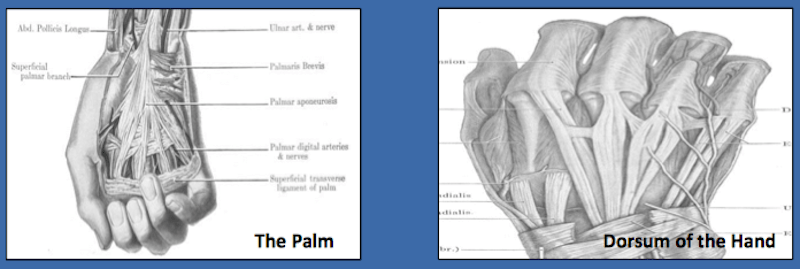
As conjunctive tissue is very strong, it is nearly impossible for the tendons of a person’s hands, transverse ligaments and aponeurosis, pierced by a nail, to give way to let the weight of the body rip the hand. This would not happen even if the body was hung from only one hand, much less from both. And for Jesus, we know he was a carpenter in his earlier years and would likely have very strong hands.
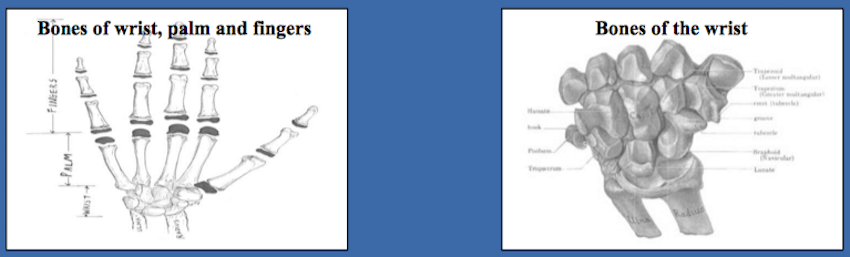
The wrist has eight bones: scaphoid, lunate, triquetrum, pisiform, trapezium, trapezoid, capitate and hamate. These bones are kept tightly together by ligaments, in such a way, that if you drive a nail through the wrists, it will pierce and break some of them. Therefore, Jesus could not be nailed by the wrists, but by the palm of the hand. The five metacarpal bones which constitute the palm of the hand, are separate from each other, and thus a nail can be driven between two of them without breaking any. (left picture) This means that the hand can be pierced by a nail without breaking a bone, but if the wrist is pierced by a nail, it necessarily will break one or more bones. (right picture)
* All pictures are taken from the book “An Atlas of Anatomy”, by J. C. Boileau Grant, M.C.; M.B.; Ch. B.; F.R.C.S. Edin, Professor Emeritus of Anatomy in the University of Toronto, Fourth Edition. Pictures numbers 57, 84, 92, and 98.
Scripture
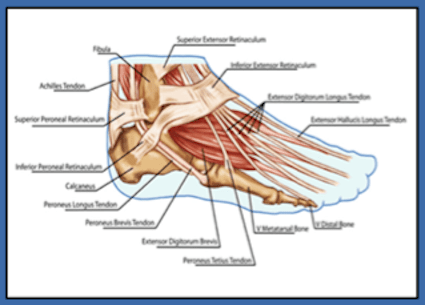
The foot is made up of 26 bones, 33 joints, 107 ligaments, 19 muscles, and numerous tendons. Complex biomechanics keep all these parts in the right position and moving together. Given these intricacies, it is not surprising that most people will experience some problem with their feet at some time in their lives.
Within each foot, the essential structure can be summed up as follows:
• Seven short tarsal bones make up the heel and back of the instep.
• Five metatarsal bones spread from the back of the foot toward front and make up the structure for the ball of the foot. Each metatarsal is associated with one of the toes.
• Fourteen phalanges, small bones, form the toe structure.
• Tarsal and metatarsal bones provide the structure for the arch of the foot.
• Bands of ligaments connect and hold all the bones in place.
• A thick layer of fatty tissue under the sole helps absorb the pressure and shock that comes from walking and everyday movements.
Foot First Podiatry CLPC – Foot Anatomy Concluding Analysis
Concluding Analysis
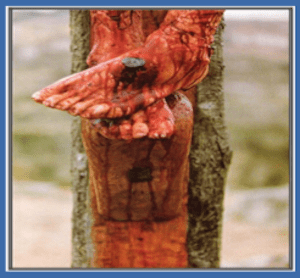 Reviewing the previous picture and researching the site, an expert in Podiatry, William Thompson, M.D. was asked to give his expert opinion.
“The nail(s) were most likely driven through the flat part of the foot above the toes. There are 5 metatarsal bones lying parallel in this area, each 4- to 6-inches in length. They are held in place by ligaments and skin. A tapered nail would push the bones apart as it penetrated. It was tapered, I am sure, because it had to be driven into the wood as well as the flesh. The bones are round and would
move to the side, stretching or tearing the ligaments, as the nail passed through the foot. The space between the big toe and the toe next to it would be a good area to place the nail rather easily. It has a natural indention that can be felt. If the nail was placed higher, there are a number of bones that are essentially round and would do the same.”
Scripture
Psalm 22:16 “For [a pack of] dogs have surrounded me; a gang of evildoers has encircled me. They pierced my hands and my feet.” [AMP]
Zechariah 13:6 “And one shall say unto him, What are those wounds in thy hands? And he will say, Those with which I was wounded in the house of my friends.” [Darby Translation]
John 19:36-37 “For all these things happened to fulfill the prophecies of the Scriptures: “Not one of his bones will be broken,” 37 and, “They will gaze on the one they have pierced!” [The Passion Translation] Scripture
John 20:25-27 “So the other disciples kept telling him, “We have seen the Lord!” But he said to them, “Unless I see in His hands the marks of the nails, and put my finger into the nail prints, and put my hand into His side, I will never believe.” 26 Eight days later His disciples were again inside the house, and Thomas was with them. Jesus came, though the doors had been barred, and stood among them and said, “Peace to you.” 27 Then He said to Thomas, “Reach here with your finger, and see My hands; and put out your hand and place it in My side. Do not be unbelieving, but [stop doubting and] believe.” [AMP]
Luke 24:38-40 “And He said, “Why are you troubled, and why are doubts rising in your hearts? 39 Look at [the marks in] My hands and My feet, [and see] that it is I Myself. Touch Me and see; a spirit does not have flesh and bones, as you see that I have.” 40 After saying this, He showed them His hands and His feet.” [AMP]
Concluding the Question
For years there has been debate regarding the nails (spikes) that pierced the hands or wrist of Jesus and how could bones not have been broken in his feet. While it may not be an interesting subject of the Scriptures and story of the Lamb of God, I have always been fascinated by the smallest details of the Bible. Knowing my heart, thoughts and love of such things, I guess this is why my “friend” – the Son of David and the Carpenter from Nazareth – asked me the question. Anything we learn about this compassionate, merciful and loving man (God) is a true blessing. Thank you, Lord Jesus.
Blessings,
Joseph “Jim” Stockstill 
The Unknown Prophet in Texas
“National War Council” – Chairman
nwc@nationalwarcouncil.org
Donations to National War Council
“Until then, there are three things that remain: faith, hope, and love—yet love surpasses them all. So above all else, let love be the beautiful prize for which you run.” 1 Corinthians 13:13
Thank You Lord Jesus for the price You paid to redeem us from our sins. John 3:3-16.
Jim – my jaw dropped when you read the Matthew 24:40, ‘Two men will be in the field; one will be taken and the other left. ‘ and you said that ‘one would be taken away to Judgment’ and the other left’. This verse had always been interpreted as one would be taken away during the Rapture and the other left on earth. As you are so good at doing, you challenged me to read all references in the Gospels in context.