

By Jim Stockstill
September 15, 2022
The Holy Place
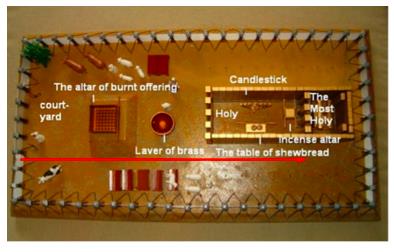
Through the blood of Jesus, we measure up in the eyes of our Father and inherit the righteousness of Christ
God’s Gracious Dealings [Why]
Deuteronomy 8:1-3 “1 All the commandments that I am commanding you today you shall be careful to do, so that you may live and increase, and go in and take possession of the land which the Lord swore to give to your forefathers. 2 And you shall remember all the way which the Lord your God has led you in the wilderness these forty years, in order to humble you, putting you to the test, to know what was in your heart, whether you would keep His commandments or not. 3 And He humbled you and let you go hungry and fed you with the manna which you did not know, nor did your fathers know, in order to make you understand that man shall not live on bread alone, but man shall live on everything that comes out of the mouth of the Lord.”
- Matthew 24:10-13 “10 At that time many will be trapped into betraying and hating each other, 11 many false prophets will appear and deceive and lead many people into error. 12 And the love of the great body of people will grow cold because of the multiplied lawlessness and inequity. 13 But whoever holds out [endures] till the end will be saved [delivered].”
- Saved [G 4982]: future tense – to deliver from the penalties of the Messianic judgment
- Travail [H 8513] [G 3449]: weariness, tiresome, hardship as hard and difficult labor, toil, and distress.
Romans 8:14-28 “14 Those who are led by the Spirit of God are sons [and daughters] of God. 15 For you [we] did not receive a spirit that makes you [us] a slave again to fear, but you received the Spirit of sonship [and daughters]. And by him, we cry, “Abba [Dear], Father.” 16 The Spirit himself testifies with our spirit that we are God’s children. 17 Now if we are children, then we are heirs – heirs of God and co-heirs with Christ if indeed we share in his sufferings in order that we may also share in his glory. 18 “I consider that our present sufferings are not worth comparing with the glory that will be revealed in us. 19 The creation waits in eager expectation for the sons of God to be revealed. 20 For the creation was subjected to frustration, not by its own choice, but by the will of the one who subjected it, in hope 21 that the creation itself will be liberated from its bondage to decay and brought into the glorious freedom of the children of God. 22 We know that the whole creation has been groaning as in the pains of childbirth right up to the present time. 23 Not only so, but we, who have the first fruits of the Spirit, groan inwardly as we wait eagerly for our adoption as sons [daughters], the redemption of our bodies. 24 For in this hope we were saved. But hope that is seen is no hope at all. Who hopes for what he already has? 25 But if we hope for what we do not yet have, we wait for it patiently. 26 In the same way, the Spirit helps us in our weakness. We do not know what we ought to pray for, but the Spirit himself intercedes for us with groans that words cannot express. 27 And he who searches our hearts knows the mind of the Spirit because the Spirit intercedes for the saints in accordance with God’s will. 28 And we know that in all things God works for the good of those who love him, who have been called according to his purpose.”
Hard to Believe With the Tests, Trials, and Hardship
Kings and Priests
Proverbs 25:2 “It is the glory of God to conceal a thing: but the honor of kings is to search out a matter.”
- Glory [H 3519]: Abundant riches and honor
- Conceal [H 5641]: To be hidden, be concealed
- Thing [H 1697]: Speech, saying, utterance, word, of words
- Search Out [H 2713]: Penetrate, search through, literally explore for an object.
Revelation 1:6 “And hath made us kings and priests unto God and his Father; to him be glory and dominion forever and ever. Amen.”
Revelation 5:10 “And hast made us unto our God kings and priests: and we shall reign on the earth.”
- Kings [G 935]: Sons/daughters who will reign over the world with Christ in His millennial kingdom.
- Priest [G 2409]: Cohanim – Cohen (Jewish translation). A direct male descendant of Aaron who served in the Holy Place. Remember Zechariah, we will come back to him when we talk about the Alter of Incense.
The Heavenly Tabernacle
Hebrews 9:11-12 “9 But when Christ appeared as a high priest of the good things having come, He entered through the greater and more perfect tabernacle [Sacred Tent], not made by hands, that is, not of this creation; 12 and not through the blood of goats and calves, but through His own blood, He entered the holy place once for all time, having obtained eternal redemption.”
Hebrews 9:24-26 “24 For Christ did not enter a holy place made by hands, a mere copy of the true one, but into heaven itself, now to appear in the presence of God for us; 25 nor was it that He would offer Himself often, as the high priest enters the Holy Place year by year with blood that is not his own. 26 Otherwise, He would have needed to suffer often since the foundation of the world, but now once at the consummation of the ages He has been revealed to put away sin by the sacrifice of Himself.”
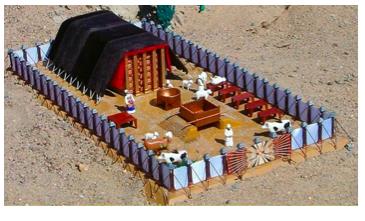
Tabernacle of Moses
The tabernacle (H 4908: Mishkan) was constructed in 1450 B.Sc. at the foot of Mount Sinai. It took about a year to build.
Hebrew Names for the Tabernacle
- Exodus 25:8–9 Mishkan means “tabernacle, dwelling, or habitation.” Mishkan is from the root word shakan meaning “to dwell, abide, settle down, reside, tabernacle.” The word shechinah derives from shakan and refers to the manifest light or presence of YHVH among his people.
- Exodus 29:42 Ohel (as in tent of the congregation/meeting) means “a nomad’s tent, dwelling, home, habitation.”
- Exodus 25:8 Miqdash means “sacred place, sanctuary, holy place” and is from the primitive root qadash and means “to consecrate, sanctify, prepare, dedicate, be hallowed or set apart, be separate or holy.”
- Exodus 30:13 Kodesh or the sanctuary because it was set apart ( or kadosh) to Elohim.
- Numbers 9:15 Ohel haeduth means “the tabernacle or tent of the testimony or witness” since it contained the ark of the covenant housing the Torah-law given to Moses, which was an abiding witness of Israel’s covenant with YHVH.
- Numbers 10:11 Mishkan haeduth means “tabernacle of the testimony.”
The Tabernacle of God/Man in the Flesh
Jesus in the Tabernacle as the divine design and blueprint points to and reveals Jesus Christ. He is the focal point throughout the Word of Jehovah.
John 1:14 “And the Word was made flesh and dwelt among us, and we beheld his glory, the glory as of the only begotten of the Father, full of grace and truth.” [KJV]
John 1:14 “And the Word (Christ) became flesh (human, incarnate) and tabernacled (fixed His tent of flesh, lived awhile) among us; and we [actually] saw His glory (His honor, His majesty), such glory as an only begotten son receives from his father, full of grace (favor, loving-kindness) and truth.” [AMP]
The Journey
A vision of the Circuit Rider:
A rigorous journey. As the early settlers/pioneers left the comforts of their cities, they sought the promise of a better life. With stories of hardship and loss of life, many continued searching for their dream.
Tabernacle:
- Outer court – Body
- Holy Place – Soul
- Holy of Holies – spirit/Spirit
Since first written, the Mosaic Covenant has served as the Jewish people’s primary source of moral instruction. The covenant is comprised of 613 commandments, 365 of which are considered to be negative and 248 of which are considered to be beneficial. The outer court symbolizes the procession from sin and judgment [bronze/brass] to redemption through the sacrifice of the lamb. Feeding on the “milk of the word,” the laver [mirrors as a reflection of the soul] cleanses daily and leads in the process of maturing in our walk with the Lord.
Plan of Salvation
The Door or Gate
John 14:6 “Jesus answered, “I am the way and the truth and the life. No one comes to the Father except through me.”
John 10:1-3, 7-9 “1 Verily, verily, I say to you, He that enters not in by the door to the fold of the sheep, but mounts up elsewhere, is a thief and a robber; 2 but he that enters in by the door is [the] shepherd of the sheep. 3 To him the porter opens, and the sheep hear his voice, and he calls his sheep by name, and leads them out. 7 Jesus, therefore, said again to them, Verily, verily, I say to you, I am the door of the sheep. 9 I am the door, if anyone enters in by me, he shall be saved, and shall go in and shall go out and shall find pasture.”
Exodus 12:7 and 13 The Passover door – where “saving” blood applied.
Bronze Alter of sacrifice
Brass [and Iron] Represents Judgment
Deuteronomy 28:15 and 23 “15 But it shall come about, if you do not obey the Lord your God, to be careful to follow all His commandments and His statutes which I am commanding you today, that all these curses will come upon you and overtake you.” 23 The heaven which is over your head shall be brass, and the earth which is under you, iron.”
Bronze [brass] alter spiritually represents Yeshua dying on the tree for our sins
Numbers 21:8-9 “8 Then the Lord said to Moses, “Make a fiery serpent, and put it on a pole; and it shall come about, that everyone who is bitten, and looks at it, will live.” 9 So Moses made a serpent of brass and put it on the pole, and it came about, that if a serpent bit someone, and he looked at the brass [bronze] serpent, he lived.”
John 3:14-15 “14 And just as Moses lifted up the serpent in the wilderness, so must the Son of Man be lifted up, 15 so that everyone who believes will have eternal life in Him.”
We discussed the brazen serpent in the wilderness
Lamb of God
John 1:29 “The next day John saw Jesus coming unto him, and saith, Behold the Lamb of God, which taketh away the sin of the world.”
Revelation 5:4-7 “4 And I wept much because no man was found worthy to open and to read the book, neither to look thereon. 5 And one of the elders saith unto me, Weep not: behold, the Lion of the tribe of Judah, the Root of David, hath prevailed to open the book, and to loose the seven seals thereof. 6 And I beheld, and, lo, in the midst of the throne and of the four beasts, and in the midst of the elders, stood a Lamb as it had been slain, having seven horns and seven eyes, which are the seven Spirits of God sent forth into all the earth. 7 And he came and took the book out of the right hand of him that sat upon the throne.”
Bronze Laver
Exodus 38:8 We are told how the laver and its base were made of bronze/brass/mirrors
“He made the laver and its base of bronze from the mirrors of the women who ministered at the door of the Tent of Meeting.” from the mirrors of the women who ministered at the door of the Tent of Meeting.”
When we look into the water of the Word and see our reflection against the standards of the righteousness of Christ, we come up short. Nevertheless, when Arron and the priests washed their bloody hands in the water of the laver – blood and water mingled. Through the blood of Jesus, we measure up in the eyes of our Father and are viewed as Paul wrote:
2 Corinthians 5:21 “For our sake He made Christ to be sin Who knew no sin so that in and through Him we might become [endued with, viewed as being] the righteousness of God in Christ.”
The Truth: Second door or veil – “The Truth” of the Way, Truth, and Life
Moses was instructed to make a beautiful veil made of blue, purple, and scarlet yarn hung from five golden pillars for the front and entrance to the tent. Five wooden pillars covered in gold supported by bronze bases held the curtains up. Again, the wood-covered gold speaks of the righteousness of the saints. Bronze speaks of Elohim’s judgment and five can speak of both the five books of the Torah, as well as the five-fold ministry, and the number for grace.
that forbade the stranger, sojourner, defiled, servant, lame, blind, or blemished from eating at the table
Priests were allowed to enter the tabernacle tent. [Kohathites] Once inside the Holy Place, the priests [Kohen] would see the table of Shewbread to their right, a golden lampstand to their left, and an altar of incense ahead, just in front of the veil separating the two chambers.
Jesus in the Tabernacle – The Holy Place
In the last study, we briefly reviewed the outer court which contained the brazen altar and the brazen laver. From the first steps of judgment, sacrifice, and washing of the water by the Word of God the maturing follower of Christ progressively moves into the Holy Place. The elements (furniture and accessories) are no long bronze, but Achaia (Shittim) wood covered in pure, refined gold. The three objects in this room will give us a greater insight into different aspects of the Lord Jesus Christ. They shall also show us what is required to make the next step from salvation to fellowship with Christ.
The Table of Shewbread
Exodus 25:23-30 “23 Make a table of acacia wood–two cubits long, a cubit wide, and a cubit and a half high. 24 Overlay it with pure gold and make a gold molding around it. 25 Also, make around it a rim, a handbreadth wide and put a gold molding on the rim. 26 Make four gold rings for the table and fasten them to the four corners, where the four legs are. 27 The rings are to be close to the rim to hold the poles used in carrying the table. 28 Make the poles of acacia wood, overlay them with gold and carry the table with them. 29 And make its plates and dishes of pure gold, as well as its pitchers and bowls for the pouring out of offerings. 30 Put the bread of the Presence on this table to be before me at all times.”
1 Chronicles 9:32 “Also some of their kinsmen of the Kohathites had charge of the showbread, to prepare it every Sabbath.” This bread was likely prepared on each Friday and placed in the tabernacle on each Sabbath in two piles of six. It would be replenished each week, allowing the priests to eat fresh bread in the holy place.”
Leviticus 24:5-9 “5 And thou shalt take fine flour and bake twelve cakes thereof: two tenth deals shall be in one cake. 6 And thou shalt set them in two rows, six on a row, upon the pure table before the Lord. 7 And thou shalt put pure frankincense upon each row, that it may be on the bread for a memorial, even an offering made by fire unto the Lord. 8 Every sabbath he shall set it in order before the Lord continually, being taken from the children of Israel by an everlasting covenant. 9 And it shall be Aaron’s and his sons, and they shall eat it in the holy place: for it is most holy unto him of the offerings of the Lord made by fire by a perpetual statute.”
The table had two rows of six baked cakes sprinkled each with pure frankincense totaling 12 for the number of the tribes of Israel. The bread could only be eaten by the priest and was replaced weekly.
Anointed to be King: David
Before covering the spiritual symbolism of Jesus, an interesting but consequential event from the Old Testament.
- 1 Samuel 21:1-9 “1 Then David went to Nob, to Ahimelech the priest; and Ahimelech was afraid at meeting David, and said to him, Why are you alone and no man with you? [he was not alone as we read further] 2 David said to Ahimelech the priest, The king has charged me with a matter and has told me, Let no man know anything of the mission on which I send you and with what I have charged you. I have appointed the young men to a certain place. 3 Now what do you have on hand? Give me five loaves of bread, or whatever you may have. 4 And the priest answered David, There is no common bread on hand, but there is hallowed bread if the young men have kept themselves at least from women. 5 And David told the priest, Truly women have been kept from us in these three days since I came out, and the food bags and utensils of the young men are clean, and although the bread will be used in a secular way, it will be set apart in the clean bags. 6 So the priest gave him holy bread, for there was no bread there but the Shewbread which was taken from before the Lord to put hot bread in its place the day when it was taken away. 7 Now a certain man of Saul’s servants was there that day, detained before the Lord; his name was Doeg the Edomite, the chief of Saul’s herdsmen. 8 David said to Ahimelech, Do you have at hand a sword or spear? The king’s business required haste, and I brought neither my sword nor my weapons with me. 9 The priest said, The sword of Goliath the Philistine, whom you slew in the Valley of Elah, see, it is here wrapped in a cloth behind the ephod; if you will take that, do so, for there is no other here. And David said, There is none like that; give it to me.”
Demonic Saul
- 1 Samuel 22:9-19 “9 Then Doeg the Edomite, who stood with Saul’s servants, said, I saw the son of Jesse come to Nob, to Ahimelech son of Ahitub. 10 And [Ahimelech] inquired of the Lord for him and gave him provisions and the sword of Goliath the Philistine. 11 Then the king sent to call Ahimelech the priest, the son of Ahitub, and all his father’s house, the priests who were at Nob, and they all came to the king. 12 Saul said, Hear now, you son of Ahitub. He replied, Here I am, my lord. 13 Saul said to him, Why have you conspired against me, you, and the son of Jesse, giving him bread and a sword and inquiring of God for him, so he could rise against me to lie in wait, as he does this day? 14 Then Ahimelech answered the king, And who is so faithful among all your servants as David, who is the king’s son-in-law, and is taken into your council and honored in your house? 15 Have I only today begun inquiring of God for him? No! Let not the king impute any wrong to his servant or all the house of my father, for your servant has known nothing of all this, little or much. 16 [Saul] said You shall surely die, Ahimelech, you, and all your father’s house. 17 And the king said to the guard that stood about him, turn, and slay the Lord’s priests, because their hand also is with David and because they knew that he fled and did not disclose it to me. But the servants of the king would not put forth their hands against the Lord’s priests. 18 The king said to Doeg, You turn and fall upon the priests. And Doeg the Edomite turned and attacked the priests and slew that day eighty-five persons who wore the priest’s linen ephod. 19 And Nob, the city of the priests, he smote with the sword; both men and women, children and suckling oxen and donkeys and sheep, he put to the sword.”
The Son of God – the Son of Man
- Matthew 12:1-6 “1 At that particular time Jesus went through the fields of standing grain on the Sabbath, and His disciples were hungry, and they began to pick off the spikes of grain and to eat. 2 And when the Pharisees saw it, they said to Him, See there! Your disciples are doing what is unlawful and not permitted on the Sabbath. 3 He said to them, Have you not even read what David did when he was hungry, and those who accompanied him. 4 How he went into the house of God and ate the loaves of the Shewbread, which was not lawful for him to eat, nor for the men who accompanied him, but for the priests only? 5 Or have you never read in the Law that on the Sabbath the priests in the temple violate the sanctity of the Sabbath [breaking it] and yet are guiltless? 6 But I tell you, Something [someone] greater and more exalted and more majestic than the temple is here.”
The Leaven of the Pharisees
- Matthew 16:5-12 “5 When the disciples reached the other side of the sea, they found that they had forgotten to bring any bread. 6 Jesus said to them, Be careful and on your guard against the leaven of the Pharisees and Sadducees. 7 And they reasoned among themselves about it, saying, it is because we did not bring any bread. 8 But Jesus, aware of this, asked, why are you discussing among yourselves the fact that you have no bread? O you of little faith! 9 Do you not yet discern (perceive and understand)? Do you not remember the five loaves of the five thousand, and how many baskets you gathered? 10 Nor the seven loaves for the four thousand, and how many [large the provision] baskets you took up? 11 How is it that you fail to understand that I was not talking to you about bread? But beware of the leaven of the Pharisees and Sadducees. 12 Then they discerned that He did not tell them to beware of the leaven of bread, but the teaching of the Pharisees and Sadducees.” [False Doctrines]
TAKANOT
To set themselves apart they created rules that were not commanded by Jehovah or in the Torah. Rules on what to eat, how to prepare, how to wash and sanctify food, and what ovens were acceptable. They created more than 500 laws governing the keeping of the Sabbath day [how far you could travel, what constitutes forbidden work]
- How to put your shoes on. First, put the right shoe (untied) then the left. Tie the left shoe and then tie the right shoe.
The earliest account of God giving Israel the 613 commandments dates back to the third century CE and can be found in the Babylonian Talmud. In contrast to the two commands of Christ, the Pharisees enforced a heartless, cold, and arrogant brand of righteousness. As such, it contained at least ten tragic flaws.
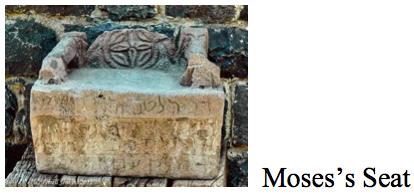
Jesus mentioned the phrase Moses’ seat in Matthew 23:2 when He said, “The teachers of the law and the Pharisees sit in the chair of Moses. So, you must be careful to do everything they tell you. But do not do what they do, for they do not practice what they preach.”
As covered in a previous teaching, Moses’ seat is a name given to a special chair of honor in the synagogue where the authoritative interpreter of the law of Moses was seated. In a symbolic sense, sitting in Moses’ seat meant teaching from the books of Moses, the Pentateuch – the first five books of the Bible. The scribes were looked upon as being the recognized exegeses of the law of Moses while the Pharisees were the spokesmen for the unwritten oral law or tradition.
Unwritten or Oral Law:
- As taught in the Law and the Seat of Moses where the Pharisees made and strictly enforced Takanot. The Pharisees had added many man-made traditions to the Law of Moses especially pertaining to the Sabbath. The idea of not threshing wheat on the Sabbath was a violation of the Sabbath doctrine of the Pharisees but not the Law of Moses.
- Matthew 15:8-9 “8 These people honor me with the lips, but their heart is far away from me; 9 but in vain do they worship me, teaching [as] teachings commandments of men.”
In this passage, Jesus did not challenge the teachings of the scribes and Pharisees which He did upon other occasions (Mark 7:1–13) but He focused on the fact that their lives are not in harmony with their exalted profession of godliness. The scribes and Pharisees professed full loyalty to the Scriptures but failed to act on its principles. Their righteous actions consisted of meticulous attention to ceremony and ritual requirements rather than to the “weightier matters of the law” (Matthew 9:13; 22:36; 23:23). Thus, this supports the principle of Sola Scriptura, not unbiblical Tradition.
- Sola scriptura means that Scripture alone is authoritative for the faith and practice of the Christian. The Bible is complete, authoritative, and true. “All Scripture is God-breathed and is useful for teaching, rebuking, correcting and training in righteousness.” [2 Timothy 3:16]
Sadly, as we see today, too many denominations and seeker-friendly “churches” misrepresent truth when they elevate traditions to equality with Scripture. To these, Jesus said, “But in vain do they worship me, teaching for doctrines the commandments of men” (Mark 7:7).
Lastly on “Moses’ seat.” It was thought to have been a figurative expression, however, modern archaeologists have discovered that ancient Jewish synagogues had actual chairs in which the interpreter of the law sat to teach. The synagogue unearthed at Hamath had a stone chair close to the south wall of the synagogue, with its back toward the “ark,” where the scrolls were stacked. It was obvious, that Takanot and oral commandments were front and center.
The Gospels record the account of the Pharisees castigating Jesus’ disciples for eating from the grain fields on the Sabbath day (Matthew 12:1-8; Mark 2:23-28; Luke 6:1-5). Under the law of Moses, the Shewbread was reserved for the Kohen Priests (Jesus confirmed it was unlawful in Matthew 12:4)
- That given by the priest Ahimelech to David was presumably from the old loaves previously “removed from before the Lord” and as yet uneaten; it was not removed on that day by Ahimelech from the table, especially for David and his men. The only point that conflicts with what is stated in Leviticus is the view expressed here that the old loaves could be eaten by non-priests in a state of purity, not specifically by priests in a holy place. This is, however, a general feature of the non-Priestly sources of the Bible, that sometimes permit to non-priests be “sanctified” by purity which the Priestly sources permit only to males among the priests.
Jesus refers to the historical incident of David to point out the Pharisees’ inconsistency. The Pharisees placed David on a very high moral pedestal and were less likely to condemn David for his sinful act. Yet, the Pharisees were quick to condemn Jesus’ disciples who had done nothing wrong!
Jesus posed a second question (as we read in Matthew 12:5 “Or have ye not read in the law that on the sabbaths the priests in the temple profane the sabbath, and are blameless.”), to further expose the inconsistencies of the Pharisees by mentioning that the priests were very busy working on the Sabbath day because they had many duties to complete (such as the changing of the Shewbread on the Sabbath, the associated duties of animal sacrifices on the Sabbath; and other priestly duties). Therefore, according to the Pharisees’ flawed, hypocritical judgment, the Pharisees should have viewed their priests as “profaning” the Sabbath by “working” these works on the Sabbath (when in fact, the priests were not violating the Sabbath because God authorized some work to be completed on the Sabbath by the priests).
The Table of Shewbread
Jesus [Yeshua Hamichia]
Being made of acacia wood and overlaid with gold, this table represents the person of Christ emphasizing both His humanity and deity.
Acacia wood is often mentioned in reference to objects used in the construction of the tabernacle in the book of Exodus. Of greatest importance is its use in the construction of the Ark of the Covenant. From a practical standpoint, acacia trees would have been one of the only types of trees growing in the wilderness regions traveled by Israel. In addition, acacia wood is dense and extremely strong, making it a great option for any type of wooden construction. The tabernacle was used for the next four hundred years, eventually finding a resting place within the temple in Jerusalem constructed during the reign of Solomon. The ark remained a crucial part of Jewish worship until the destruction of the temple by the Babylonians centuries later.
Frankincense
”Edible” is not the right word to use as a whole. It can be chewed or taken internally but only at roughly 4 grams per day. While it has multiple uses in herbal medicine, it is bitter to the taste, and it can cause slight stomach upset for some.
Boswellia tree extracts – the trees start producing resin at about eight to 10 years old. Tapping is done two to three times a year with the final taps producing the best tears due to their higher aromatic terpene, sesquiterpene, and diterpene content. Generally speaking, the more opaque resins are the best quality. Cheap resin is produced in the Horn of Africa, which is the Roman Catholic Church’s major source.
Cancer Treatment
Immunologist Mahmoud Suhail is hoping to open a new chapter in the history of frankincense. Scientists have observed that there is some agent within frankincense which stops cancer from spreading, and induces cancerous cells to close themselves down. He is trying to find out what this is.
- “Cancer starts when the DNA code within the cell’s nucleus becomes corrupted,” he says. “It seems frankincense has a re-set function. It can tell the cell what the right DNA code should be. Frankincense separates the ‘brain’ of the cancerous cell – the nucleus – from the ‘body’ – the cytoplasm, and closes down the nucleus to stop it from reproducing corrupted DNA codes. Working with frankincense could revolutionize the treatment of cancer. Currently, with chemotherapy, doctors blast the area around a tumor to kill cancer, but that also kills healthy cells and weakens the patient. Treatment with frankincense could eradicate the cancerous cells alone and let the others live. The task now is to isolate the agent within frankincense which works this wonder. Some ingredients of frankincense are allergenic, so you cannot give a patient the whole thing.”
The Table: Wedding Feast – Many Are Called, But Few Are Chosen
Matthew 22:1-14 “1 And again Jesus spoke to them in parables, saying, 2 “The kingdom of heaven may be compared to a king who gave a wedding feast for his son, 3 and sent his servants to call those who were invited to the wedding feast, but they would not come. 4 Again he sent other servants, saying, ‘Tell those who are invited, “See, I have prepared my dinner, my oxen and my fat calves have been slaughtered, and everything is ready. Come to the wedding feast.”’ 5 But they paid no attention and went off, one to his farm, another to his business, 6 while the rest seized his servants, treated them shamefully, and killed them. 7 The king was angry, and he sent his troops and destroyed those murderers and burned their city. 8 Then he said to his servants, ‘The wedding feast is ready, but those invited were not worthy. 9 Go therefore to the main roads and invite to the wedding feast as many as you find.’ 10 And those servants went out into the roads and gathered all whom they found, both bad and good. So the wedding hall was filled with guests. 11 “But when the king came in to look at the guests, he saw there a man who had no wedding garment. 12 And he said to him, ‘Friend, how did you get in here without a wedding garment?’ And he was speechless. 13 Then the king said to the attendants, ‘Bind him hand and foot and cast him into the outer darkness. In that place, there will be weeping and gnashing of teeth.’ 14 For many are called, but few are chosen.”
Mephibosheth
- 2 Samuel 9:10-11 “10 You and your sons and your servants shall cultivate the land for him, and you shall bring in the produce so that your master’s grandson will have food to eat; nevertheless Mephibosheth, your master’s grandson, shall eat at my table regularly.” Now Ziba had fifteen sons and twenty servants. 11 Then Ziba said to the king, “according to everything that my lord the king commands his servant, so your servant will do.” So, Mephibosheth ate at David’s table as one of the king’s sons.”
Marriage of the Lamb
Revelation 19:7 “Let’s rejoice and be glad and give the glory to Him, because the marriage of the Lamb has come, and His bride has prepared herself.” 8 It was given to her to clothe herself in fine linen, bright and clean; for the fine linen is the righteous acts of the saints. 9 Then he said to me, Write: ‘Blessed [to be envied] are those who are invited to the wedding feast of the Lamb.’ And he said to me [further], These are the true words (the genuine and exact declarations) of God.”
The Bread of Life
1 Corinthians 11:23-24 “23 For what I received from the Lord is just what I passed on to you — that the Lord Yeshua, on the night he was betrayed, took bread; 24 and after he broke it and said, “This is my body, which is for you. Do this as a memorial to me.”
John 6:31-35 “31 Our forefathers ate the manna in the wilderness; as the Scripture says, He gave them bread out of heaven to eat. 32 Jesus then said to them, I assure you, most solemnly I tell you, Moses did not give you the Bread from heaven [what Moses gave you was not the Bread from heaven], but it is My Father who gives you the true heavenly Bread. 33 For the Bread of God is He Who comes down out of heaven and gives life to the world. 34 Then they said to Him, Lord, give us this bread always (all the time)! 35 Jesus replied, I am the Bread of Life. He who comes to Me will never be hungry, and he who believes in and cleaves to and trusts in and relies on Me will never thirst anymore.”
Deuteronomy 8:3 “And He humbled you and allowed you to hunger and fed you with manna, which you did not know nor did your fathers know, that He might make you recognize and personally know that man does not live by bread only, but man lives by every word that proceeds out of the mouth of the Lord.”
With the procession through the Way and Truth, [Life – Holy of Holies] we come closer in fellowship and intimacy with God the Father and His only begotten Son – Jesus the Christ.
We also are in a metamorphosis of carnality to spirituality and as the law trained for obedience we are drawing closer to becoming a Royal Kingship and Priesthood.
The representatives of the Church and of creation, then, adore the Lamb, through whose redeeming act grace may be given to men of every kindred and tongue, to enable them to overcome sin and Satan, and in the freedom of God’s service to reign on earth as kings and conquerors over all unworthy passions. In this way, too, we account for the present tense of the verb, which is most probably the correct reading.
Greek
You have made
ἐποίησας (epoiēsas)
Verb – Aorist Indicative Active – 2nd Person Singular
Strong’s 4160: (a) I make, manufacture, construct, (b) I do, act, cause. Apparently a prolonged form of an obsolete primary; to make or do.
them {into}
αὐτοὺς (autous)
Personal / Possessive Pronoun – Accusative Masculine 3rd Person Plural
Strong’s 846: He, she, it, they, them, same. From the particle au; the reflexive pronoun self, used of the third person, and of the other persons.
a kingdom,
βασιλείαν (basileian)
Noun – Accusative Feminine Singular
Strong’s 932: From basileus; properly, royalty, i.e. rule, or a realm.
priests
ἱερεῖς (hiereis)
Noun – Accusative Masculine Plural
Strong’s 2409: A priest, one who offers sacrifice to a god From hieros; a priest.
Strong’s Greek 749: Chief Priest, High Priest (OT – Hebrew word 3548: ko-hane’ – High or Chief Priest)
to [ serve ]
τῷ (tō)
Article – Dative Masculine Singular
Strong’s 3588: The, the definite article. Including the feminine he, and the neuter to in all their inflections; the definite article; the.
our
ἡμῶν (hēmōn)
Personal / Possessive Pronoun – Genitive 1st Person Plural
Strong’s 1473: I, the first-person pronoun. A primary pronoun of the first person I.
God,
Θεῷ (Theō)
Noun – Dative Masculine Singular
Strong’s 2316: A deity, especially the supreme Divinity; figuratively, a magistrate; by Hebraism, very.
and
καὶ (kai)
Conjunction
Strong’s 2532: And, even, also, namely.
they will reign
βασιλεύσουσιν (basileusousin)
Verb – Future Indicative Active – 3rd Person Plural
Strong’s 936: (a) I rule, reign, (b) I reign over. From basileus; to rule.
upon
ἐπὶ (epi)
Preposition
Strong’s 1909: On, to, against, on the basis of, at.
the
τῆς (tēs)
Article – Genitive Feminine Singular
Strong’s 3588: The, the definite article. Including the feminine he, and the neuter to in all their inflections; the definite article; the.
earth.”
γῆς (gēs)
Noun – Genitive Feminine Singular
Strong’s 1093: Contracted from a primary word; soil; by extension a region, or the solid part or the whole of the terrene globe.
Blessings in Christ,
Joseph “Jim” Stockstill 
“National War Council” – Founder and Chairman
Jim5555@nationalwarcouncil.org
P.O. Box 931
Argyle, TX 76226
nwc@nationalwarcouncil.org
Jim5555@nationalwarcouncil.org
Donations to National War Council
“The two most important days in your life are the day you are born and the day you find out why.”
Mark Twain
Anyway you can make pages so we can print off so we can study.
Thank you
Is it kings and priests…
Or a kingdom OF priests?
“And hast made us unto our God kings and priests: and we shall reign on the earth.” Revelation 5:10